Pantograph: scaling and copying paths
Draw a curve with one point of the mechanism and let another point, tied to the same structure of bars, draw that same curve twice as large. That is a pantograph: a four-bar parallelogram chain that reproduces a motion at a different scale, point by point, while preserving its shape. Engravers used it to copy and enlarge drawings centuries before the photocopier existed. The same kinematics lives on in every articulated-arm lamp and every lathe copier. But the pantograph drags along a flaw that hounds it in FDM printing, one that no other linkage suffers so directly: it doesn't have one pivot, it has four or five, and every tenth of a millimeter of play you leave in any one of them doesn't stay put — it gets multiplied by the very scale ratio you were after and reappears at the tracing tip as error.
The similarity lives in the parallelogram
The magic of the pantograph isn't in the bars, it's in a similarity of triangles that the parallelogram holds no matter what. Mount four articulated links so that four of their segments form a parallelogram, and pin to the ground a point that is not a vertex of the parallelogram, but instead falls on the extension of one of its sides. The tracer and the reproducer also mount on extended sides, on different links. By construction, the opposite sides of the parallelogram stay parallel at all times, however far you open or close the figure. Those parallel sides generate two similar triangles, and the similarity is what forces three specific points — the fixed pivot, the tracer, and the reproducer — to stay always aligned on a single straight line and at proportional distances from that pivot.
That is where the magic comes from. The fixed pivot is the center of a homothety: a transformation that stretches everything radially from a point, without rotating or deforming it. At every instant the reproducer is the image of the tracer, scaled from the pivot by a constant ratio. And "constant" is the word that makes the mechanism useful: it isn't that the scale is right in one position and drifts in another; it's that the parallelogram structure keeps it identical along the entire path, because the sides never stop being parallel. You move the tracer along any curve and the reproducer traces the same curve multiplied by that ratio, without you having to do anything to maintain the proportion.
The scale ratio isn't a number engraved into the bars: you set it yourself by the position of the points along the sides. The tracer (the input) goes on the inner point, closer to the pivot; the reproducer (the enlarged output) goes on the outer point. The amplification is the ratio of the pivot-to-reproducer distance to the pivot-to-tracer distance, so the closer to the pivot you place the tracer relative to the reproducer, the larger the ratio. That is why the same set of bars can enlarge 2
or 3 depending on where you put the points along the sides; what you cannot do is break the parallelogram, because the moment the sides stop being parallel — and enough play is all it takes to pull them off that condition — the alignment of the three points is lost, and with it the similarity.Every curve comes out scaled, sometimes inverted
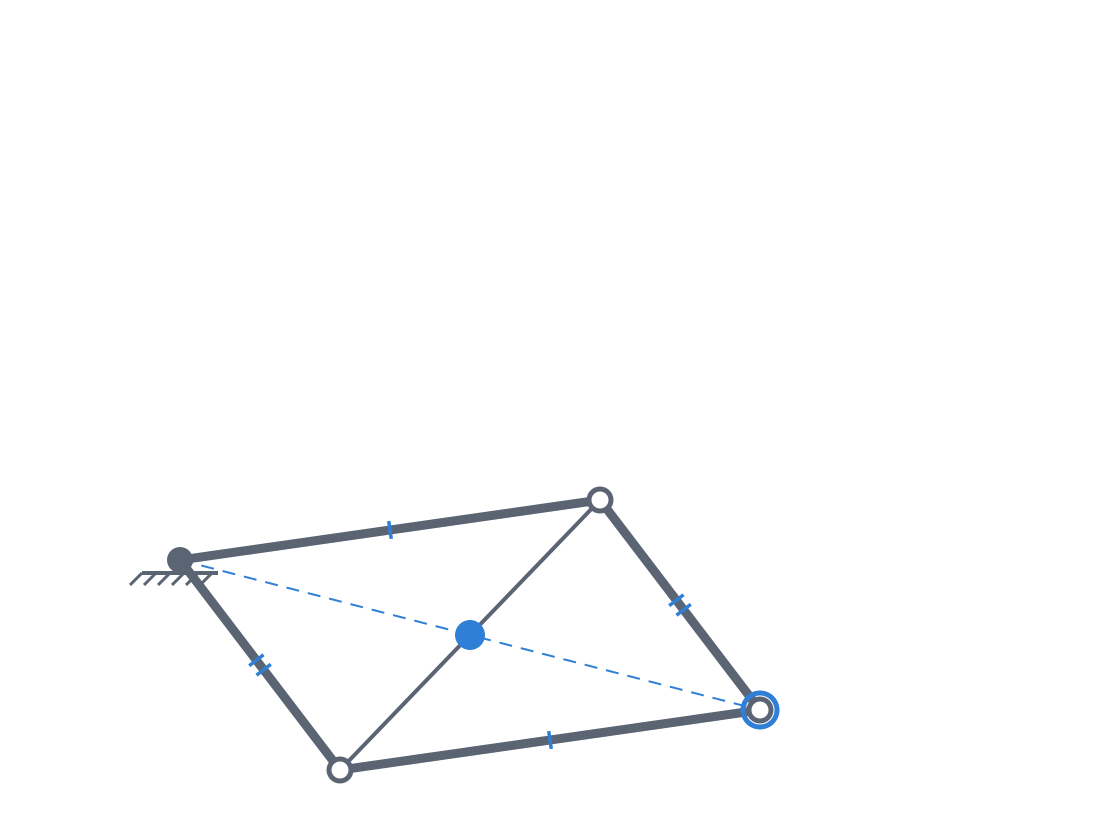
The practical consequence of the homothety is direct: any curve that one point traces is reproduced at the other, enlarged or reduced, with the same shape. There are no "good" curves and "bad" curves for a pantograph the way there are for a cam follower; as long as the parallelogram holds, a straight line comes out straight at a different scale, a circle comes out a circle, a signature comes out a signature. That universality is what historically set it apart as a copier: it serves to scale whole drawings, not specific paths you planned out ahead of time.
There is a subtlety of assembly worth being clear about before you fix the geometry, because it changes the sign of the result. In the standard arrangement the pivot, the tracer, and the reproducer are collinear and the tracer and reproducer fall on the same side of the pivot: the image comes out direct, in the same direction as the input (homothety with a positive ratio, no rotation). There is another arrangement in which the pivot sits between the tracer and the reproducer: then the image comes out inverted, symmetric about the pivot, as if the enlargement had been reflected through it (homothety with a negative ratio). It isn't a simple swap of which point is which on the same set of bars: it's a different pin topology, and choosing it forces you to rethink where you place each point. Decide the sign before you print, because correcting it afterward redoes the whole layout.
From here come its three families of use. There is the copier and scaler of drawings or profiles, the classic case. There is motion amplification: if the tracer is driven by a short-throw actuator, the reproducer delivers a proportionally larger travel, useful when you need to multiply a displacement without adding intermediate stages. And there is the scaled reach arm, the articulated lamp that keeps the orientation of the head fixed as you extend the arm, precisely because the parallelogram preserves the parallelism of the sides along with the proportion.
The play gets multiplied by the scale ratio
Here is the trap that makes the pantograph different from any other printed linkage, and it has to be faced head-on. A printed pivot has play between the pin and its hole — it's unavoidable, Tolerances for moving parts develops it. In a single-pivot mechanism, that play translates into a little dead motion at the output and not much else. In a pantograph it doesn't: you have four or five pivots and their plays accumulate along the chain. And each one enters with its own lever arm: the play of a pivot near the tracer is amplified by almost the full scale ratio, while that of a pivot near the reproducer or the fixed pivot weighs much less. The error that reaches the tip is the sum of them all, each one stretched by its own factor.
This inverts your intuition. You design the pantograph to amplify useful motion, but the mechanism doesn't distinguish between the motion you want and the error you don't: it enlarges both alike. An effective play on the order of 0.2 mm per joint, perfectly acceptable in any loose pivot, turns into play on the order of a millimeter at the tracing tip once the chain accumulates it and the scale stretches it. The failure mode isn't that the mechanism doesn't work; it's that it works and lies about the scale: the output path is right in shape but loose in dimension, with a dead motion that ruins any copy meant to be precise.
The defense is to minimize the play joint by joint, not globally. Every pivot you tighten pays off more than it would in a simple mechanism, because its error is no longer local: it travels down the chain and comes out scaled. Bring the pin clearances to the low end of a sliding fit — just enough that they turn without seizing, not a hair more — and accept that here you can't be generous with the gap "just in case," the way you could be in a coarse hinge. In a pantograph, the generous gap comes back to you multiplied.
Slender, stiff bars, laid flat on the bed
The second enemy of fidelity is bending of the bars, and it comes in through two doors worth separating. One is geometric: a bar that's too thin bows under the mechanism's own load or under the force you apply while tracing, and the moment a bar curves it stops being the straight segment the parallelogram geometry takes for granted. The "ideal" parallelogram loses its parallelism, the alignment of the three points strays, and the output curve comes out distorted. The other door is the printing process: FDM makes one and the same bar far stiffer in one plane than in another.
That is why the bars of a pantograph are designed slender but stiff, which is a deliberate tension. Slender, because every gram of bar is mass you move and leverage that bends; stiff, because any flexing directly falsifies the path the mechanism presumes straight. The way to resolve that tension is the cross-section, not raw thickness: a flat, wide bar is very stiff in its plane — exactly where the mechanism works — and flexible out of it, where you ask nothing of it. Give it depth in the plane of motion rather than mass in every direction.
Three failure modes, and which to watch first
Put the above together and a printed pantograph fails along three paths, in this order of likelihood. The first and dominant one is scale and path error from accumulated play: the pivots' play adds up, the homothety amplifies it, and the output loses dimensional precision even as it keeps its shape. It is the mechanism's characteristic failure and the one that justifies all the care with the joints; if you're going to watch only one thing, watch this.
The second is distortion from bending of bars that are too thin. Here the symptom is different and telling: the output curve isn't loose, it's deformed — a straight line that comes out slightly curved, a circle that comes out oval — and it gets worse the more force you apply while tracing. If the error grows with the load, it's bending, not play; if it's there even when you move the mechanism unloaded, it's dead motion. Knowing how to tell them apart saves you from tightening pivots that were already fine. On top of this, in horizontal setups with the tracer cantilevered, there's out-of-plane bending from the self-weight of the extended pantograph: the assembly sags a little under its own mass and the path drifts out of plane, an effect that especially punishes the scaled reach arm.
The third is slow: wear of the pins with use. Plastic against plastic in a joint that turns repeatedly eventually polishes material away and opens up play where there was none when it was new. In a single-pivot mechanism that shows up late; in a pantograph, because the play accumulates and gets amplified, a small amount of wear at each joint degrades the scale fidelity sooner than you'd expect. If the pantograph is going to run many cycles, plan on replaceable bushings or pins from the start, because the precision you had fresh off the printer is not the precision you'll have a thousand traces later.
The pantograph doesn't forgive the play that other mechanisms tolerate, because everything you leave loose comes back to you multiplied. Before you print yours, go back over Tolerances for moving parts and bring every pivot to the tightest gap that still turns freely: in this mechanism, that extra tenth of a millimeter doesn't stay where you left it.