Ball detent and indexed knob: clicking into position
Some controls have to tell you where they are without your looking at them. A mode selector that jumps from one position to the next with a firm click, a volume knob that stays where you leave it, a regulator that marks steps instead of sliding through a continuum: they all do the same thing, turning a smooth rotation into a series of discrete positions that your finger recognizes. The mechanism behind it is the detent: an elastic element that pushes a ball or a bump against a notched track, so that every hollow is a place where the part wants to settle. The beauty, and the difficulty, is that the click is designed entirely in the geometry of the notch and the force of the spring, and in FDM both degrade by different routes.
Every notch is an energy well
The kinematics of a detent are those of a body traveling across an energy landscape of valleys and crests. The ball, pushed by the spring against the track, always seeks to descend: at the bottom of a notch it sits in a local minimum, and to move to the neighboring notch it has to climb the exit ramp—compressing the spring as it rises—until it tops the crest that separates the two positions, and then drops into the next valley. That rise and fall is the click. It is not an acoustic flourish: it is the spring returning all at once the energy you spent to lift the ball out of the well. As long as you don't supply enough torque to top the crest, the ball falls back into the same valley, and that is why the position holds itself without your steadying it. That same torque that resists getting started is what resists an external load: it is what keeps a vibration or an accidental brush from moving the selector on its own.
From this come the two quantities that govern the feel. The first is the holding torque: how hard it is to break out of a position. It grows with three things at once: with the force the spring presses on the ball, with the radius of the track where the notch acts—the same detent closer to the axis gives less torque—and with how steep the ramp is, which enters through the tangent of its angle and so rises in a strongly nonlinear way. A shallow ramp lets the ball climb out with little effort—the click is soft; a steep, nearly vertical ramp forces a lot of spring compression for very little angular travel, and the control turns hard and abrupt. The second quantity is the resolution: the number of notches divides a full turn into equal steps, so the angular step is simply 360 divided by the number of notches. Twelve notches give 30° steps; twenty-four, 15°. The more you fit, the finer the indexing, but also the less room for each notch around the perimeter. The hard limit is not depth: it is that the available notch width, π·D divided by the number of notches, must not drop below the diameter of the ball or bump. When the notch narrows to the size of the ball, it no longer seats in discrete hollows and the indexing disappears no matter how deep you go.
Feel versus wear
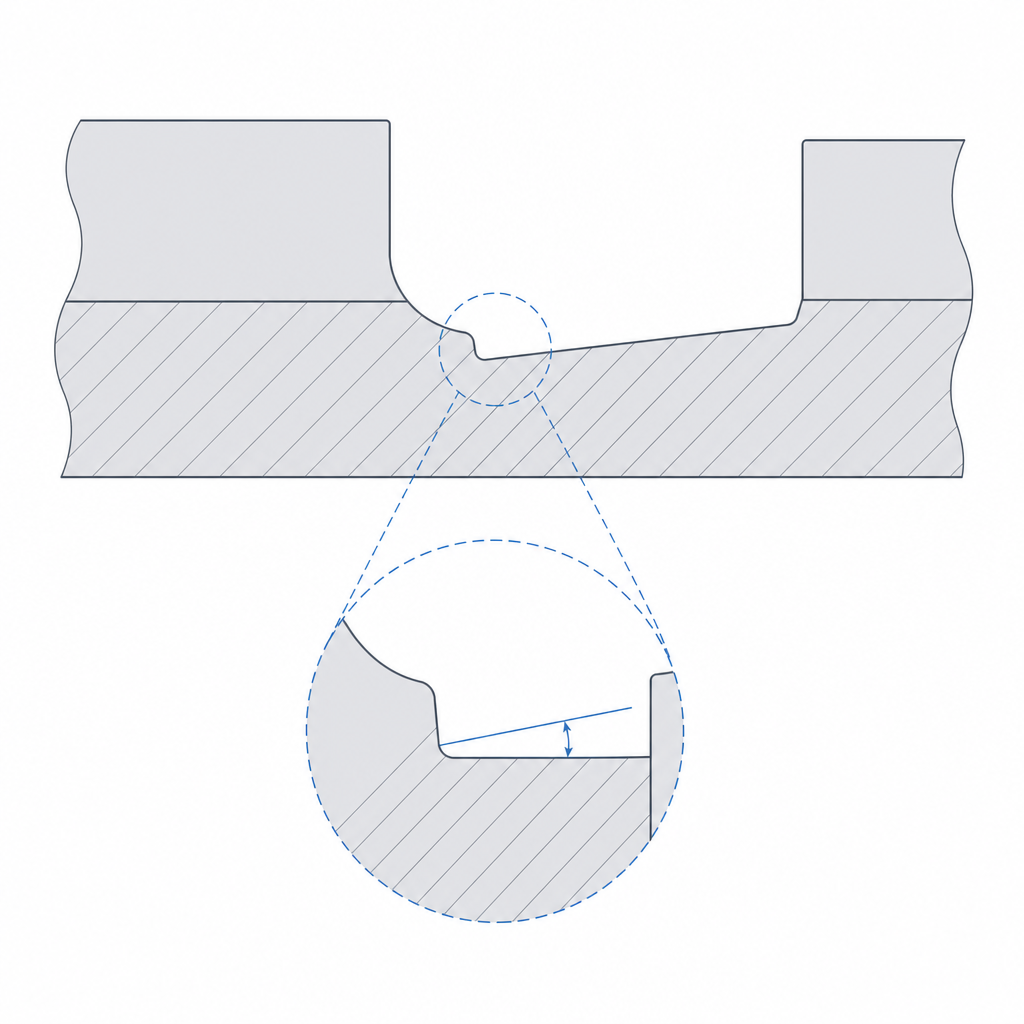
Here is the first conflict you cannot dodge: what makes the click good is exactly what wears the detent. A steep ramp gives an unmistakable position, but it concentrates all the spring's force into a small, heavily loaded contact each time the ball climbs and drops the step. The more abrupt the click, the more contact pressure on the notch edge, and the faster that edge rounds off with use. A shallow ramp lasts much longer, but is barely felt. The design criterion is to find the minimum click your finger can clearly distinguish, not the maximum the geometry allows.
And it pays to be clear about the direction of the ramp. Often you don't want the two faces of the notch to be the same. If the control should turn easily one way and resist the other—a regulator that steps up one notch at a time but must not slip down on its own—you give it a shallow exit ramp in the direction of use and a near-vertical return face in the opposite one. The ball tops gently toward where you want and hits a wall toward where you don't. In FDM you also have friction on your side: rough plastic-on-plastic or plastic-on-steel surfaces have a high coefficient, and when the tangent of the ramp angle falls below that coefficient the face self-locks—the ball cannot push it outward no matter how much axial force it gets. That same friction, however, dirties the other side: a ramp you drew shallow may not come out as smooth as you expected. If the control is symmetric—a selector that turns equally well in both directions—the two faces are made equal and every position feels identical, whichever way you came from.
| Decision | Effect on the click | Cost |
|---|---|---|
| More notches (step = 360/n smaller) | Finer indexing | Less width per notch; hard limit at the ball diameter |
| Steeper ramp (larger tan θ) | Abrupt, firmer click | More contact pressure, faster wear |
| Deeper notch | Longer click travel | More material to file away before it flattens |
| Shallow ramp | Smooth position, long life | The finger barely notices it |
| Asymmetric faces | Easy one way, firm the other | Only useful if the use has a preferred direction |
| Stronger spring | Raises the torque of every position | Wears the whole track equally |
The spring: printed cantilever or embedded coil
The elastic element is where durability is decided, and you have two routes depending on how many cycles the knob has to endure.
The fully printed route is a cantilever arm ending in a rounded bump, which acts as ball and spring at once: it flexes outward as it climbs the ramp and pushes inward as it drops into the valley. It is the free option, with no parts to buy, and for a prototype or a low-cycle control it is more than enough. But it drags along FDM's characteristic problem: the arm flexes, and a printed arm is strong along the beads and weak between layers. Interlayer failure shows up when the layer interfaces sit perpendicular to the arm's axis—layers stacked along its length—because then the axial bending stress crosses every interlayer weld head-on and the arm ends up delaminating, opening like a clean crack at the root. The rule is to orient it so it flexes in the plane of the layers, so the interfaces run along the arm and the bend pulls on no weld; it is exactly the same orientation reasoning that governs any elastic tab, and it is laid out in Layer orientation for motion. Also add a fillet at the root, where the deformation is greatest: a sharp corner there is a stress concentrator that snaps the arm well before its time.
The other route is to embed a metal ball and spring: a printed cylindrical pocket, a real compression spring, and a steel ball that pokes out the mouth and rides on the track. It costs two hardware components, but it wins on everything that matters for a real-use knob. The steel spring does not creep over time the way plastic does, a hard steel ball wears the track far less than a sliding plastic bump, and the force stays practically constant over vastly more cycles. It pays to know that the ball does not roll free: pushed against its seat, it climbs the ramp combining a little rolling with a good deal of sliding, so the real advantage is the hardness of the steel and the point contact, not clean rolling. To house the spring and the ball with the right dimension—and to keep the ball from falling out—it pays to follow the practice in Embedded hardware: magnets, bearings, and inserts. The boundary is simple: low cycles or prototype, printed cantilever; high cycles and constant feel, metal ball and spring.
Give the shaft clearance, but no more
The detent lives on a shaft that turns, and that shaft needs its own clearance so it doesn't seize—but the amount matters more here than at almost any other pivot, because shaft play and detent indexing compete. If the shaft wobbles too much in its hole, the ball doesn't seat cleanly at the bottom of the notch: the whole assembly shifts sideways under the spring's force, the positions lose definition and, in the worst case, the detent skips between notches instead of dropping into each one with its click. You want just enough clearance to turn freely without rubbing, and not a tenth more.
That clearance is not the one you draw, but the one that comes off the bed: the printed hole comes out narrower than its nominal dimension and the shaft thicker, so zero on screen is interference in the part. The real value comes from your printer and your calibration, not a table, and the way to pin it down—printing a coupon and measuring which column turns freely—is the same one that works for any moving joint; it's in Tolerances for moving parts. For an indexed knob it pays to stay at the tight end of the "turns freely" range: enough that it doesn't rub, but without the loose play that would soften every position.
How a detent dies
A detent does not fail all at once; it fades, and it pays to recognize the three modes separately because each has its own antidote. The first is the rounding of the notches: with each click, the ball strikes and drags the edge of the ramp, and that edge files down until it loses its sharpness. The click, born abrupt, softens until it becomes a gentle bump the finger barely notices. It is the wear you accelerate precisely when you want a very firm feel, and the one fought by a solid-material track and a ramp no steeper than necessary.
The second is the creep of the elastic arm, and it affects only the printed spring. Plastic under sustained load creeps slowly: a cantilever that sits preloaded against the track at rest gives way over the weeks, loses pushing force and, with it, holding torque. The knob that at first sat locked in each position starts to move with a soft drag. So if the spring is printed, design it so that at rest it is not preloaded, and that is why an embedded metal spring is the only honest route for a control that has to keep its feel for years—a steel spring can also relax or fatigue if you overcompress it, but it endures orders of magnitude more cycles than any plastic. The third is the excessive shaft clearance we already saw: when the play grows—from the factory or from wear of the pivot itself—the detent skips and the positions stop being positions.
None of the three is catastrophic, but all three are cumulative, and together they explain why a cheap printed knob loses its character while one with a steel ball and spring keeps it. Deciding which of the two you need is, at bottom, the same durability question that runs through any part with embedded hardware: how many times it will be used and how long it has to feel the same. When the answer is "many, and always," the design answer is in Embedded hardware: magnets, bearings, and inserts.