Detented slide and wheel: positions that stay put
A detented control feeds information back through your finger: you move it and, instead of sliding smoothly, you feel a stop, push past a resistance, and drop into the next position with a click. That sensation — the detent — is not a tactile flourish — it's position memory without electronics. A mode selector that stays where you left it, an adjustment wheel that counts off discrete steps, an indexed knob you know is on notch four because you felt it drop in. All of it comes from one elastic part pressing against a row of notches, and the entire character of the control — whether the clicks are firm or soft, whether it lasts a year or wears out in an afternoon — is decided by the geometry of that notch and by how the flexure riding over it bends. On top of that, FDM has a resolution floor below which the click simply stops existing.
The mechanics of a detent: a flexure against a ramp
A detent is always the same pair: an elastic element that pushes, and a series of notches the element wants to drop into. The elastic part can be a ball on a spring, a flexible boss printed in one piece, or a detent ring that deforms as it passes. The kinematics don't change: in each stable position the flexure rests at the bottom of a notch, relaxed, pushing against the walls around it. To move to the next one, you have to pull it free, and pulling it free means compressing it as it rides up the notch ramp to the crest that separates one notch from the next. That climb is the click: force rises while the boss compresses, peaks at the crest, and falls away sharply as it slips down the far face into the next notch.
The force you need to clear that step has two factors worth keeping apart, because each is tuned independently. One is the stiffness of the flexure: how hard it resists being compressed. A stiff spring or a thick boss demands more force over the same travel. The other is the ramp geometry: how far the flexure rises — the depth of the notch — and at what slope — the ramp angle. Don't conflate those two axes. Depth sets how much the flexure compresses: a deeper notch means more compression, more stored normal force. The angle doesn't change compression at a given depth; it changes how much of that normal force you feel as resistance. What you overcome when you move the control is the tangential force, and it's the flexure's normal force projected through the slope: roughly, it grows with the tangent of the ramp angle, plus friction. That's why a steep ramp gives a harder click even when the notch is the same depth: it doesn't compress more — it projects more of the force sideways. A shallow ramp turns the climb into a gentle wedge in which nearly all of the normal force goes into travel and little into resistance; a steep ramp concentrates that resistance into a short, dry stretch. Raise the stiffness or the depth and the flexure pushes harder; steepen the ramp and that push translates into more tangential resistance. Lower any of them and the control softens until the detent disappears and it slides smoothly again.
The shape of the notch sets the feel
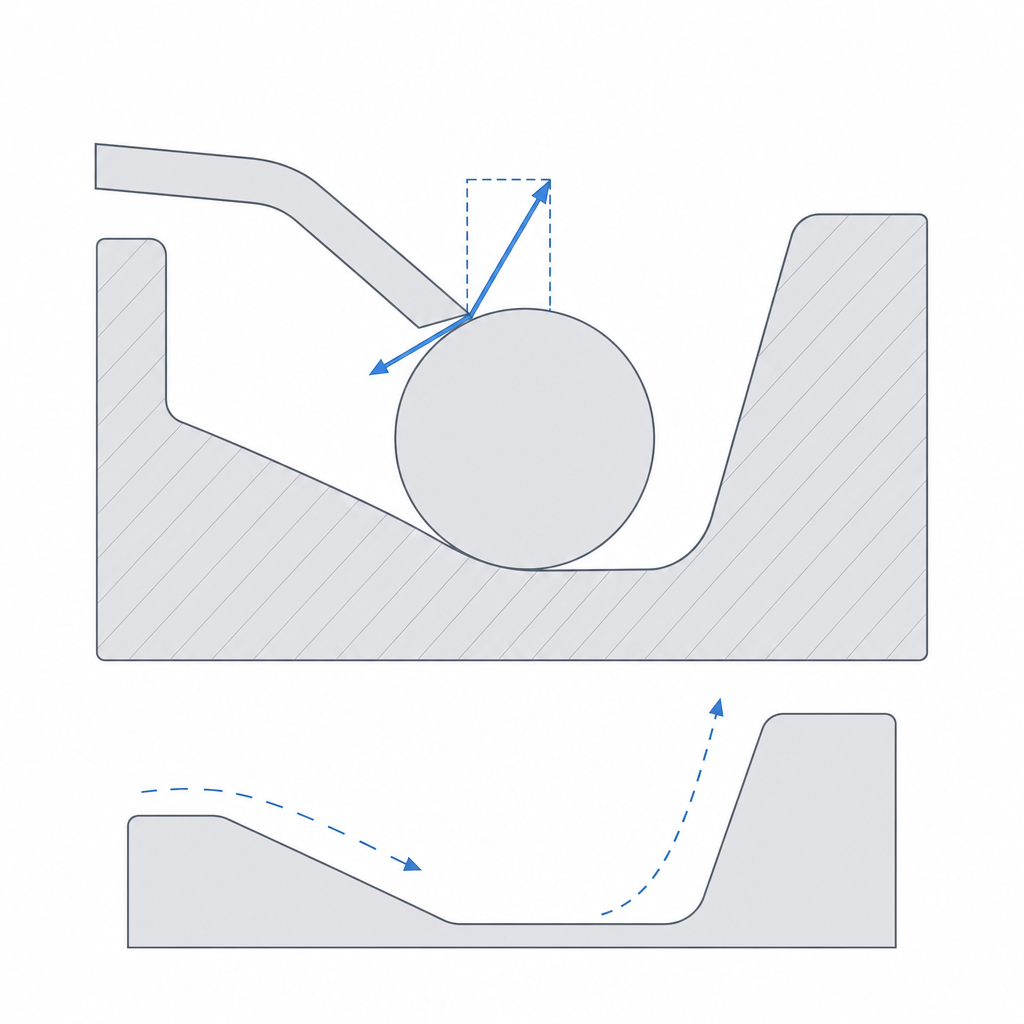
Once you understand that the ramp projects the flexure's push, the shape of the notch stops being decorative and becomes the main lever you have over the feel. Each part of the notch does a different job.
The side faces — the ramps — set the transition. If they are gentle, they give a soft detent that yields with little force and reads more like a preference than a stop; the control wants to stay in the notch but doesn't resist if you move it. If they are steep, they give a firm latch: the flexure has to compress more and, above all, the slope turns that compression into a high breakaway force, so the click is sharp. Make the walls nearly vertical and you get a detent that truly holds — almost a latch; the control won't move on its own or under vibration, but it demands deliberate force to change position.
The ramps offer one more lever: asymmetry. Nothing forces the two faces of the notch to share the same angle. If you make one face steep and the other shallow, it takes more force to enter the position from one side than to leave it from the other — that's the basis of ratchets and directional detents. The same trick works for a "parked" position you want the control to drop into easily but resist leaving by accident: shallow entry ramp, steep exit ramp. The entry and exit forces are no longer equal, which gives you controlled hysteresis — a tactile tool a symmetric detent doesn't have.
The bottom decides how well-defined the position is. A flat bottom gives a stable rest zone: the flexure settles and has no preferred point along it. That gives a robust position, but with a dead band exactly as wide as the bottom minus the flexure's contact width; a bottom barely wider than the flexure gives a small dead band, one much wider gives a large one, and the control tolerates lateral play before it begins to center. A V notch, by contrast, has no flat bottom: the flexure drops to the vertex and centers itself, because any deviation pushes it back down one of the ramps to the low point. The V is what you want when the position has to be exact and repeatable — a positioner, or a selector that has to align to a feature; the flat bottom, when you only want the control to stay put within a region. Most good detents are a softened V: rising ramps that give the click and a narrow valley that centers.
The resolution floor: below a few tenths of a millimeter, no click
This is where FDM imposes its own rule, and it's the one that wrecks more printed detents than any other. A notch is a small, sharp detail: a ramp that rises, a crest, another ramp that falls. The printer reproduces that profile by laying down beads about 0.4 mm wide, and it can't draw a detail finer than its own bead. But bead width isn't the only limit: when the notch has a vertical component — the ramp rising in Z — layer height quantizes the profile into steps. With 0.2 mm layers, a notch 0.3 mm deep is barely a layer and a half, the crest prints rounded, and the flexure slides over a soft ripple instead of catching in a notch with a defined crest. The click simply never shows up.
The practical consequence is that the notches of a printed detent have to be generous — in both depth and pitch. As a working figure, aim for at least 0.5 to 0.8 mm of depth for a clear click, not the two or three tenths of a millimeter at which the profile washes out, and leave the crest between notches wide enough that the bead forms it whole instead of eating it away. A detent with twelve tiny positions on a small wheel won't print with enough definition; the same control with six deeper notches will. If you need many fine positions, that's when to bring in hardware — covered in Embedded hardware: magnets, bearings, and inserts — instead of squeezing the printer's resolution.
And there's orientation, which matters twice over here, because two parts are at risk, not one. The detent flexure works in bending every time it clears a notch, so it's a cantilever beam taking thousands of cycles, and the rule for any flexing part applies to it: print it in the plane of the layers, not on edge. If the layers stack in the direction the boss bends, every click pulls on the bond between layers and the flexure delaminates at the root — it splits in a clean crack, often before it has even worn. Laid in the plane of the layers, the bending follows the beads and the boss survives the cycles you designed it for. But the notch track also has a preferred orientation of its own: the crests take the rubbing and the impact of the click, and if they end up formed by layer lines running across the motion, they peel away with use. The trouble is that the two parts compete: often the ideal orientation for the flexure isn't the ideal one for the notches, and if they share a part you have to decide which one you sacrifice, or split them into separate parts. The full reasoning for why orientation decides bending strength is in Layer orientation for motion.
Clearances: the detent's side load tilts the control
A detent doesn't live alone: it lives mounted on a guide that slides or a shaft that turns, and that support has to be right, or the detent will ruin it. The guide or the shaft needs a free fit, clearance enough to move without binding, exactly like any moving part — the starting numbers are in Tolerances for moving parts. But the detent adds a side load a plain slider doesn't have: the flexure presses against the notches with a force perpendicular to the motion, and that force has to bear against something.
If the detent presses hard and the control has no good support facing that load, the classic failure appears: the lateral pressure tilts the control inside its guide. Instead of sliding straight, the control cocks, digs into the guide at one corner, and binds — and the harder the detent presses, the worse the effect. It's the textbook case of a poorly supported detented slide: the firmer you wanted the click, the more the assembly jams. The fix is geometric: either you back the control against the detent's load with a wall or a rail facing it, so the load is spread and creates no moment, or you place the detent so its push passes through the center of the guide and doesn't lever. A well-designed detent presses against something that holds it without twisting the control; a badly designed one turns its own holding force into binding.
Failure modes: the boss flattens and loses the click
An all-plastic detent almost always fails in the same place: the flexure loses its push over time, and without push there is no click. There are two mechanisms, and both go after the flexible boss. One is wear: the boss rubs against the notches on every use, and a plastic boss rubbing against plastic crests rounds over, wears down, and after many cycles its tip stops seating cleanly in the notch. The other is creep: plastic under sustained load flows slowly and deforms permanently. The case that kills the detent isn't the flexure resting at the bottom of a notch — there, by definition, it carries no load. It's the design that leaves a permanent preload: a flexure that never fully relaxes, even at rest. That one lives under constant load, and over the months it flattens, loses effective height, and the detent that had firm clicks starts to feel imprecise until it disappears. And don't assume PLA gets a pass for being stiff: it's brittle in the boss — it delaminates or cracks before bending far — but on top of that, under sustained load it creeps at room temperature more than its stiffness would suggest; PETG and nylon flex better but creep too. No material gives you a free pass on the problem.
The real way to extend service life is to stop trusting plastic to provide the push. A metal ball with a real spring — embedded hardware housed in a printed pocket — lasts orders of magnitude longer than any printed boss: the steel spring doesn't creep, doesn't lose force with cycles, and the metal ball rubbing against plastic notches wears slowly because it's the hard part of the pair. The plastic only provides the housing and the notches; all the elasticity comes from the spring, which is built for it. For a frequently used control you'll use daily for years — a selector moved a thousand times — that ball-and-spring is the difference between a mechanism that keeps its feel and one that softens in a few months. How to size the pocket and seat the hardware so it doesn't pop out or rattle is in Embedded hardware: magnets, bearings, and inserts.
If you stick with the all-plastic detent for simplicity — and for an occasionally used control that's perfectly reasonable — give the boss room against both modes: make it long enough and with a fillet at the root so it flexes without accumulating excessive permanent deformation, and don't leave it preloaded at rest, because creep attacks exactly what stays loaded. It's the same interference-and-tension reasoning that cracks press-fits when you push the stress too far: Interference without cracking works it through. A detent designed to rest relaxed in its notches, and to compress only during the instant of the step, keeps its click far longer than one held under tension around the clock.
Decide early whether your control sees occasional or frequent use, because that answer governs the rest: a selector touched now and then holds up fine without hardware, while a wheel the user will turn a thousand times calls for the ball-and-spring from the start. From there, everything else — notch depth, flexure stiffness, guide support — follows from the same clearance calibration as any other moving part, and you have it in Tolerances for moving parts.