
Use ABS or ASA when a part has to take more heat than PETG or spend years in the sun. Their heat deflection temperature (HDT) at 0.45 MPa is 87 °C for ABS and 100 °C for ASA, against 69–71 °C for PETG, and ASA is also the outdoor material. The catch is that both shrink more as they cool: they want an enclosed, warm printer, and they give off styrene while they print. On the right machine they print without drama; a large flat part on an open printer will not.
A plastic with rubber inside
They are built the same way: a stiff, glassy matrix of styrene-acrylonitrile (SAN) with tiny rubber particles dispersed through it. The SAN brings the stiffness and the heat resistance. The rubber particles stop cracks: when a crack reaches a particle, the rubber deforms and soaks up its energy. That is why they take knocks better than PLA. The elongation at break of test bars does not show it (in XY, 10.5 % for ABS and 9.2 % for ASA, against 12 % for PLA Basic). What changes is how they fail: they give before they break instead of shattering.
Do not compare Charpy impact strength across families, because every manufacturer measures it differently. Between these two you can, from Bambu's datasheets: notched, 21.5 kJ/m² for ABS and 19.6 for ASA in XY, and 7.4 and 4.9 in Z.
The difference between them is the rubber. ABS uses polybutadiene, which has carbon-carbon double bonds in its backbone. Ultraviolet light and oxygen attack exactly those bonds: the surface yellows, turns matt and chalky, crazes with microcracks, and the part loses toughness from the outside in. ASA (acrylonitrile styrene acrylate) swaps that rubber for an acrylic one with no double bonds in the backbone, and sunlight does far less to it. They print the same and sit in the same heat class, but outdoors they last very differently. If a datasheet credits ABS with "UV resistance", be skeptical: its rubber is exactly what sunlight breaks down, and that is why ASA exists.
Both are amorphous: they have no sharp melting point, only a glass transition around 100 °C. Above it they soften gradually. Two things follow from that. Annealing barely raises their heat ceiling, which the glass transition sets; it only relieves internal stress. And that same glass transition is what makes the enclosure essential, as you will see below.
They are light: 1.05 g/cm³ each, against about 1.24 for PLA, so a kilo gets you roughly 18 % more volume. According to the datasheets they resist acids and alkalis, but not some solvents, oils and greases. Acetone dissolves both; vapor smoothing and solvent welding rely on it.
How much heat they take
HDT at 0.45 MPa is 87 °C for ABS and 100 °C for ASA, according to Bambu's technical datasheets (V2.0); at 1.8 MPa, 84 and 92 °C. Distrust any figure without its test condition: "withstands 95 °C" with no load stated means nothing. And bear in mind that those bars spent 12 h at 80 °C before testing, which relieves their stress: a part straight off the printer can come in a few degrees lower.
For a loaded part, design 15–20 °C below the HDT at 0.45 MPa (Heat, cold, sunlight and chemicals): about 70 °C for ABS and about 80 °C for ASA. That takes in an engine-bay cover away from the exhaust, a lamp housing, a part next to a stepper motor, or the panels of the printer's own enclosure.
The car is the borderline case. In summer, a car's dashboard in the sun reaches 70–100 °C. A loaded part there needs a fiber-filled compound: PA-CF, PET-CF or PPA-CF. Unloaded or in the shade, in the console or the glovebox, ASA, PC or annealed PLA-HT will do, and PC wherever it takes knocks. Inside a car, never PLA or PETG. Dark colors in the sun run hotter than the air around them: a black part heats up more, although it handles UV better, and on a dashboard both count. Below freezing, both keep their toughness better than PLA.
In the sun: ABS yellows, ASA holds up
After a few months outside, an ABS part yellows, especially if it is white or a light color. Then the surface goes matt and chalky, and finally brittle: the tab that flexed happily in spring snaps in autumn.
ASA keeps its color and toughness far longer. It is the go-to material for anything that lives outside: garden parts, letterboxes, exterior trim on a bike or a car, aerial and camera mounts. Pigment helps both: a black part, loaded with carbon black, resists UV better than a natural or white one. If you have no choice but ABS, a paint or a UV-filtering clear coat protects it (Painting and priming). PETG copes reasonably for a season; for several years outdoors, ASA.
Why they want an enclosed chamber
ABS shrinks by 0.5–0.8 % as it cools, and ASA by 0.4–0.7 %, against 0.2–0.5 % for PLA. What matters is the temperature range over which that shrinkage builds up. A freshly laid layer arrives well above its glass transition and is soft: while it stays that way, it deforms without storing stress. It starts storing it once it cools below about 100 °C. From there down to the temperature of the surrounding air it keeps shrinking, but it is now bonded to the cooler, stiffer layers below, which hold it back. The bigger the drop from the glass transition to the air, the more stress is frozen in to every layer. In a room at 20 °C that drop is about 80 °C; in a chamber at 50–60 °C, roughly half. The enclosure does not change the material: it shortens that drop.
The stress escapes through the weakest point. If that is the bond to the bed, the corners lift: that is warping. If it is the bond between layers, the part splits along a layer partway up: that is delamination. Long, flat parts curl; tall ones with a draft on one side crack. The full diagnosis is in Warping and lifting corners and Layers splitting apart.
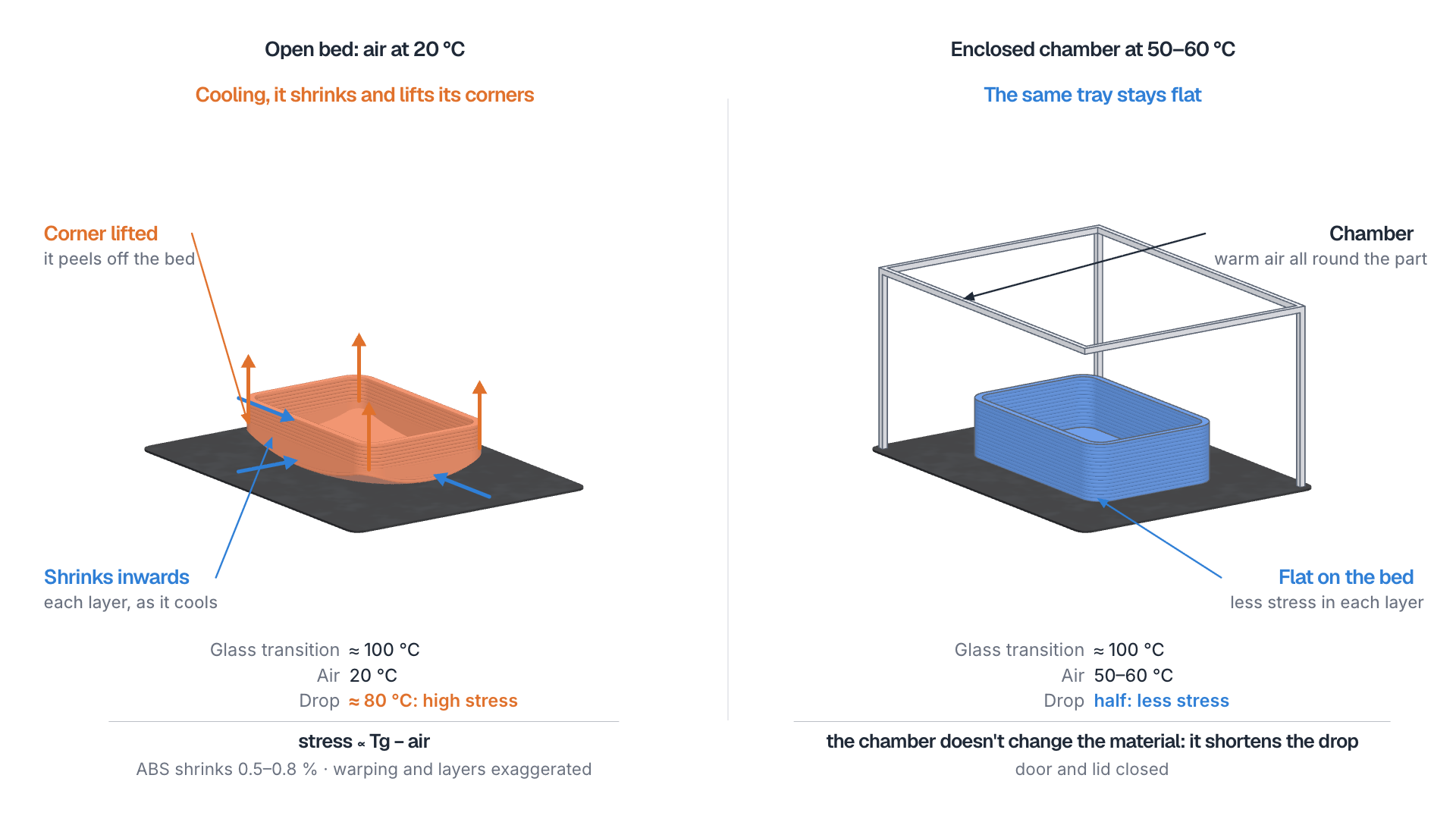
In practice, "enclosed" means a CoreXY with an enclosure, door and lid shut. At the end of 2026 that covers machines such as the P1S or P2S, the X1C, the H2 series, the CORE One, the K2 or the Qidi range. Bambu's datasheets (V2.0) recommend a 45–60 °C chamber for both materials. A passive enclosure, heated only by the bed, is the minimum; for large parts, aim for 50–60 °C. The H2D heats its chamber with its own heater, up to 65 °C. The CORE One heats it with the bed alone, regulates it with its fans and settles around 55 °C. Before a large part, let the bed warm the chamber for 10–15 minutes.
On an open bedslinger, a part a few centimeters across will print if you give it a brim, shield it from drafts and cover it with a makeshift cardboard enclosure or a printer tent. A 200 mm flat part will not, and no slicer setting fixes that.
The door rule is the opposite of PLA's. With PLA and PETG you open the door to avoid heat creep, which clogs the hotend; with ABS and ASA you keep it shut (Enclosures and heated chambers).
How to print them
| ABS | ASA | |
|---|---|---|
| Nozzle | 240–280 °C | 240–270 °C |
| Bed | 90–110 °C (80–100 on Bambu plates) | 90–110 °C (80–100 on Bambu plates) |
| Chamber | passive at minimum; heated is better (45–60 °C in Bambu's datasheets) | passive at minimum; heated is better (45–60 °C in Bambu's datasheets) |
| Part cooling fan | 10–30 % (more on overhangs; 25–30 % on bridges) | 15–30 % (more on overhangs; 25–30 % on bridges) |
| Surface | smooth or textured PEI; glue optional | smooth or textured PEI; glue optional |
| Drying | 75–80 °C × 8 h, recommended | 75–80 °C × 8 h, recommended |
| Maximum speed (Bambu datasheets) | < 300 mm/s | < 250 mm/s |
The hotend. If your hotend has a PTFE tube running down to the nozzle, as many legacy bedslingers do, stay at or below 240 °C: print at the bottom of the range or switch to an all-metal hotend. Above about 250 °C PTFE breaks down and its fumes are dangerous.
The fan. The "fan off for ABS" advice is out of date. Current profiles run it at 10–30 % inside an enclosed chamber, with more on overhangs and 25–30 % on bridges. It works because what keeps the part warm is the chamber, not the lack of airflow, and a little fan keeps overhangs clean. Too much fan on a large part causes delamination.
Overhangs and bridges. The maximum overhang drops by about 5–10° compared with PLA, and clean bridges are shorter. Bambu's ABS datasheet V2.0 quotes about 70° and about 40 mm in ideal conditions: treat that as a ceiling, not a design rule.
Why ASA prints slower. Its melt flow index is 7.0 g/10 min, against 34.2 for ABS, both at 260 °C and 2.16 kg in Bambu's datasheets. A more viscous melt needs more pressure and more heat to come out, so ASA usually hits its flow limit first. The melt flow index only gives you the trend: the real limit comes from the flow test (Flow ratio and max flow tests). Let the maximum volumetric flow in the filament profile cap the speed (Volumetric flow sets the speed).
Moisture. They absorb little: 0.65 % for ABS and 0.45 % for ASA at saturation in 55 % relative humidity. Even so, a damp spool pops, strings and bonds its layers worse. Dry them at 75–80 °C for 8 h. A 65 °C dryer, such as the AMS 2 Pro's, is not enough for these materials; an 85 °C one, such as the AMS HT's, is (Drying and storing filament).
First layer. Bed fully up to temperature and chamber warm before you start. Add a brim or mouse ears to large flat parts or parts with sharp corners (Brims, rafts and mouse ears). Smooth PEI holds ABS well while hot; on it, glue is mainly there to release the part without tearing the surface. The routine for each plate is in Bed prep for each material.
Variants: easy, fiber-filled, foaming and PC-ABS
As with PLA, each variant is the base polymer with something added, and that something changes how it prints and how the part behaves.
"Easy" or low-warp ABS. Manufacturers tune the rubber content and the flow so that it warps less; Bambu's ABS datasheet says it is designed to reduce warping and cracking. It shrinks the problem, but it still needs an enclosure.
ABS-GF, glass-filled. On Bambu's datasheet (V1.0), an HDT of 99 °C at 0.45 MPa and a flexural modulus of 2860 MPa, against 1880 for plain ABS. It warps less and its matt finish hides the layers, but elongation drops to 6.3 % in XY and 2.3 % in Z, and the maximum speed falls to 180 mm/s. Glass is abrasive: it needs a hardened nozzle (Carbon and glass fiber filaments).
ASA-CF, carbon-filled. An HDT of 110 °C and a flexural modulus of 3740 MPa on Bambu's datasheet (V1.0), with the nozzle at 250–280 °C and the fan on. It is stiffer and more stable, not stronger in tension: 34 MPa in XY and 30 in Z, against 52 and 35 MPa for unfilled ASA. It is abrasive too.
Foaming ASA. Grades such as Bambu's ASA Aero foam as they heat in the nozzle: the filament has a density of 0.99 g/cm³ and the part comes out much lighter. It is for RC aircraft and lightweight parts; the price is an HDT down to 85 °C and a speed below 150 mm/s (Functional specialty filaments).
PC-ABS. A step toward the toughness and heat resistance of polycarbonate (Polycarbonate and its blends).
What they give off
All FDM printing gives off ultrafine particles, and the ABS family gives off the most. In the first study to measure it, ABS released about 2 × 10¹¹ particles per minute and PLA about 2 × 10¹⁰: ten times fewer. The main volatile organic compound (VOC) ABS emits is styrene, at about 10–110 µg/min. ASA's matrix is styrene-acrylonitrile too, so treat it the same way. In 2018 the IARC (International Agency for Research on Cancer) classified styrene as "probably carcinogenic to humans" (Group 2A).
Do not print ABS or ASA in a bedroom or in an occupied, unventilated room. Use an enclosure with a HEPA and activated carbon filter, or vent the air outside. HEPA catches particles and does nothing against styrene; carbon does, but it saturates and needs replacing. A hotter nozzle emits more. Your nose is no gauge: styrene is detectable at low concentrations, and the particles have no smell at all. The fixes, from cheapest to most expensive, are in Emissions and ventilation.
What changes in your design
Geometry against warping. Three rules matter more than the rest: generously round the outside corners that touch the bed, avoid long flat bases with sharp corners, and do not change cross-section abruptly. A 0.5 mm 45° chamfer on the edge that touches the bed also helps (The face on the bed). The full list is in Warping and lifting corners.
Strength between layers. Bambu's test bars give 41 MPa in XY and 32 in Z for ABS (Z keeps 78 %), and 52 and 35 for ASA (67 %). But those bars spent 12 h at 80 °C before testing and were printed in ideal conditions. In a real part from an open printer or a drafty chamber, Z can end up at 20–40 % of XY. For design, assume the part is half as strong in Z as in XY, and less if the machine is open, and orient it so the main load runs along the beads (Layer adhesion and anisotropy).
Snap fits. The allowable strain is 2–2.5 % for a fit assembled once and 1.5 % for repeated use: a little better than PLA, below PETG and PC (3–4 %) and well below nylon (6 %) (Print-friendly snap fits).
Heat-set inserts. ABS and ASA take them very well; set the iron to 260–270 °C (Designing for heat-set inserts).
Fits. Because they shrink more, clearances change: check yours with Real printed clearances. The underlying physics is in Shrinkage and dimensional stability.
Acetone. ABS smooths in acetone vapor, and so does ASA, more slowly. The vapor rounds edges and closes small holes: do not use it on a part with tight fits unless you allowed for it in the design (Vapor and chemical smoothing). The same acetone welds ABS parts together (Gluing and welding printed parts).
ABS or ASA, and when neither
If the part lives outside or in the sun, ASA. If it lives indoors, with some heat, and you want the cheapest material and the one that smooths best, ABS: about €15–30/kg against €25–40/kg for ASA (indicative prices). Since on an enclosed machine they print almost the same, many people use ASA for everything.
There are cases where neither will do:
- More than about 80 °C under load, or heavy impacts. The next step up in heat and toughness is polycarbonate: Polycarbonate and its blends.
- Wear, sliding contact or repeated flexing. Nylons and polyamides.
- Above 100 °C, and stiffness. A fiber-filled PA, PET or PPA, in Carbon and glass fiber filaments.
- No heat, no sun and no enclosure. PETG, PCTG and other copolyesters.
When it fails
| Symptom | Cause | Fix |
|---|---|---|
| The corners lift partway through the print | The part is cooling more than its base can take | Shut the door and lid, let the chamber warm up, add a brim or mouse ears and round the corners of the base; if it happens on an open machine, the part is too big for it |
| A horizontal crack partway up | Delamination from a draft or too much fan | Turn the fan down, raise the nozzle 5–10 °C within the range and shield the part from moving air |
| Popping, bubbles and a rough surface | A damp spool | Dry it at 75–80 °C; a 65 °C dryer falls short |
| ASA with thin walls and gaps at high speed | You have gone past its maximum flow in mm³/s | Lower the profile's maximum flow or the speed |
| A strong smell in the room | Styrene and particles in the air you breathe | A filter or extraction before the next print (the "What they give off" section above) |
| The outdoor ABS part yellows and cracks | Sunlight breaks down its rubber; not a print defect | Reprint it in ASA or protect it with paint |
See also
- Heat, cold, sunlight and chemicals: from HDT to service temperature, and how each family ages in the sun.
- Warping and lifting corners: every remedy for warping, from the plate to the model.
- Enclosures and heated chambers: passive enclosure against heated chamber, and when to open the door.
- Emissions and ventilation: filters and extraction, from cheapest to most expensive.