
The PLA clip snapped the third time you opened it, and the part under the sink lives wet. In cases like these, PETG is the material to try: it yields before it breaks, water and nearly every household cleaner leave it alone, and it prints without an enclosure. PETG, PCTG and PET are copolyesters, cousins of the plastic in drinks bottles. They print on the same beds in a similar temperature window, and they share three habits: they string, they grip smooth PEI too hard, and, except for annealed PET, their heat ceiling sits around 70 °C.
Why PETG bends where PLA snaps
The PET in bottles and polyester fiber can crystallize: its straight, regular chains fold into ordered stacks. The G in PETG stands for a glycol modifier, a bulkier monomer (CHDM) that sits in the chain and stops neighboring chains from packing. PETG stays amorphous, and it shows in use: unpigmented it is clear, it shrinks little as it cools (0.3–0.5 %) and, under load, its chains can slide and yield before the part breaks. It is tough, but less stiff than PLA.
On a stress-strain curve, the obvious difference is the slope: PLA climbs more steeply, because it deforms less under the same load. What changes less in printed specimens is the elongation at break: Bambu's datasheets give 12 % for PLA Basic and 9.5 % for PETG Basic. PETG's toughness shows in how it fails. It yields and whitens before it breaks, and it copes better with a knock or a notch; PLA snaps all at once, with no warning. For a jig or a template that must not flex by a tenth of a millimeter, PLA may be the better choice.
Between layers, PETG loses more than PLA. Layers fuse well when hot, but the fan cools them quickly. On Bambu's PETG Basic datasheet, tensile strength is 51 MPa along the beads and 35 MPa across the layers: 69 % of the first. PLA Basic keeps 89 %. PETG's elongation at break falls from 9.5 % to 5.2 %, so in Z even PETG breaks brittle. Design as if strength in Z were half of that in XY and align the load with the beads; the reasons are in Layer adhesion and anisotropy.
Water and household products are no problem for PETG: rain, washing-up water, most cleaners. That is why it is the usual choice for parts that live wet or outdoors for a season. It handles sunlight better than PLA, but for years outside ASA is the safer bet. The chemical resistance tables are in Heat, cold, sunlight and chemicals.
The heat ceiling: about 70 °C
PETG and PETG-HF have a heat deflection temperature (HDT) of 69–71 °C at 0.45 MPa. Under load, an amorphous plastic such as PETG works up to about 15–20 °C below its HDT at 0.45 MPa: about 50 °C (Heat, cold, sunlight and chemicals). That covers a hot room, a part next to a power supply or a shelf in a warm kitchen. It does not cover a dishwasher or a car.
In summer, a car's dashboard in the sun reaches 70–100 °C, and inside a car it is never PLA or PETG: under load, a fiber-filled compound (PA-CF, PET-CF or PPA-CF); unloaded or in the shade, ASA, PC or annealed PLA-HT (Choosing a filament).
Nor is there a "PETG-HT" to match high-temperature PLA. PETG is amorphous by design, so annealing does not crystallize it or raise its heat ceiling: it only relieves internal stress. Glycol-free PET is the exception; Annealing and strengthening explains it. High glass-transition copolyesters such as Tritan do exist, but they print like ABS: a very hot bed and an enclosure.
PETG, PETG-HF, PCTG and PET: how they differ
| Material | What it is | Nozzle (°C) | Bed (°C) | Fan | When to choose it |
|---|---|---|---|---|---|
| PETG | The general-purpose copolyester | 230–270 (245) | 60–80 (70) | 30–60 % (bridges 50–90 %) | Parts that get wet, knocked or flexed, at moderate speed |
| PETG-HF | PETG formulated to melt faster | 230–260 | 60–80 | 10–40 % (overhangs 90 %) | The same as PETG, at the speed of a high-flow PLA |
| PCTG | Copolyester with more CHDM | 240–270 | 70–80 | 20–50 % | Parts that get dropped, knocked or flexed a lot; clear parts |
| PET / rPET | No glycol, often recycled | hotter than PETG | check the datasheet | check the datasheet | More stiffness; can be annealed |
Bambu Studio's profiles turn the PETG fan down to 10–40 %; the 30–60 % in the table is a general starting point, and both work.
PETG-HF
"HF" stands for high flow: a PETG that melts faster, so the same hotend accepts more volumetric flow. As of late 2026, Bambu Studio's base profile caps PETG Basic at 8 mm³/s and PETG HF at 21 mm³/s. Speed is flow divided by line width times layer height: with a 0.45 × 0.20 mm line, 8 mm³/s is about 89 mm/s and 21 mm³/s about 233 mm/s. A high-flow hotend raises the ceiling for ordinary PETG too. Print ordinary PETG at high-flow PLA speeds and the hotend cannot melt it fast enough: the part comes out under-extruded and the layers fuse poorly. Pick an HF grade or stay within the flow limit (Volumetric flow sets the speed explains it). Shop by the HF label, not by the brand.
PCTG
In PCTG, CHDM makes up most of the glycol component. Manufacturers agree that it takes knocks better than PETG, with similar strength, stiffness and heat ceiling, and that it comes out clearer. It prints slightly hotter. Impact figures on datasheets vary by an order of magnitude from one brand to the next because they are not measured the same way, so take away the idea: it handles knocks better, and how much better depends on the brand. It is sold by brands such as Fiberlogy, 3D-Fuel, Spectrum and MatterHackers, and more mainstream brands keep adding it.
PET
Without glycol, the chains can crystallize. PET is stiffer and can be annealed to take more heat, but it is fussier to print: cool it badly and it crystallizes in patches, turning cloudy and brittle. For most people it is a niche material. A lot of filament sold as rPET is really recycled PETG and prints as such; check the datasheet before treating it as PET. Carbon-fiber PET, with an HDT of 205 °C, is a different material: you will find it in Carbon and glass fiber filaments.
Printing it: temperature, fan and moisture
Start at 245 °C on the nozzle and 70 °C on the bed. With the nozzle too cold, layers come out matt and weak, and they split apart. Too hot, and you get more stringing and more ooze. Tune each spool with a temperature tower, as described in Temperature towers and retraction tests.
Do not run the fan at 100 %. PETG needs heat at the weld to bond to the layer below, and with the fan flat out the walls look lovely but you can pull the layers apart by hand. Turn it up only for overhangs and bridges. Even then, overhangs manage 5–10° less than in PLA and bridges have to be shorter: allow for it when you design.
With PETG in an enclosed printer, open the door or lid if the bed runs at 70 °C or more. Otherwise the chamber heats up, heat climbs into the cold zone (heat creep), the filament softens too early and the nozzle clogs.
Dry the spool before you trust any setting: 60–65 °C for 8 hours for PETG and 60–70 °C for 6–8 hours for PCTG. Wet PETG crackles, strings and loses strength between layers. The full method is in Drying and storing filament.
PETG also clings to a brass nozzle: it builds up there and drops off onto the part as dark blobs. A silicone sock and a clean nozzle prevent most of them. Z hop lifts the nozzle clear of the top surface, but with PETG it adds stringing: enable it only on the top layers, which slicers let you do. It is covered in Nozzle and hotend care.
Stringing: why it happens and what to fix first
After a retraction, plastic keeps coming out under the residual pressure in the nozzle. During the travel move, that drop gets drawn out. Molten PLA is more brittle and the strand breaks; molten PETG is more cohesive and elastic, and it stretches into a string. It also comes out about 30 °C hotter and with less fan, so it takes longer to set.
Tackle stringing in this order, from the simplest to the most involved:
- Dry the spool. Water vapor pushes plastic out of the nozzle between moves.
- Drop the nozzle temperature by 5–10 °C, staying within 230–270 °C. A runnier melt oozes more.
- Calibrate retraction with a test, rather than copying someone else's number.
- Adjust travel moves: keep them from crossing walls and have the nozzle wipe as it retracts.
- Accept the last few wisps and give them a quick pass with a heat gun.
Do not overcorrect. On a direct-drive extruder, a very long retraction chews the filament or drags molten plastic up into the cold zone, and the nozzle clogs. The general method, for any material, is in Stringing and blobs.
When it tears chunks out of PEI
PETG is a polar polyester and wets PEI, another polar polymer, so well that on a smooth sheet the bond can be stronger than the coating's own grip on the steel. When you remove the part, it takes a flake of the coating with it, and leaves a permanent pit in the plate.
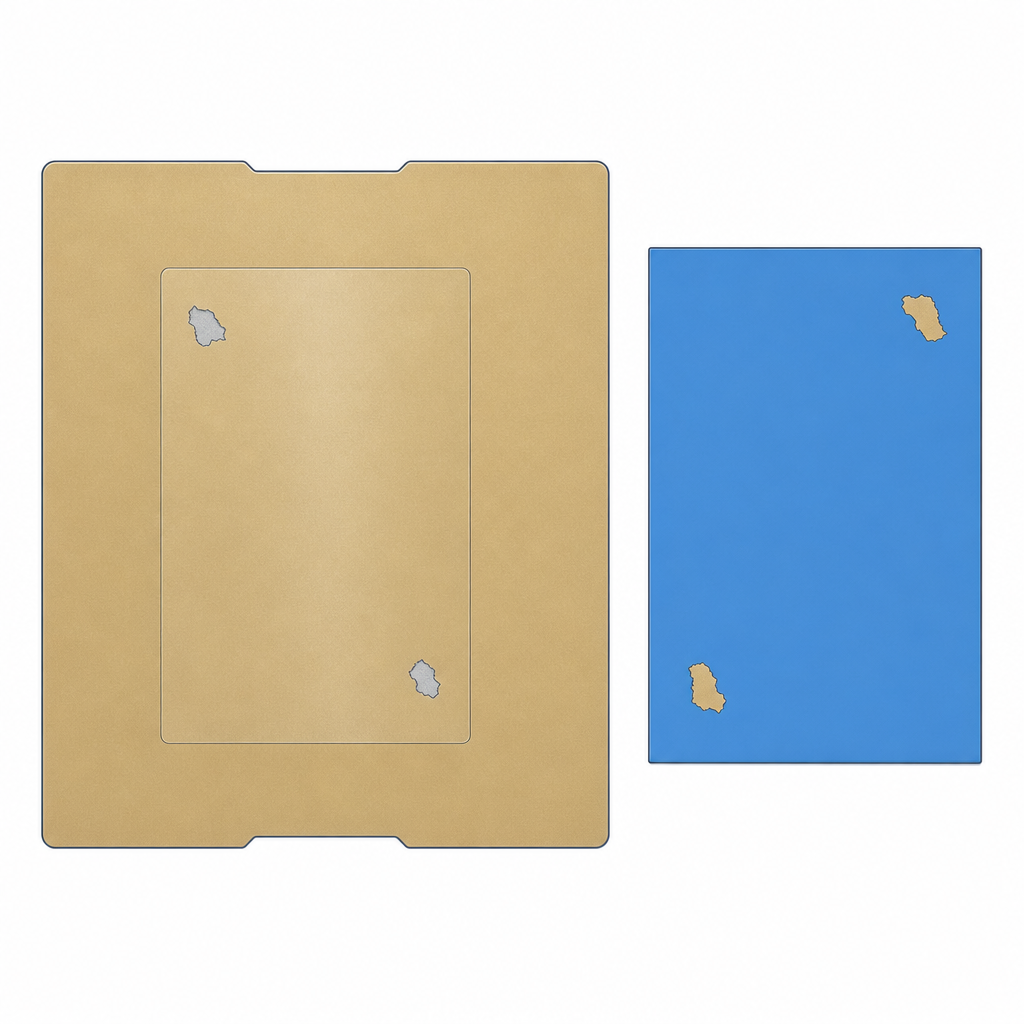
Print PETG on textured PEI. The part only touches the peaks, grips less and lets go as it cools. On smooth PEI, use it only with a layer of glue stick as a release agent, never on the bare sheet. Do not over-squish the first layer either: with the Z offset too low, PETG presses into the sheet and bonds even harder.
To release the part, let the plate cool completely and flex it: plate and part shrink by different amounts as they cool, and that difference is what breaks the bond. Never push a scraper under the edge to lever it off. If it will not come away, cool the plate further (a few minutes somewhere cold) and flex it again.
PETG supports grip a PETG part the same way, which is why they are so hard to remove. PLA and PETG, on the other hand, do not bond to each other, and each works as a support interface for the other: see Support materials. The full bed routine for each material is in Bed prep for each material.
What changes in your design
Snap fits
PETG's allowable strain is 3–4 % for a fit assembled once and 2 % for repeated use; PLA's is 2 % and 1–1.5 %. With the same geometry, a PETG tab tolerates 1.5 to 2 times the deflection; keep the deflection the same and it lasts longer. And because it is less stiff, it takes less force to assemble. The calculations are in Print-friendly snap fits.
Stiffness and creep
PETG flexes more under the same load. A jig, a shelf bracket or a long, thin arm may need ribs or a thicker section to match its PLA version: see Stiffness, strength and toughness. At room temperature, PLA holds a light sustained load about as well as PETG: no reliable data on printed parts says which creeps more. PETG only wins when the part gets warm. For a sustained load, use PC or ASA, or a fiber-filled filament if the part is not a spring (Creep and fatigue).
Clearances
PETG beads come out slightly wider and oozing plastic fills narrow gaps, so a fit tuned in PLA often ends up tight in PETG. Print the clearance coupon in the PETG you will use (Real printed clearances).
Heat-set inserts
With PETG, set the soldering iron to 250–260 °C: the plastic flows well around the knurling. The pocket dimensions are in Designing for heat-set inserts.
Food
Many PETGs are made from food-grade resin, but that does not make the printed part food-safe: gaps remain between beads, and the nozzle and pigments count too. It is covered in Printing for food contact.
When it fails
| Symptom | Cause | Fix |
|---|---|---|
| The layers pull apart by hand | Fan too high or nozzle too cold | Fan at 30–60 %, more only for overhangs and bridges; nozzle 5–10 °C hotter |
| Strings between parts and between towers | Wet spool, nozzle too hot or uncalibrated retraction | Dry, drop 5–10 °C and calibrate retraction, in that order |
| Dark blobs on the part | Plastic built up on the brass nozzle | A silicone sock and a clean nozzle |
| The part tears flakes out of the plate | PETG on smooth PEI with no release agent, or an over-squished first layer | Textured PEI or glue stick; raise the Z offset |
| Under-extrusion and poorly fused layers when printing fast | Ordinary PETG above its maximum flow | PETG-HF, or drop to the flow limit |
| The part has sagged in the car or next to a heat source | Above its service temperature under load, about 50 °C | Change family (Choosing a filament) |
| A fit tuned in PLA comes out tight | Wider beads and oozing plastic | Print the clearance coupon in PETG |
See also
- PLA and its variants: when PLA's stiffness is worth more than PETG's toughness.
- Polycarbonate and its blends: the next step when the part needs more heat and more impact resistance.
- Volumetric flow sets the speed: why ordinary PETG cannot run at high-flow PLA speeds.
- Bed prep for each material: the full bed routine for each material.