
A part straight off the printer is not food safe, whatever the spool label says. For some uses it can become so if four conditions hold at once: a material with a declaration of compliance (DoC) for food contact covering that exact product in that color; a stainless steel nozzle and a clean filament path; a surface you can genuinely clean, or a compliant coating over it; and a use within the limits of temperature, food type and contact time.
What "food safe" means
The phrase hides two separate questions. The first is chemical: does the material release substances into the food? That is migration. The second is hygiene, and at bottom it is a matter of geometry: can you keep the surface free of microbes? A filament with a DoC partly answers the first and does nothing for the second.
The polymer alone is not enough. PLA, PETG and PP are all used in packaging, but packaging comes smooth out of a mold, is made from a grade with declared additives, and has its migration tested. When you print, the declared grade is all that carries over, at best: you melt it again, push it through your nozzle and leave a surface of beads no test has ever seen.
In the EU the legal framework is Regulation (EC) 1935/2004: a material in contact with food must not transfer its constituents in quantities that endanger health or bring about an unacceptable change in the food's composition, smell or taste. For plastics, Regulation (EU) 10/2011 sets the list of authorized substances, an overall migration limit of 10 mg/dm² of surface, and specific migration limits per substance. Testing uses food simulants, substances that stand in for each type of food, under time and temperature conditions that reproduce the intended use.
| Food type | Simulant |
|---|---|
| Aqueous | 10 % ethanol (A) |
| Acidic | 3 % acetic acid (B) |
| Alcoholic | 20 % ethanol (C) |
| Dairy and oil-in-water emulsions | 50 % ethanol (D1) |
| Fatty | Vegetable oil (D2) |
| Dry | Modified polyphenylene oxide, Tenax (E) |
On top of that sits Regulation (EC) 2023/2006 on good manufacturing practice. The most you get from a supplier is a declaration of compliance, which states the conditions it covers: food types, maximum temperature and contact time.
In the US the FDA neither approves nor certifies filaments or finished objects. Resins are listed in 21 CFR (for example 177.1630 for PET, 177.1315 for PETG-type copolyesters and 177.1520 for polyolefins) or covered by a food contact notification (FCN), which is the case for PLA. It is the supplier who declares that its grade complies. "FDA-approved filament" is a marketing claim with no legal standing.
To check what a filament promises, ask for the DoC and make sure it names the product and the color. Some manufacturers do this properly. Formfutura's DoC for EasyFil ePETG cites 10/2011, 1935/2004 and 2023/2006, and excludes untested colors. For Ultrafuse PLA, BASF Forward AM leaves compliance of the printed part to the user. Prusa states that Prusament PLA and PETG use non-migrating pigments and publishes the list of confirmed colors, while making clear they are not certified and limiting them to personal use. A product page that says "food safe" without a DoC is not a declaration. Nor is a datasheet: the difference between a technical datasheet, a safety data sheet and a declaration of compliance is explained in Reading a material datasheet. And ask for the current version: DoCs get revised.
Even a valid DoC covers the filament under the conditions it states, not the printed object. Melting it at 200–250 °C, running it through your nozzle and the surface it leaves are on you. If you sell the object as food safe, in the EU you become the one who must declare its compliance, keep good manufacturing practice records and mark it with the glass-and-fork symbol, unless the use is obvious. For a commercial product, use a molded part: buy one or have one made.
Materials that can work
None of them works without a DoC for the exact product and color, and each has its temperature limit. Under load, PLA and PETG, both amorphous, work up to 15–20 °C below their HDT at 0.45 MPa: PLA about 40 °C and PETG 50. PP is not loaded hot (Heat, cold, sunlight and chemicals).
| Material | HDT at 0.45 MPa | Good for | Not for |
|---|---|---|---|
| PLA | 57 °C (52–60) | Cold or room-temperature use; hand washing in warm water | Hot drinks, dishwashers, a car in the sun; Bambu advises against it from about 50 °C |
| PETG and copolyesters | 69–71 °C | More chemical and thermal margin than PLA | Dishwashers; drinks at 80–90 °C |
| PP | no reliable figure for filament | The plastic food tubs are made of, the best chemical resistance; usually survives the dishwasher if it carries no load, per your spool's datasheet | Precise parts: it shrinks 1.5–2.5 % and is hard to print |
Search for "PLA for hot food" and you will end up at annealed PLA-HT. Annealing raises the thermal limit, but it does not close the valleys between layers, it changes dimensions by 1–5 % in XY, and that filament rarely has a DoC. It does not change the route.
Rule out ABS, ASA and HIPS: their filament rarely has a DoC and, as styrenics, they retain residual styrene (IARC classes styrene as Group 2A). Rule out PC too, whose monomer is bisphenol A, banned in food contact in the EU by Regulation (EU) 2024/3190. Printed nylon absorbs water, holds moisture in the valleys between beads and rarely has a DoC for filament. Filled filaments (fiber, metal, wood, glow-in-the-dark, glitter) add undeclared particles, wear the nozzle and leave a rough surface. And a cured photopolymer resin part is not food safe; the resin families are in Types of resin.
Color matters. Pigments and additives are the usual reason a DoC leaves a product out, and natural, uncolored filament is the one most often covered. Multicolor printing sends traces of other filaments through the same nozzle. Print food parts in a single color the DoC covers.
Two widespread myths. "PLA is food safe because it comes from corn": the origin says nothing about additives, pigments or bacteria. "It is biodegradable, so it is harmless": wrong again. For how to print each one, see PLA and its variants, PETG, PCTG and other copolyesters and Polypropylene.
The nozzle and the filament path
Free-machining brass such as CW614N (CuZn39Pb3) contains 2.5–3.5 % lead to make it easier to machine. Wear and contact with molten plastic can carry traces into the filament. Nobody has measured it reliably, but you do not need a number to rule it out: there are lead-free alternatives. Brasses with under 0.1 % lead exist (Wieland's Eco SZ3, for example), and some nozzles are sold as lead-free brass. Trust the claim only if the manufacturer names the alloy.
Stainless steel contains no lead and is the starting choice for food. It conducts heat poorly (~16 W/m·K, against ~110 W/m·K for brass), so it handles less flow: print 10–20 % slower or 5–10 °C hotter, within the filament's range. It is no good for abrasive filaments. As of late 2026 some machines ship with one as standard (the Bambu A1 and P1, according to their wiki); others come with brass or hardened steel. Check which yours has. Most hardened steels contain no lead, but not every manufacturer says so: stainless is the safe bet. Other nozzle materials are in Nozzles: size and material.
A nozzle that has printed glow-in-the-dark or fiber-filled filament is worn and may hold residue. One that has printed ABS or PC carries residue into the next part. The practical rule: keep a stainless nozzle for food only, or a hotend module on quick-swap machines. Before printing, purge 20–50 mm of the food filament or do a cold pull (Nozzle and hotend care). And do not run it through a filament switcher shared with other materials.
A hotend with a PTFE liner down to the nozzle runs at 240 °C at most: it suits PLA and TPU, and PETG only at the bottom of its range, 230–240 °C. Add the 5–10 °C a stainless nozzle asks for and PETG needs an all-metal hotend. The limit comes from PTFE fumes, not migration. Keep the food spool sealed and dry, away from workshop dust, and put no grease or PTFE spray on anything the filament touches.
Layer lines that harbor bacteria
A bacterium is 1–2 µm across. The valleys between stacked beads on a wall, and the gaps between neighboring beads on a top face, are tens of µm wide and deep. The voids between walls can also connect to the infill. The fibers of a scourer or brush are wider than the valley: water and food residue reach the bottom, scrubbing does not. A damp, sheltered corner with nutrients in it: that is where a biofilm starts.
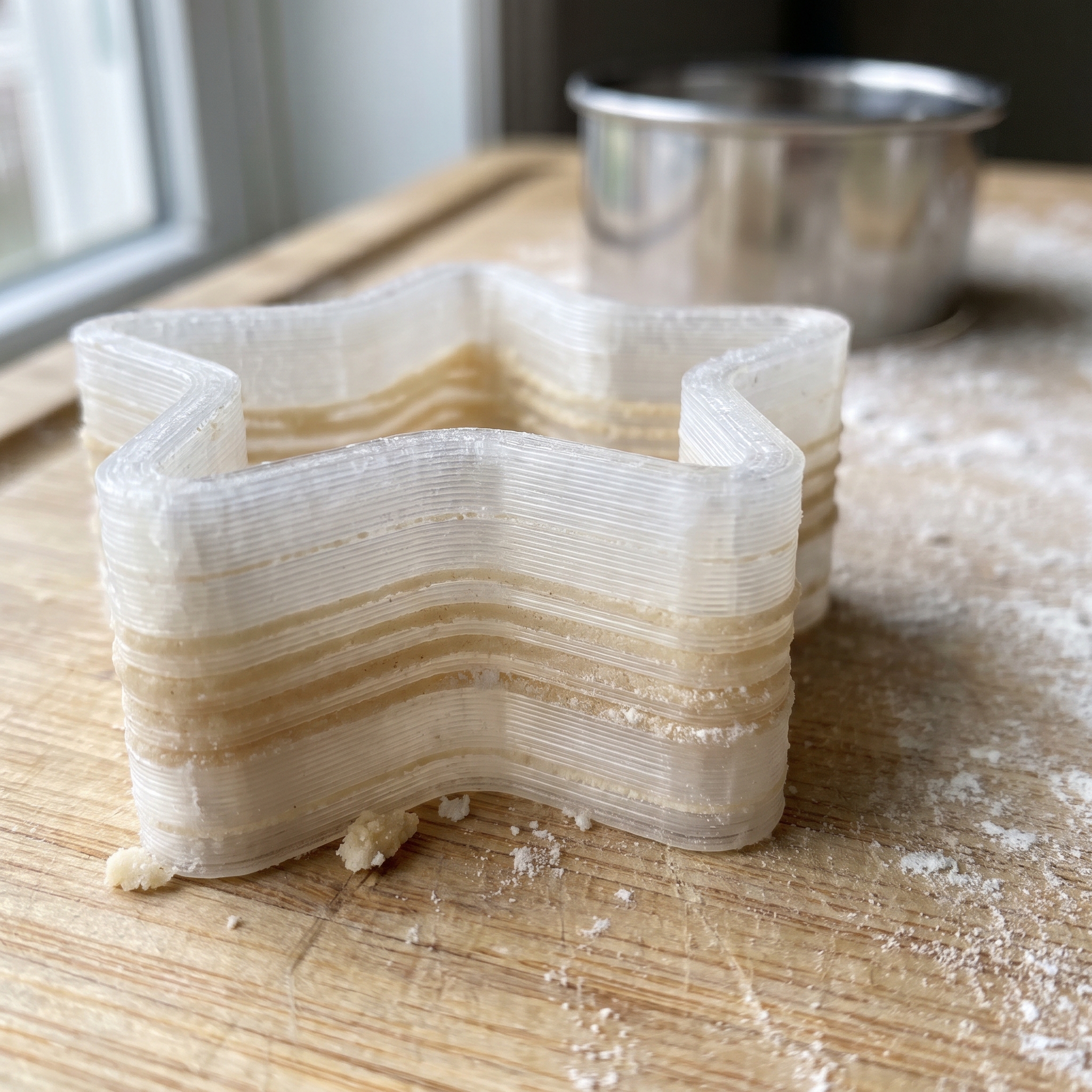
The little data there is points the same way. Hall and colleagues (Frontiers in Microbiology, 2021) found that biofilm formation on printed PLA depends on surface structure and hydrophobicity. In an informal Prusa test with cups of milk over 14 days, the largest colonies grew in an untreated PLA cup and none in an epoxy-coated one. In a 2023 conference paper, researchers at Utah Valley University measured that washing PLA and PETG parts with soap and warm water cut microbes by around 90 %. Washing helps, but 90 % is not sterile, and if the part is used often with wet or fatty food, the survivors grow back.
What does not close the valleys:
- Thinner layers or 100 % infill. They narrow the gaps but do not close them.
- Solvent smoothing. Smoothing PLA or PETG takes hazardous solvents and leaves residues of its own. Smoothing ABS with acetone gives you a smooth surface on a material you should not use with food. More in Vapor and chemical smoothing.
- Boiling it or putting it in the dishwasher. Boiling water is far above PLA's 57 °C HDT, and PETG deforms too. A dishwasher runs at 55–75 °C with an alkaline detergent: in hot alkaline water PLA hydrolyzes, so its surface degrades and loses its gloss even below its HDT.
A dilute bleach soak at room temperature (about 5 ml of household bleach per liter, 5–10 minutes, then a rinse) is compatible with PLA and PETG. But disinfectant does not reach the bottom of a biofilm that has settled in the valleys either: it is no substitute for coating or replacing the part.
Designing and slicing so you can clean it
- The food face on the bed: on a smooth plate it comes out smoother and denser than a wall (The face on the bed). A textured plate imprints its texture on that face. And if you print PETG on smooth PEI with glue stick as a release agent, the glue ends up on the food face: wash it well. If that is not possible, use a top surface with ironing (Top surfaces). Where you can, keep food off walls with layer lines.
- Generous internal radii, 3–5 mm or more, instead of sharp corners. No undercuts, no blind slots, no text or texture on the food side, and never fuzzy skin on that face (Fuzzy skin and textures).
- Close the shell: at least 3 walls and 5 top and bottom layers (1 mm minimum), with flow calibrated so the beads touch. If gaps remain, water wicks into the infill and stays there. See Walls, perimeters and infill and Flow ratio and max flow tests.
- Cut the contact area. A cookie cutter only needs its edge in the dough; a funnel or a scoop for dry pulses barely touches the food, and only briefly.
- The seam on the outside: never inside a cup or on a cutting edge (Where the seam goes).
Coating: when it works and its limits
A coating closes the valleys and becomes the surface that touches the food. It is the normal route for a cup, a bowl or any part that will be wet or reused. It works if four conditions hold, covered in detail in Coatings and epoxy:
- The product declares food-contact compliance when cured, for your market. In the US, a statement of compliance with 21 CFR 175.300. In the EU, a DoC under 1935/2004. On top of that, Regulation (EU) 2024/3190 bans bisphenol A in coatings and its general transition period ended in July 2026: almost no consumer epoxy resin is usable in the EU any more.
- Full cure, as the datasheet specifies.
- A continuous film, with no pinholes or bare edges.
- Use within the limits the product declares.
Cutlery and scourers scratch the film and eventually cut through it. Hot drinks and the dishwasher soften the PLA underneath. Inspect the part and replace it once the film is scratched. A coated part is still no good as a chopping board, in the microwave or for hot soup. Cyanoacrylate, any old varnish, paint or leftover UV resin are not food-contact coatings.
The routes that work
- Brief, dry, room-temperature contact: cookie cutters, dough stamps, a scoop for dry pulses, a funnel. Expect a short life; if it is dough, which contains fat, keep the contact brief.
- Wet, fatty, acidic or daily use: coat it with a declared product, or do not print the face that touches the food.
- Hot or dishwasher: unloaded PP, checking the temperature on your spool's datasheet. For boiling water, a printed part is not the answer.
- Print the mold, not the part: the food-grade platinum silicone, with its own DoC, touches the food and the print never does. Layer lines copy into the mold, so sand or coat the master if you want smooth chocolate. It is the best route for chocolate molds, ice trays and custom shapes.
- Print the part that does not touch the food: stands, organizers, handles, lids that sit outside the rim. Almost everything printed for the kitchen falls here.
- For sale, or for someone vulnerable (babies, hospitals, allergies): buy a molded part or have one made. Selling it obliges you to declare its compliance, and a home process has no migration tests to back that up.
When it fails
| Symptom | Cause | Fix |
|---|---|---|
| The "food-safe" PLA mug smells of sour milk | The DoC covers the filament, not the valleys in the wall | Coat the food face, or do not print it |
| The cookie cutter no longer comes clean | Dough contains fat and works into the layer lines | Hand wash it as soon as you finish, dry it, and replace it when the edge wears or gets scratched |
| The PETG cup warped in the dishwasher or with coffee | 55–75 °C in a dishwasher and 80–90 °C in coffee, at or above its 69–71 °C HDT | Hand wash, and nothing hot |
| The part came out streaked with another color | Traces of another filament without a purge, or a pass through the filament switcher | Purge, a dedicated nozzle and a single color |
| The part was printed with the stock brass nozzle | Free-machining brass contains lead | A stainless nozzle kept for these parts |
| The silicone mold stayed tacky | The master inhibited the platinum silicone's cure: undercured resin, or materials and release agents containing sulfur or tin | A PLA or PETG master, or thoroughly post-cured resin; test on an offcut first |
See also
- Coatings and epoxy: which products work, how they cure and how to apply them.
- Heat, cold, sunlight and chemicals: the heat limits of a part that lives in the kitchen without touching food.
- Nozzles: size and material: the other nozzle materials and what each is for.