
Turn to PPS, PEEK, PEKK or PEI when a loaded part goes above about 180 °C, lives soaked in fuel or solvents, or has to meet a fire standard: a bracket next to a turbo, a jig for a curing oven, an aircraft panel. There the common families give up, PA-CF included, and these four stay stiff. Apart from fiber-filled PPS, none of them prints on a desktop machine: they need a 400–450 °C hotend, a chamber at 90 °C or more and filament that costs hundreds of euros a kilo.
Why they take the heat: stiff chains and crystals
First, the chains of PPS (polyphenylene sulfide), PEEK and PEKK (two polyaryletherketones, the PAEK family) and PEI (polyetherimide, sold as ULTEM). They are built mostly from aromatic rings joined by ether, ketone, sulfide or imide links. These are rigid segments that need a lot of heat before they start sliding past each other, which is why the glass transition (Tg) is high: PPS ≈90–100 °C, PEEK 143 °C, PEKK ≈160 °C and PEI from ≈186 °C (ULTEM 9085) to ≈215 °C (ULTEM 1010).
Second, the crystals. PPS, PEEK and PEKK are semi-crystalline. Above Tg the amorphous fraction softens, but the crystals hold the part's shape until close to the melting point: about 280–285 °C for PPS and 343 °C for PEEK. PEI is amorphous: it has no crystals, so it keeps its stiffness up to Tg and then softens within a few degrees.
What that means in practice: in a semi-crystalline polymer, the heat deflection temperature (HDT) and the useful limit depend on how far the printed part has crystallized. In PEI the limit sits a little below Tg, no matter how the part was cooled.
It is the same idea as annealing PLA (Annealing and strengthening) and nylon's misleading HDT (Nylons and polyamides), one rung higher.
PPS: the one that fits on a desktop machine
PPS is semi-crystalline, with a Tg of ≈90–100 °C and a melting point of ≈280–285 °C. It resists almost every common solvent, fuels, oils, brake fluid and most acids. It absorbs very little water, so it holds its dimensions where nylon swells. It is self-extinguishing: Bambu advertises its PPS-CF as UL 94 V-0 flame retardant. That rating belongs to the material tested at a specific thickness, not to your printed part.
Its weak point is brittleness, above all between layers. Bambu's PPS-CF datasheet gives 87 MPa tensile in XY and 24 MPa in Z: 28 % of XY, and less than PLA Basic's 31 MPa in Z. The matrix crystallizes fast and freezes the interface before the chains can cross it, and the fiber does not bridge layers (the mechanism is in Layer adhesion and anisotropy). For design, assume the part is 30 % as strong in Z as in XY, as with any fiber-filled filament, and orient it so the main load runs along the beads.
On the spool it nearly always comes fiber-filled: PPS-CF or PPS-GF. Unfilled PPS is rare and even more brittle.
| Setting | PPS-CF / GF | PPA-CF / GF |
|---|---|---|
| Nozzle temperature | 310–340 °C | 285–320 °C |
| Bed | 100–120 °C, with glue | 100–120 °C, with glue |
| Chamber | heated | heated |
| Part fan | 0–20 % | 0–20 % |
| Nozzle type | hardened: 0.6 mm first, 0.4 mm later; never 0.2 mm, brass or stainless steel | same |
| Drying | 100–140 °C × 8–12 h, in an oven, mandatory | same |
| HDT (0.45 MPa) | 264 °C | 227 °C |
| Shrinkage along the bead | 0.2–0.4 % | 0.2–0.4 % |
Neither a 65 °C nor an 85 °C dryer is enough for PPS-CF: the oven is part of the process (Drying and storing filament).
You need a machine in the 320–350 °C class. As of late 2026, Bambu approves PPS-CF only on the X1E (320 °C, at the bottom of the range) and the H2 series (350 °C). Other brands advertise hotter hotends; before you buy filament, check your machine's spec sheet for the maximum hotend temperature and whether the chamber is actively heated or only holds heat.
For annealing, Bambu's PPS-CF technical datasheet suggests 180–220 °C for 6–12 h. Treat that as guidance, not a rule. A kitchen oven gets that hot, but it overshoots and fills the place where you cook with plastic fumes: use a dedicated oven that never sees food. The method is in Annealing and strengthening.
Compared with PPA-CF, PPS-CF prints a little hotter and is more brittle, and in return it gains about 40 °C of HDT, chemical resistance and the fire rating. Choose PPS when chemicals, fire or those extra degrees matter, about 30 °C under load. If impact matters, PPA-CF.
PEEK and PEKK: crystallinity decides the part
PEEK has a Tg of 143 °C (onset), melts at 343 °C and, injection molded and unfilled, gives an HDT of 152 °C at 1.8 MPa (Victrex 450G). It is stiff and tough, has excellent wear and fatigue resistance, survives almost every chemical except strong concentrated acids, takes up little water and is flame retardant.
PEEK only crystallizes between its Tg and its melting point. In a chamber below Tg, each bead is quenched as it leaves the nozzle and the part comes out largely amorphous. You can see it, and that is your quick test: it comes out amber and translucent instead of beige and opaque, and it softens toward its Tg, 143 °C, like any amorphous plastic. Crystallized PEEK holds up far better.
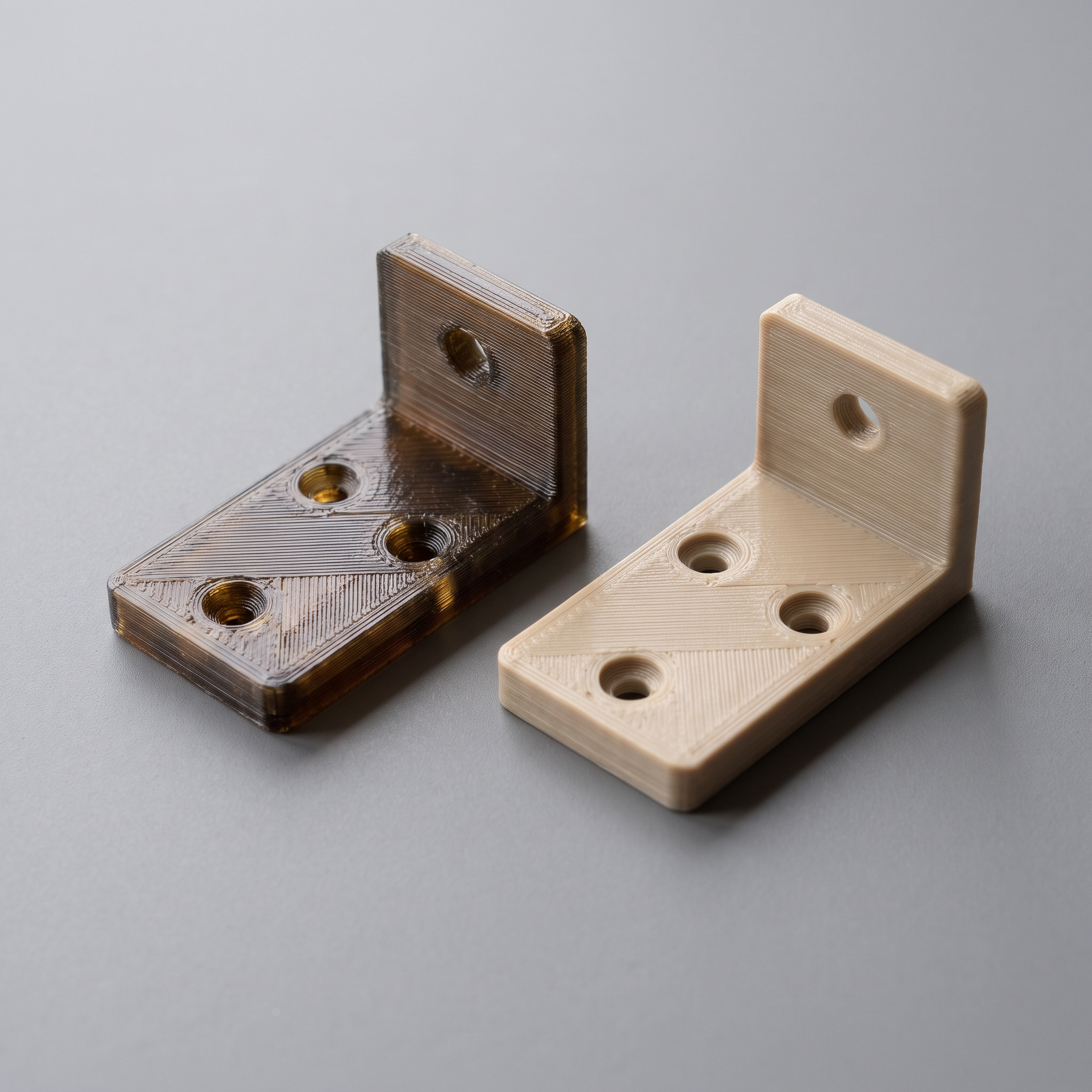
The same PEEK part printed in a cold chamber (left, amorphous) and crystallized (right). If light passes through it when you hold it up, the part has not crystallized.
Be clear about what the chamber actually does. A 90 °C chamber, the minimum for the industrial class, is still 50 °C below Tg: it controls warping and improves Z bonding, but the part still comes out amorphous. Crystallinity comes one of two ways: a chamber near or above Tg (120–140 °C or more, only on large industrial machines) or a later anneal at around 200 °C. Either one brings more shrinkage and more risk of warping.
The chamber also decides layer adhesion. The hotter it is, the smaller the temperature step between the fresh bead and the layer below, and the longer the interface stays above Tg for the chains to cross it. That is why a machine with a 450 °C nozzle and a lukewarm chamber prints PEEK that is weak in Z.
PEKK belongs to the same family: Tg ≈160 °C and a melting point between ≈300 and 360 °C depending on the ratio of terephthalic to isophthalic units. Arkema's Kepstan 6000, the series aimed at printing, melts at around 305 °C and crystallizes slowly. That slowness is its advantage: it prints almost like an amorphous polymer, with less warping and better layer bonding, and annealing gives it the crystallinity afterwards. Stratasys's Antero grades are PEKK-based. Their nozzle temperatures depend on grade and machine: plan on an industrial-class machine, as for PEEK.
PEI: amorphous, flame retardant and dimensionally stable
PEI has no crystallinity to manage. It shrinks less (0.5–0.7 %), gives the most predictable dimensions of the four, is flame retardant and gives off little smoke.
Two Stratasys grades dominate printing. ULTEM 9085 is a PEI/PC blend, tougher, with a Tg of ≈186 °C and an HDT of ≈153 °C at 1.8 MPa according to Stratasys. It meets the aerospace fire, smoke and toxicity standard (FAR 25.853) within Stratasys's certified process. ULTEM 1010 is neat PEI, stiffer, with a Tg of ≈215 °C and an HDT of ≈213 °C at 1.8 MPa; Stratasys advertises food-contact and biocompatibility certifications for the resin. Those certifications belong to the resin within its process, not to your part: a part printed on your machine from the same filament carries none of them, and Printing for food contact explains why.
Mind the name. PEI filament welds itself to a PEI sheet, because it is the same polymer, and when you pull it off it can tear the sheet away. Print it on Kapton or on the adhesive the manufacturer specifies (Bed prep for each material).
It resists chemicals less well than PEEK or PPS: as an amorphous polymer, it is attacked by some chlorinated solvents and strong bases. And grade 1010 is notch-sensitive.
| Setting | PEEK | PEI (ULTEM 9085 / 1010) |
|---|---|---|
| Nozzle temperature | 380–440 °C | 340–390 °C |
| Bed | 120–160 °C | 120–160 °C |
| Chamber | industrial, ≥ 90 °C (120 °C or more to crystallize) | industrial, ≥ 90 °C |
| Part fan | off | off |
| Surface | Kapton or PEI sheet with high-temperature adhesive | Kapton or a dedicated adhesive; never a bare PEI sheet |
| Drying | 120–150 °C × 3–6 h, mandatory | 120–150 °C × 4–6 h, mandatory |
| Shrinkage | 1–1.5 % | 0.5–0.7 % |
| Abrasive | no; fiber-filled grades, yes | no; fiber-filled grades, yes |
The machine they demand
- A high-temperature hotend, 400–450 °C. For the plastic to flow, the nozzle has to sit 40–100 °C above the melt for the semi-crystalline polymers, and 120 °C or more above Tg for amorphous PEI. A stock all-metal hotend at 290–300 °C does not get there, and neither does the 350 °C desktop class. Getting there means changing the heater, the sensor (PT100 or thermocouple) and the heat break, not only the nozzle (Hotends and how much they can melt).
- A chamber at 90 °C or more, up to about 200 °C on large industrial machines. It limits warping and improves layer bonding; PEEK only starts crystallizing during the print above about 120 °C. An H2D's 65 °C chamber falls short even of that minimum (Enclosures and heated chambers).
- Electronics, motors and belts that survive that chamber. The usual answer is to keep them outside the heated zone, and that is what makes these machines expensive.
Benchtop industrial machines include the Intamsys FunMat HT (450 °C hotend, 160 °C bed, 90 °C chamber). Among the large ones are the Stratasys F900 and Fortus 450mc (PEI, PEKK), and makers such as AON3D, 3DGence and miniFactory. Cheaper "PEEK" machines are also sold, with a 420–450 °C nozzle and a 65–70 °C chamber, such as the CreatBot F160 PEEK or the Tractus3D T850P. They melt PEEK, but with more warping and a weaker Z than a 90 °C chamber. On any of them, if the chamber does not go past 90 °C, PEEK comes out amorphous and needs annealing.
Do not convert a home printer to print PEEK. The wiring, the PTFE parts, the belts, the plastic parts and the bed adhesive are not built for those temperatures, and what you are risking is a fire (Fire risk and unattended printing).
Printing at these temperatures needs an enclosure with extraction, for the material's fumes and for the heat the machine throws off (Emissions and ventilation). And the fiber-filled versions of any of the four need a hardened nozzle, like every fiber-filled filament.
Do you really need one?
Go through the list. If your part meets none of these conditions, you do not need them.
- Sustained temperature under load above ≈180 °C. For a fiber-filled semi-crystalline polymer, design 15–20 °C below the HDT at 1.8 MPa, not the one at 0.45 (Heat, cold, sunlight and chemicals): PPA-CF (196 °C at 1.8 MPa) gives you about 180 °C. PPS-CF publishes no 1.8 MPa figure; estimated, it holds about 210 °C under load, and you have to test that hot. Do not take the margin off its 264 °C at 0.45 MPa: at 245 °C it is well above its Tg and about 35 °C from the melt, it flows under sustained load (Creep and fatigue) and in Z you only have 24 MPa. Above about 210 °C, only crystallized PEEK or PEKK, ideally fiber-filled. Not PEI: it softens at its Tg, 186 or 215 °C depending on the grade.
- Fuels, solvents or chemicals that dissolve or swell PA or PC.
- A required fire rating. PEI is the usual choice here.
- Repeated sterilization cycles. Besides these four there are the polysulfones (PPSU, PSU, PESU), amorphous and autoclavable, and also industrial-class.
- A regulated sector (aerospace, medical) that demands certified material and process.
A fiber-filled engineering filament is almost always enough. Under load, counting from the HDT at 1.8 MPa: PA6-CF about 140 °C, PAHT-CF about 150, PET-CF about 165, PPA-CF about 180 and PPS-CF about 210, the first and last estimated (Carbon and glass fiber filaments). Their HDTs at 0.45 MPa, 186 to 264 °C, rank materials but are not for designing under load; and do not compare them with the PEEK or ULTEM figures at 1.8 MPa, which come out lower under the higher load (Reading a material datasheet).
If you really need PEEK, PEKK or PEI, order the part from a service with an industrial machine: FDM in ULTEM or Antero, or SLS with PEKK powder (When to order the part instead). The filament costs hundreds of euros a kilo (Filament comparison table), and the machine comes on top. Ordering a couple of parts costs less than buying a machine you will use twice.
When it fails
| Symptom | Cause | Fix |
|---|---|---|
| Amber, translucent PEEK part that softens far below the datasheet figure | chamber below Tg: amorphous part | chamber at 120 °C or more, or anneal at around 200 °C with a controlled ramp; allow for more shrinkage |
| Layers that split or break in Z | cold chamber or long layer times | hotter chamber; fewer parts per plate to shorten layer time; load along the beads; for PPS-CF, Z at 30 % of XY |
| Corner warping and cracks between layers in PEEK | 1–1.5 % shrinkage with a chamber below 90 °C | industrial chamber, brim, Kapton with high-temperature adhesive |
| PEI part welded to the plate, sheet torn off | printed on a PEI sheet | Kapton or the dedicated adhesive |
| Bubbles, rough surface, weak part | wet filament (all four take up some) | oven drying at the temperature in the table; built-in dryers do not get there |
| PPS-CF part that breaks when dropped | brittle matrix plus fiber | PPA-CF or PA-CF when impact matters; fillets on the corners |
| Hardened nozzle orifice wears wider after printing fiber-filled grades | abrasive fiber | a harder nozzle, tungsten carbide or ruby (Nozzles: size and material) |
How to test it
PPS-CF's 210 °C or so under load is an estimate. Before you rely on it, print a coupon with the part's orientation, profile and anneal, load it the way the part will be loaded and leave it for several hours in an oven at the service temperature. Measure the deflection going in and coming out: if it keeps growing with the hours, lower the working temperature or order the part in PEEK or PEKK. The quick test for PEEK is light: if the part lets light through when you hold it up, it has not crystallized.
See also
- Carbon and glass fiber filaments: PA-CF, PET-CF and PPA-CF, which cover nearly every hot part.
- Heat, cold, sunlight and chemicals: how to get from HDT to the service temperature under load.
- Annealing and strengthening: the method for crystallizing PPS-CF and PEEK after printing.
- When to order the part instead: how to order a part in ULTEM, Antero or sintered PEKK.