
Use TPU for whatever has to give and spring back: feet that do not slip, a bumper, a case, a gasket, a cable grommet. PLA breaks and PETG stays bent; TPU stretches several times its own length and returns. The hard part is printing it: the extruder pushes a soft rod, and a soft rod bends. And "TPU" now covers everything from soft rubber to a semi-rigid 68D, so the number on the label tells you more than the name. How much the part should give is decided in Designing flexible parts.
What TPU is, and what "TPE" means
TPU (thermoplastic polyurethane) is a block copolymer. Its hard segments cluster into small domains that act as physical crosslinks between chains: they fix the shape and pull it back after a stretch. The soft segments, sitting between those domains, are the part that stretches. Heat melts the hard domains, so TPU prints and remelts like any other thermoplastic. As it cools, the domains re-form and the material gets its elasticity back. The higher the hard-segment content, the harder the grade.
TPE (thermoplastic elastomer) is the whole family, and TPU is one member of it. But on a filament label, "TPE" usually means a different chemistry, often a styrenic blend such as SEBS. It is not always softer: there are 60A TPUs and 90A TPEs. It tends to be tackier, less abrasion-resistant and harder to feed. The rule: read the Shore number and the datasheet, not the acronym.
Two figures matter for the finished part. Bambu Lab's TPU 95A exceeds 700 % elongation at break in XY and 500 % in Z, and their TPU 85A keeps 88 % of its XY tensile strength in Z, which almost no other family manages. A soft TPU part rarely fails along its layers. A hard grade can: 68D stretches more than 650 % in XY and only 31 % in Z. Layer adhesion and anisotropy explains why.
In service, TPU handles abrasion, oils and greases well. Heat deflection temperature (HDT, at 0.45 MPa) is meaningless for TPU: at room temperature its soft segments are already above their glass transition, and what holds the shape is the hard domains. The useful question is when those soften and the part starts to sag under load over time (creep). Some datasheets list a Vicat temperature, which is the closest figure. How it copes with UV and hydrolysis depends on whether the formulation is polyester- or polyether-based, and filament datasheets almost never say. For each environment, see Heat, cold, sunlight and chemicals.
Shore hardness: reading the number
A durometer presses a spring-loaded indenter into the material and measures how far it sinks: 0 if it sinks all the way, 100 if it does not sink at all. Shore A uses a blunt tip and a light spring, for soft rubbers. Shore D uses a sharp tip and a stiffer spring, for hard rubbers and semi-rigids. There are two scales because each loses resolution at the end the other covers.
The scales overlap at the top of A and the bottom of D, and there is no exact conversion between them. So 95A and 68D are not neighbors, even though they look it: 68D is far harder. Do not trust A↔D conversion charts or comparisons with everyday objects; none of them is a measurement.
Nor is the scale linear in stiffness. By Gent's empirical relation, going from 85A to 95A makes the material roughly three times stiffer; Gent gives the ratio, not the modulus on a datasheet. Within one brand and one test method, Bambu's datasheets give an XY modulus of 9.2 MPa for TPU 95A and 1190 MPa for TPU for AMS (68D): more than a hundred times stiffer. Across brands, with different methods, moduli are not comparable.
The grades on sale today:
- 95A: the standard. Firm rubber, and the most reliable grade to print.
- 90A and 85A: softer, and harder to feed.
- Below about 80A: ultra-soft TPUs (down to 60–70A), TPEs and foaming TPU. All of them want a direct-drive extruder, a tightly guided path and low speed.
- 64D–68D: "TPU for switchers", a tough semi-rigid.
Start with 95A and get the flexibility from the geometry; drop to a softer grade only when the shape has nothing left to give. The full reasoning lives in Designing flexible parts.
Why it jams: pushing a soft rod
The drive gears push the filament into the melt zone against the nozzle's back-pressure. A stiff rod passes that push along. A soft rod, in the stretch between the gears and the hotend, buckles (bends sideways) as soon as the push exceeds what it can carry. A column's buckling load rises with the material's stiffness and falls with the square of its unsupported length (Euler: proportional to E·I/L²). Halve the unsupported length and the rod carries four times the push. With a soft grade and a long or loose path, the push the rod can take is very low.
In practice it buckles in three places: the gap between the gears and the hotend inlet, any slack in a guide, and the whole length of a Bowden tube. Inside the tube, the filament snakes through the free space, and the extruder has to take up that slack before the nozzle feels any push. The classic jam: the filament escapes through the gap and wraps itself around the gears.
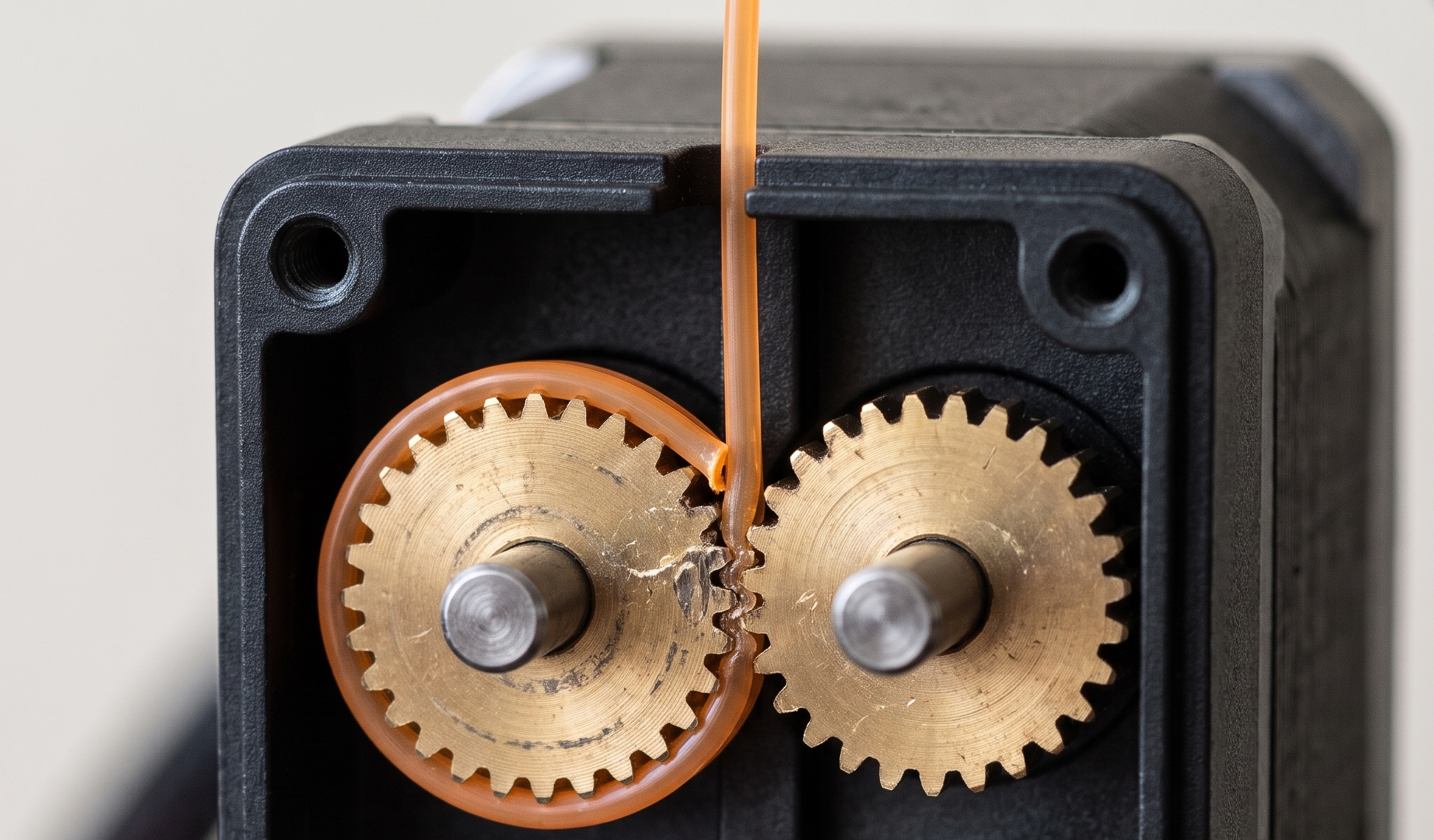
The other half of the problem is speed. Back-pressure rises with it: the more plastic you ask for per second, the harder the nozzle resists and the harder the gears have to push. That is why speed, as much as the extruder, decides whether TPU will print. A 0.6 mm nozzle helps too: at the same flow it offers less back-pressure, and it is the cheapest hardware lever. Sharp teeth under heavy idler pressure crush and bite soft filament; with moderate pressure and dual-gear drive, grip improves. For the hardware, see Extruders: direct drive or Bowden.
Almost every current machine has a direct-drive extruder, from modern bedslingers (A1 or MK4S class) to enclosed CoreXY machines, and on them TPU from 95A down to 85A prints straight off the spool, with no modifications. On a classic Bowden bedslinger (original Ender 3 or V2 class), 95A prints, slowly and with a well-guided path; 85A and anything softer does not.
How to print it
TPU's speed is capped by volumetric flow (Volumetric flow sets the speed):
speed = volumetric flow / (line width × layer height)
As of late 2026, Bambu Lab publishes these maximum flows: 3.6 mm³/s for TPU 95A, 12 mm³/s for TPU 95A HF and 18 mm³/s for TPU for AMS. At 3.6 mm³/s, with a 0.42 mm line and 0.20 mm layers, that works out at about 43 mm/s. With the same line and layer, the HF at 12 mm³/s reaches about 143 mm/s. Rather than touching every speed in the slicer, cap the maximum volumetric flow in the spool's profile and let the slicer slow down wherever it needs to. Softer grades go lower still. Calibrate the cap for each spool with Flow ratio and max flow tests.
Nozzle between 200 and 250 °C; start at 225 °C, which any hotend can reach. Hotter flows better and needs less push, but strings more. Part-cooling fan at 50–100 %. A 0.4 mm brass nozzle is fine; avoid 0.2 mm (Bambu lists TPU for AMS as incompatible with it).
Retracting soft filament is like pulling on a rubber band: first it stretches, then it moves. A long or fast retraction stretches it and, when the extruder pushes again, makes it buckle. As a starting point, use a short, slow retraction of 0.5 to 1 mm on direct drive, or none at all; on Bowden, none. Against stringing, keep travel moves from crossing walls and drop the temperature by 5–10 °C. Temperature towers and retraction tests gives the tuning method, and Stringing and blobs the diagnosis.
Soft filament also compresses inside the path, so extrusion starts and stops late: blobs at the seams and thin starts. Pressure advance fixes that; calibrate it for each spool, and expect higher values than for PLA on the same machine.
Bed between 30 and 45 °C. TPU sticks too well to PEI, especially smooth PEI. Use textured PEI with a thin layer of glue stick, which here acts as a release layer rather than an adhesive, and remove the part cold (Bed prep for each material). In an enclosed printer, open the door for PLA, PVA or TPU once the bed is above about 45 °C (Enclosures and heated chambers); otherwise the filament softens before the nozzle and jams.
Drying is mandatory: 70 to 75 °C for 8 to 18 hours. Wet TPU crackles in the nozzle, strings, and leaves weak, bubbly walls. Print from a dry box. A 65 °C dryer, such as the AMS 2 Pro's, is not enough for TPU; an 85 °C one, such as the AMS HT's, is (Drying and storing filament).
| Grade | Nozzle (°C) | Bed (°C) | Max flow (mm³/s) | Extruder | Switcher-compatible? |
|---|---|---|---|---|---|
| TPU 95A | 200–250 (225) | 30–45 | 3.6 (Bambu) | direct; Bowden slow and guided | no |
| TPU 95A HF | 220–240 (230) | 30–45 | 12 (Bambu) | direct | no |
| TPU 85A–90A | 200–250 (225) | 30–45 | lower than 95A; calibrate it | direct | no |
| TPU for switchers (68D) | 230 (Bambu) | per datasheet | 18 (Bambu) | direct | yes, per the switcher's list |
| Foaming TPU | 190–200 unfoamed; foaming from 220–230 | per datasheet | — | direct | no |
Solid TPUs (85A–95A, HF and switcher grades) shrink 0.5 to 1 %; for foaming TPU and TPE, follow the manufacturer's datasheet.
High-flow TPU and TPU for switchers
High-flow (HF) TPU melts and flows under less pressure at the same temperature. Bambu Lab sells it (TPU 95A HF), and other brands sell it under names like "high speed". Less back-pressure means less push, so the rod carries more flow before it buckles: the same machine pushes about three times the flow, from 3.6 to 12 mm³/s by Bambu's figures. It is still a 95A: it wants direct drive and drying.
TPU for switchers ("TPU for AMS", 68D) tackles the long path from the other end: it stiffens the rod. That is why it is a 68D. It feeds through the AMS and AMS lite and prints at up to 18 mm³/s, but it is stiff and tough, not a rubber: a modulus of around 1190 MPa against 9.2 MPa for 95A, and far less ductile between layers, with 31 % elongation at break in Z against more than 650 % in XY. It suits clips that take knocks, guards and cable chains; it is no good for a soft foot or a gasket. Not every switcher accepts it: check your unit's compatibility list.
Generic soft TPU and TPE should not go through a switcher. The AMS 2 Pro accepts neither generic TPU nor TPE, and a 95A spool in a long PTFE path is the textbook buckling case. Feed them from the external spool holder, straight to the toolhead. On dual-nozzle machines, soft TPU goes in the nozzle with the direct-drive extruder: the X2D's second nozzle is Bowden-fed and does not take TPU. Filament switchers: AMS, MMU, CFS and ACE lists what each one accepts. Rigid and TPU hold mainly by mechanical interlocking; the bond figures per pair are in Functional multi-material parts.
Foaming TPU: one spool, several hardnesses
The filament carries a foaming agent that releases gas above a certain temperature. The bubbles swell the extruded bead, and density and hardness drop. According to colorFabb, its varioShore TPU is 92A unfoamed, at 190–200 °C; it starts foaming around 220–230 °C (the figures vary between its datasheets), grows 1.4 to 1.6 times in volume, and reaches about 55A fully foamed. Other brands sell similar foaming or lightweight TPUs.
The usual mistake: because the bead grows, you have to lower the flow ratio in inverse proportion to the expansion, around 0.6–0.7 for a 1.5× expansion, or the walls come out over-extruded. Foaming also depends on speed, layer time and fan (less fan, more foam), not only on temperature. Print a small tower or plate first and calibrate from it (Test coupons). And hotter is not always softer: CNC Kitchen measured the expansion dropping again at even higher temperatures.
It suits soft grips, padding, insoles and prosthetic liners, with several hardnesses from a single spool. It has limits: a foamed part absorbs moisture more readily and its dimensions are less predictable. Do not use it for gaskets.
Which flexible for which part
- Firm rubber parts (feet, bumpers, cases, wheels, gaskets): 95A or 95A HF.
- Soft grips and wearables: 85A–90A on direct drive, or foaming TPU foamed down to a softer hardness.
- Very soft or grippy parts: ultra-soft TPU or TPE, very slowly and only on direct drive.
- A tough part that flexes and has to go through a switcher: 68D.
- A rigid part with a built-in hinge that bends thousands of times: polypropylene (Living hinges and flexures, Polypropylene). If the whole part can be soft, TPU also survives thousands of flexes.
TPU is not food-safe on its own, because of the gaps between beads, the nozzle and the colorants; Printing for food contact explains what it takes.
When it fails
| Symptom | Cause | Fix |
|---|---|---|
| The extruder clicks and the wall comes out thin and gappy mid-print | The rod has buckled or the gears have slipped | In this order: lower the maximum volumetric flow, remove gaps and unguided bends from the path, ease off the idler pressure and dry the spool |
| Filament wrapped around the gears | It escaped through the gap before the hotend | Guide the filament all the way into the melt zone and drop any long retraction |
| Strings all over the part | Moisture or retraction | Dry the spool, shorten the retraction and drop the temperature by 5–10 °C |
| Jams after a while in an enclosed printer | Heat creep | Open the door or lid |
| The part will not come off the plate, or tears chunks out of the PEI | Missing release layer | Glue stick on textured PEI; remove the part cold |
| A TPU for AMS that will not flex | It is a 68D, a semi-rigid grade | If you need rubber, change grade and feed it from outside the switcher |
See also
- Designing flexible parts: how much the part should give, and how to get the flexibility from the geometry.
- Extruders: direct drive or Bowden: which extruder feeds soft filament, and why.
- Functional multi-material parts: joining TPU and a rigid material in one part.
- Filament comparison table: TPU against the other families.