
A PLA phone mount sits on the dashboard for months until one July afternoon you find it slumped onto the dash. A PC lid cracks around its screws a week after you clean it with isopropyl alcohol. Both were designed correctly for their load and failed because of their environment. A marginal load can be fixed with thicker walls or ribs, but no wall keeps a plastic stiff above its glass transition, or holds off ultraviolet (UV) radiation or a solvent. That is why the environment picks the material before you open the model.
What "softens at 57 °C" means
The figure you see on datasheets is the heat deflection temperature (HDT), nearly always at 0.45 MPa: the temperature at which a bar under a small, constant bending stress deflects by a set distance. It ranks materials, it is not the temperature your part survives, and how the test is run is in Reading a material datasheet.
The structure of the chains explains that ceiling. Amorphous plastics (PLA as it comes off the printer, PETG, ABS, ASA, PC) are glassy below their glass transition temperature (Tg) and rubbery above it. Near Tg their modulus collapses, which is why PLA's HDT at 0.45 and at 1.8 MPa are almost the same: 57 and 54 °C. The load barely changes the temperature at which it gives way. Semi-crystalline plastics (nylon, PP, PEEK, fiber-filled PA and PPA, annealed PLA-HT) keep their crystalline phase rigid above Tg, so their HDT sits well above it and depends more on load: PAHT-CF is rated at 194 and 170 °C (at 0.45 and 1.8 MPa); CoPA, 111 and 70 °C.
Stiffness does not drop off a cliff at the HDT. It falls steadily as you approach it, and creep speeds up with it. A PLA bracket in a 40 °C loft is already softer than the datasheet says, because the datasheet is measured at around 23 °C. Hence the rule, which depends on the structure: under load, design 15–20 °C below the HDT at 0.45 MPa if the plastic is amorphous (PLA, PETG, ABS, ASA, PC), and 15–20 °C below the HDT at 1.8 MPa if it is semi-crystalline, with or without fiber (nylon, PP, PA-CF, PET-CF, PPA-CF, PPS-CF). In a semi-crystalline plastic the 0.45 MPa figure overstates what it holds under sustained load, as CoPA shows. If the sheet gives no 1.8 MPa figure, take 25–30 °C off the 0.45 MPa value, then apply the margin and test it hot. Nylon that has absorbed moisture, which is its normal service state, also has a lower Tg and softens sooner than when dry.
| Material | HDT at 0.45 / 1.8 MPa | Rule | Under load, up to about |
|---|---|---|---|
| PLA | 57 (52–60) / 54 °C | amorphous | 40 °C |
| PETG | 69–71 °C / no figure | amorphous | 50 °C |
| ABS | 87 / 84 °C | amorphous | 70 °C |
| ASA | 100 / 92 °C | amorphous | 80 °C |
| PC | 112–117 °C / no figure | amorphous | 95 °C |
| Annealed PLA-HT | ~105 °C / no figure | semi-crystalline | ~85 °C, light loads only |
| Unfilled nylon (CoPA) | 111 / 70 °C | semi-crystalline | ~50 °C, less when moist |
| Fiber-filled PA, PET or PPA | 194–227 / 170–196 °C | semi-crystalline | 150–180 °C |
Unloaded does not mean safe. A printed part holds residual stresses from cooling layer by layer, stresses frozen into the plastic. Near Tg they relax and the part warps even with nothing pushing on it: the lid of a PLA box left in the car curls, a part left in a hot enclosure bows. And the datasheet bar is dried and conditioned before testing (some sheets call it annealing), so a part fresh off the printer, damp or full of stress, can give way a few degrees below that figure.
A bare "95 °C" on a spool label, without the load and the method, means nothing; sustained heat also oxidizes the plastic and turns it brittle, even if it never reaches its HDT.
How hot the part really gets
What counts is the temperature of the part, not of the air. Sunlight and color add tens of degrees to it.
The car is the best-measured case. A 2018 study in Arizona (Arizona State University and UC San Diego, published in the journal Temperature) left six cars parked in the summer sun. After an hour the cabin air averaged about 47 °C, the steering wheel 53 °C and the dashboard 69 °C; one dashboard reached about 89 °C. In the shade the dashboard stayed at about 48 °C. That is one climate and one fleet, so do not treat it as a limit: it explains why the design rule assumes 70–100 °C on a dashboard in summer. A loaded part there needs a fiber-filled compound: PA-CF, PET-CF or PPA-CF. Unloaded or in the shade, in the console or the glovebox, ASA, PC or annealed PLA-HT will do, and PC wherever it takes knocks. Inside a car, never PLA or PETG. The rear parcel shelf, under the back window, behaves like the dashboard.
Outside the car, color decides. ASTM D4803, written for PVC profiles, estimates up to about 50 °C above ambient for a horizontal black surface with the sun square on it, and about 41 °C for a vertical one. White absorbs around 20 % of visible light; black, around 90 %. For a printed part: a black part on a balcony on a 30 °C day can reach 70–80 °C, beyond PLA and PETG and at the limit of ABS. The same part in white or light gray stays a good deal cooler, so outdoors color is a design decision. A light color has a price: black protects better against UV (you will see that in the sunlight section). For a loaded part in full sun the answer is black ASA, PC or a fiber-filled grade, not a white PLA.
Indoors, the heat comes from whatever sits next to the part. Next to a stepper motor, a power supply, an LED strip driver or a lamp heatsink, behind a television or inside a closed electronics box, 40–65 °C is normal. Inside an enclosed printer, too: machines such as the Bambu H2D actively heat the chamber up to 65 °C. Print parts for a printer enclosure in ABS, ASA or PC, not PLA.
Hot water counts as well. A dishwasher runs at 55–75 °C: it softens PLA (HDT 57 °C) and warps PETG (69–71 °C). Unloaded PP takes it, and ASA and PC take the temperature, but surviving the heat does not make a part food-safe (Printing for food contact). Its alkaline detergent also speeds up the hydrolysis of PLA, PETG and PC. Hot tap water or a freshly made drink poses the same problem on a smaller scale.
When in doubt, measure: stick a thermocouple or a thermometer strip to the part, or use an infrared thermometer (it misreads glossy or metallic surfaces, so aim at a matt area or a piece of tape). Measure on the hottest day the part will have to survive.
| Environment | Typical part temperature | Minimum family under load |
|---|---|---|
| Room or office | 20–30 °C | any |
| Next to a motor, power supply or lamp | 40–65 °C | PETG at the low end of the range; ABS or ASA above it |
| Black part in the sun, outdoors | up to 70–80 °C | ASA (at its limit under load), PC |
| Dashboard or parcel shelf in summer | 70–100 °C | PC unloaded; under load, fiber-filled PA, PET or PPA |
| Dishwasher | 55–75 °C, wet | Unloaded PP; PLA and PETG deform |
| Engine bay or near the exhaust | over 120 °C | fiber-filled PPA or PPS, PEEK, PEI |
In the cold, the part turns brittle
Cold does not soften: it embrittles. To absorb an impact the chains have to move and slide, and that takes time. As the temperature drops they move more slowly, and the same knock the part used to absorb by yielding now opens a crack. Every plastic has a ductile-to-brittle transition band, and notches, thick sections and fast impacts push that band to higher temperatures.
Family by family: PLA is already brittle at room temperature and is the worst in the cold. ABS and ASA keep their toughness better thanks to their rubber phase. PETG holds up reasonably well. PC stays tough below zero when unnotched; with notches and thick walls it turns brittle at higher temperatures. PC-PBT is sold for sub-zero use: its maker says it keeps a good share of its impact strength at −30 °C. PP homopolymer turns brittle around 0 °C, because its Tg sits slightly below that. Dry nylon is brittle; conditioned (with absorbed moisture) it is much tougher, and loses some of that toughness in the cold. TPU stays flexible but stiffens noticeably.
Designing for the cold means designing for impact. Round every inside corner the impact passes through, prefer thin, flexible sections to thick, rigid ones, and make nothing out of PLA that takes knocks in winter: garden, car exterior, bike or ski accessories, freezer boxes. Toughness by family, with numbers, is in Stiffness, strength and toughness.
Temperature swings also bring thermal expansion. Per degree, a plastic expands several times more than steel or aluminum. A plastic part bolted rigidly to a metal one works loose or cracks at the screws as summer turns to winter. Use slotted holes or extra clearance in the through-holes. The dimensional side of the problem is in Shrinkage and dimensional stability.
Outdoors, water and frost split layers. Water that gets into the gaps between beads expands by about 9 % when it freezes, and in a thin-walled part it can open up layers over a winter. Keep it out: more walls, drain holes so water never sits inside, or a sealing coat.
Sunlight degrades the surface
A UV photon carries enough energy to break a bond in the chain. With oxygen present, that chain scission triggers photo-oxidation. The damage concentrates in the outer skin, where the light is absorbed, and progresses through recognizable stages: first the color changes (yellowing or fading), then the surface goes matt and powdery (chalking), and finally a brittle, micro-cracked skin forms. When the part works in bending, those cracks start a fracture that runs through a core that is still sound. Heat and moisture speed it up, and in the sun the part is hot too.
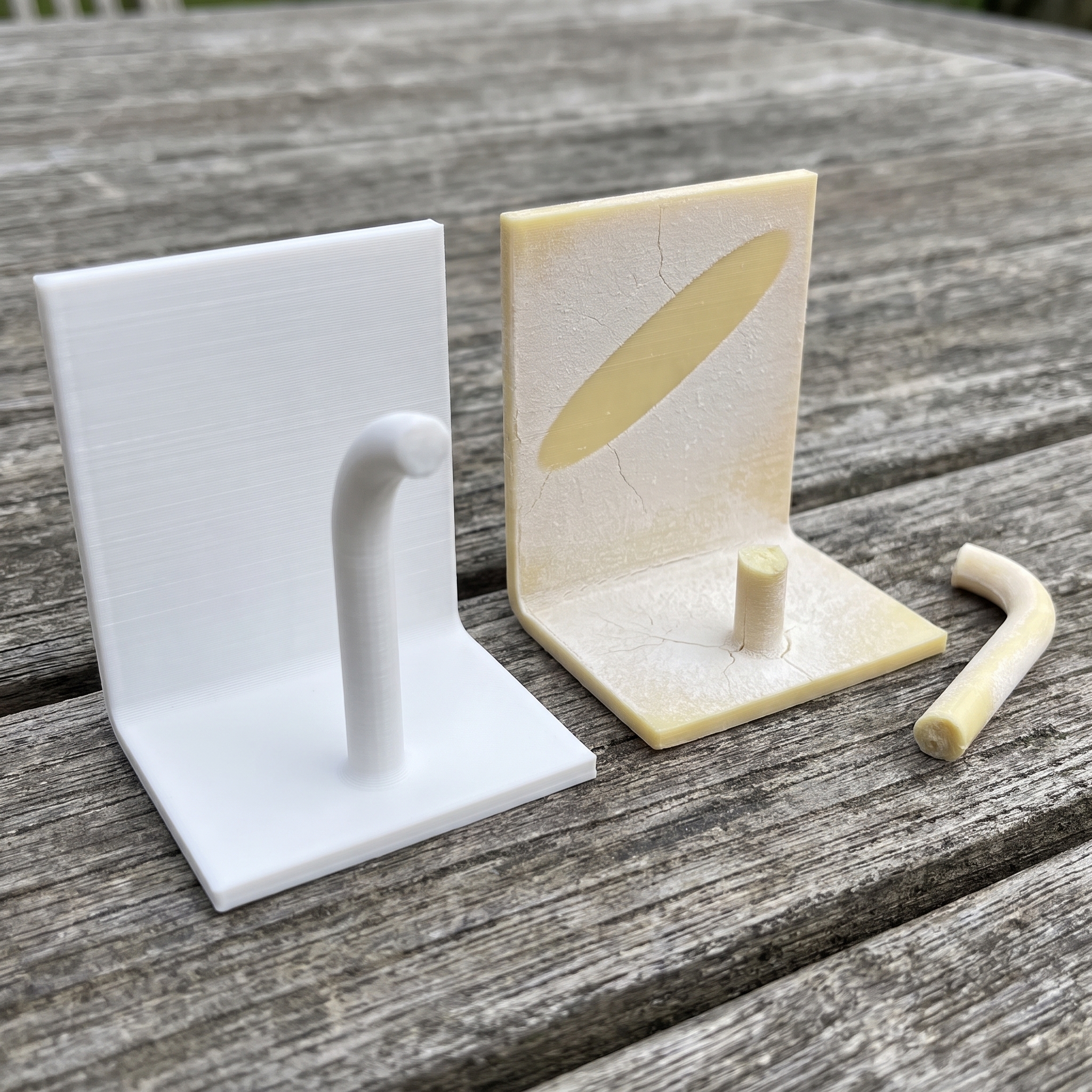
ASA is the weathering material: its acrylic rubber lacks the double bonds UV attacks (the mechanism is drawn in ABS and ASA). ABS yellows and turns brittle within months. PETG lasts anywhere from one season to several. Outdoors, PLA fails from heat and moisture before UV gets to it: a dark part goes past 57 °C in one afternoon. Even so, it turns brittle within a few seasons. Unstabilized PC yellows visibly within months and then loses surface toughness, which is why outdoor PC sheet carries a UV-protective layer. Unstabilized PP chalks and embrittles (Polypropylene), unstabilized nylon degrades too (Nylons and polyamides), and TPU yellows.
Standard SLA and MSLA resins stand up to the sun worse than any common filament (Types of resin).
Amza and co-workers (Polymers, 2021) found that, under sterilizing UV-C, printed PETG loses far more strength than PLA; that is not the sun's wavelength, so it is only a pointer. What the published tests do support is that ASA is the only common filament designed and tested for this.
Protection, from most to least effective:
- A UV-stabilized grade. The datasheet or product page says so explicitly; if it does not, assume it is not.
- Black (carbon black). Carbon black absorbs UV in the first few microns and shields the rest. The trade-off is a hotter part. Other dark colors, such as a blue or gray from organic pigment, do not protect in the same way.
- UV-resistant paint or clear coat. See Painting and priming and Coatings and epoxy; plain epoxy yellows and needs a UV-protective top coat.
- Thicker walls. One or two extra walls on outdoor parts, so the brittle skin is a smaller fraction of the wall.
- Nothing thin working in bending in the sun. Keep snap-fit arms and living hinges in the shade.
Datasheets give at most one qualitative line ("excellent UV resistance"), with no hours and no retained strength, and you cannot design with that. The proof is up to you: leave a coupon outdoors for a summer next to the real part (Test coupons).
Solvents, oils and cleaners
A chemical can damage a printed part in three ways.
Dissolution or swelling
A solvent with a polarity similar to the chain gets in between the chains and pushes them apart. Acetone dissolves ABS and ASA, which is exactly what Vapor and chemical smoothing exploits. Aromatic and chlorinated solvents swell PP; ketones and esters attack PC. The part softens, goes tacky or changes size.
Environmental stress cracking
Environmental stress cracking (ESC) is when a product harmless to an unstressed part cracks the same part when it is under stress, because it plasticizes the chains exactly where tension is pulling them apart. The classic cases: PC with isopropyl alcohol, oils, some cleaners and alkaline detergents; ABS with some oils and greases under stress. Cracks appear around screw bosses, press fits, inserts and the roots of snap fits, often days later. The PC case is in Polycarbonate and its blends.
Hydrolysis
Water breaks the ester and carbonate bonds of polyesters and PC. At room temperature it is slow; hot and humid, it is fast: PLA and, more slowly, PETG in warm, humid environments; PC with prolonged exposure to hot water or steam. The part turns brittle without looking any different.
A printed part is more exposed than a molded one. Liquid gets in through the gaps between beads and along the layer lines, and every layer line is a notch where ESC can start. A well-fused skin with more walls, and a coating, help. But if the part has to hold a solvent or a fuel without leaking, the material comes first and sealing second.
The table is a general guide for brief or occasional contact at room temperature. The oils, acids and alkalis rows for PLA, ABS/ASA and PA come from manufacturer datasheets; the rest from general polymer tables, not filament datasheets. Before you rely on it, check the chemical resistance chart from the maker of your exact product and immerse a coupon.
| Family | Cold water | Hot water | Oils and grease | Petrol, diesel | Alcohols (IPA, ethanol) | Acetone and ketones | Dilute acids and alkalis | Chlorinated and aromatics |
|---|---|---|---|---|---|---|---|---|
| PLA | good | poor (softens, hydrolysis) | good | test it | limited | poor | poor | poor |
| PETG | good | limited | good | test it | good | poor (swells, cracks) | acids good; alkalis limited | poor |
| ABS / ASA | good | limited | limited (ESC under stress) | poor | limited | poor (dissolves) | good | poor |
| PC | good | limited (hydrolysis) | limited (ESC) | poor (ESC) | poor under stress | poor | acids good; alkalis poor | poor |
| PA (nylon) | absorbs water | absorbs water | good | good | limited | good | poor | test it |
| PP | good | good | good | limited (swells) | good | good | good | poor (swells) |
| TPU | good | limited | good | limited | limited | poor (swells) | limited | poor |
Two rows need a caveat. Nylon absorbs water and changes size and stiffness; design for that state (Nylons and polyamides). And if PC has to live with oils or fuels, the blend made for that is PC-PBT. PPS and PEEK resist almost everything; for the engine bay, aggressive solvents or hot fuels, see PPS, PEEK, PEKK and PEI.
You fight ESC through design and process. Avoid permanent stress where the product will act: no press fits and no tight self-tapping screws in PC; use a clearance through-hole with a bolt, washer and nut, or a heat-set insert followed by a stress-relief anneal, because the insert itself leaves stress in the boss. That anneal, below Tg, is in Annealing and strengthening. Clean PC with soap and water, not alcohol. And test the real product on a stressed coupon for a week: a snap-fit arm flexed and held, or a screw tightened into a boss. A loose offcut dropped in the liquid tells you nothing about ESC.
The order to decide in
Before you model, describe the environment in four lines:
- The highest temperature of the part (with sun and color), and whether it is loaded then.
- Hours of sun per year.
- Every chemical it touches, and whether the part is under stress at that spot.
- The lowest temperature, and whether it takes knocks then.
Filter in that order. First rule out by temperature (the HDT rule above), then by sun, then by chemicals and finally by cold, which rules out the least and is nearly always fixed with geometry. Whatever survives goes on to the mechanical choice (Stiffness, strength and toughness, Choosing a filament) and the sustained-load check (Creep and fatigue). The Filament comparison table has the HDT of every family.
Then design for the environment: a light color where heat matters most, black where UV matters most; extra walls outdoors; no stress concentrations where the chemical or the cold impact acts; slotted holes against expansion; drainage.
When it fails
| Symptom | Cause | Fix |
|---|---|---|
| Part sagged or bent in the car or by a window | It went past its HDT (and its Tg) | Higher-HDT material: PC unloaded, fiber-filled grades under load; ASA only in shade. A lighter color |
| Warped with no load in a hot spot | Residual stresses relax near Tg | A material with more margin; a grade that can be annealed |
| Chalky, faded and snaps after a summer outdoors | UV photo-oxidation | ASA or a stabilized black grade; paint or clear coat; more walls |
| Cracks from a knock in winter | Cold embrittlement at a notch | Fillets, thin flexible sections; ABS, ASA, PC-PBT or conditioned nylon instead of PLA |
| Fine fan-shaped cracks around a screw or insert after cleaning | Environmental stress cracking | Remove the stress, change the cleaner; PC-PBT, PP or PA for that product |
| Soft, tacky or swollen after touching a solvent or fuel | Dissolution or swelling | A material rated "good" in that column; check the maker's chart |
| PLA deformed in the dishwasher | Hot water at or above its Tg | PP, or wash by hand |
How to test it
Test where the part will work: a coupon or the real part on the dashboard, on the balcony, in the freezer or immersed in the product, for a realistic period. For heat under load, run the hot test at the service temperature under load: 40 °C for PLA and 50 °C for PETG. For chemicals, use a stressed coupon, not a loose offcut. The method is in Test coupons.
See also
- Creep and fatigue: whether the part carries its load for months at that temperature.
- Reading a material datasheet: how the HDT is measured and what the datasheet leaves out.
- Printing for food contact: what it takes, beyond surviving the heat, for a part to touch food.
- ABS and ASA: the weathering material and why it resists UV.