
A month of printing fills a bag: failed parts, support offcuts, brims, spool ends, empty spools and, if you print in color, purge blobs. The four-color cube in the Bambu Lab wiki's example needs 153 changes and about 83 g of purge at 0.20 mm: about 28 m of filament in the bin for a single model. A gram you do not print never needs recycling. What you do print can only be recycled if you keep it sorted by material, and "bio" on a label tells you where the plastic comes from, not where it goes.
Where the waste comes from
Waste has five sources:
- Failed prints: the whole print, or however much of it got printed, goes in the bin.
- Supports, rafts and brims: plastic printed only to be pulled off.
- Multicolor purge: the blobs from the purge chute and the prime tower.
- Spool ends and tangles: the last meters, too short for a part or knotted on the spool.
- The empty spool and the packaging: the spool itself, the bag, the desiccant and the box.
Which one weighs most depends on how you print. With single-color functional parts, failures and supports dominate. In multicolor, with small parts, the purge can outweigh the part itself: a filament switcher purges 0.2 to 0.8 g per change depending on the color pair, so a part with a hundred changes already wastes tens of grams.
Weigh your waste for a month, sorted by source. That number tells you where to act better than any "typical" percentage.
Throwing away less
Ranked by how much each one saves:
- Fewer failures. A calibrated printer and a dry spool save more plastic than any recycled filament, because a six-hour print that fails in its last hour ends up in the bin whole. Start with What to calibrate, and in what order and Drying and storing filament. If a large part depends on a doubtful clearance, test it first with a few grams (Test coupons).
- Fewer supports, from design and orientation. A chamfer instead of a flat ceiling removes the support at the design stage (Designing out supports), and a good resting face reduces it.
- Fewer grams in the part. Walls and infill sized to the load, not to habit: Walls, perimeters and infill and Lightweighting.
- Less purge. Cut down, in the model itself, the layers that carry more than one color (Designing for multicolor), use thicker layers, print several copies per plate, and purge into the infill, into the supports or into an object you can use: Purge and multicolor waste.
- Brim only where it is needed (Brims, rafts and mouse ears).
- Use up spool ends. The last 20–50 g are enough for small parts, and a switcher with automatic refill moves on to another spool of the same material.
A toolchanger purges milligrams per change instead of tenths of a gram, but it only pays off if most of your layers carry several colors (Toolchangers, IDEX and dual nozzles).
Energy matters less than you might think: a 6 h PLA print at an average of about 110 W uses 0.66 kWh. Drying and heated chambers add a little more, but on a home printer the plastic and the failures cost you more than the electricity.
Bio-based is not the same as biodegradable
These are two independent questions. One is where the plastic's carbon comes from: oil or plants. The other is what happens when you throw it away: whether it persists or microorganisms break it down, and under what conditions. There are materials in all four combinations.
PLA is made by fermenting plant sugars, but it only composts in an industrial plant. The EN 13432 standard requires at least 90 % of it to turn into CO₂ within six months in a controlled composting test at about 58 °C, which are the conditions of an industrial plant: hot (55–70 °C) and moist. The reason: before microorganisms can digest it, water has to cut its chains (hydrolysis), and that only happens quickly above its glass transition temperature, about 55–60 °C. A home composter does not hold that temperature for long, and soil, the sea or a drawer come nowhere near it: there, PLA lasts for years. On top of that, many composting plants reject printed parts because they cannot tell them apart from conventional plastic.
Pure PHA and some PHA-rich blends are the only filaments with grades certified for home composting, such as TÜV's "OK compost HOME" mark. Ordinary PLA/PHA blends are mostly PLA and behave like it. Check the certificate number for that specific product: a label that says "compostable" with no standard and no conditions guarantees nothing. PHA is softer, prints more slowly and has a narrower temperature window.
The other two quadrants exist too. Bio-PE is made from sugar cane; commercial bio-PET only partly so (around 30 % of its carbon is plant-based). Both behave like their fossil equivalents: they do not break down. PBAT and PCL come from oil and do biodegrade.
Filler does not change the base plastic: a PLA with wood, cork, algae or coffee is still PLA (Decorative filaments). The same goes for pigments from organic waste, such as Prusament's rPLA ranges colored with algae, maize or risotto and made from recycled PLA bought in from an outside supplier: they change the color, not the end of life, and Prusa warns that they come out somewhat more brittle and absorb more moisture than its PLA.
Biodegradable is no license to throw a plastic into a field. You want a functional part to last: choose the plastic for its job and, when you throw it away, sort it.
Recycling what you print
Council recycling almost never works for printed parts. A printed part is not packaging, so in Spain it does not go in the yellow packaging bin, and the same logic applies to packaging collections elsewhere: depending on your council, it goes in general waste or to the household recycling center. PLA, PETG and ABS carry resin code 7 ("other") or none at all. Sorting plants separate plastics by near-infrared and by shape, and small, dark or mixed-material pieces end up as rejects. PP (code 5) is the only common filament the industry recycles in volume, and only if it arrives sorted; even so, a printed PP part is not packaging either and does not go in the packaging bin (Polypropylene).
Mechanical recycling needs a single polymer. PLA and PETG do not mix or bond to each other: a filament made from incompatible plastics comes out weak and brittle. And a scrap of PETG in a PLA regrind can clog the nozzle, because at PLA temperature PETG barely flows and leaves unmelted lumps.
On top of that, every melt degrades the plastic. Heat and moisture cut the chains, above all in PLA and PETG, which hydrolyze; heat alone, with oxygen from the air, cuts them as well. With each cycle the molecular weight drops: the melt runs more freely and the part comes out more brittle. Drying the regrind before extruding it reduces the loss but does not prevent it. That is why recycled filament is made from clean first-generation offcuts, or blended with virgin material.
The habit that makes everything else possible is sorting:
- One container per material: PLA, PETG and others.
- Purge kept apart, and sorted by material too.
- Soluble supports (PVA, BVOH) never go in the regrind: they dissolve in water (Support materials).
- Remove labels, metal inserts and magnets.
Sorting by color is optional; sorting by material is not.
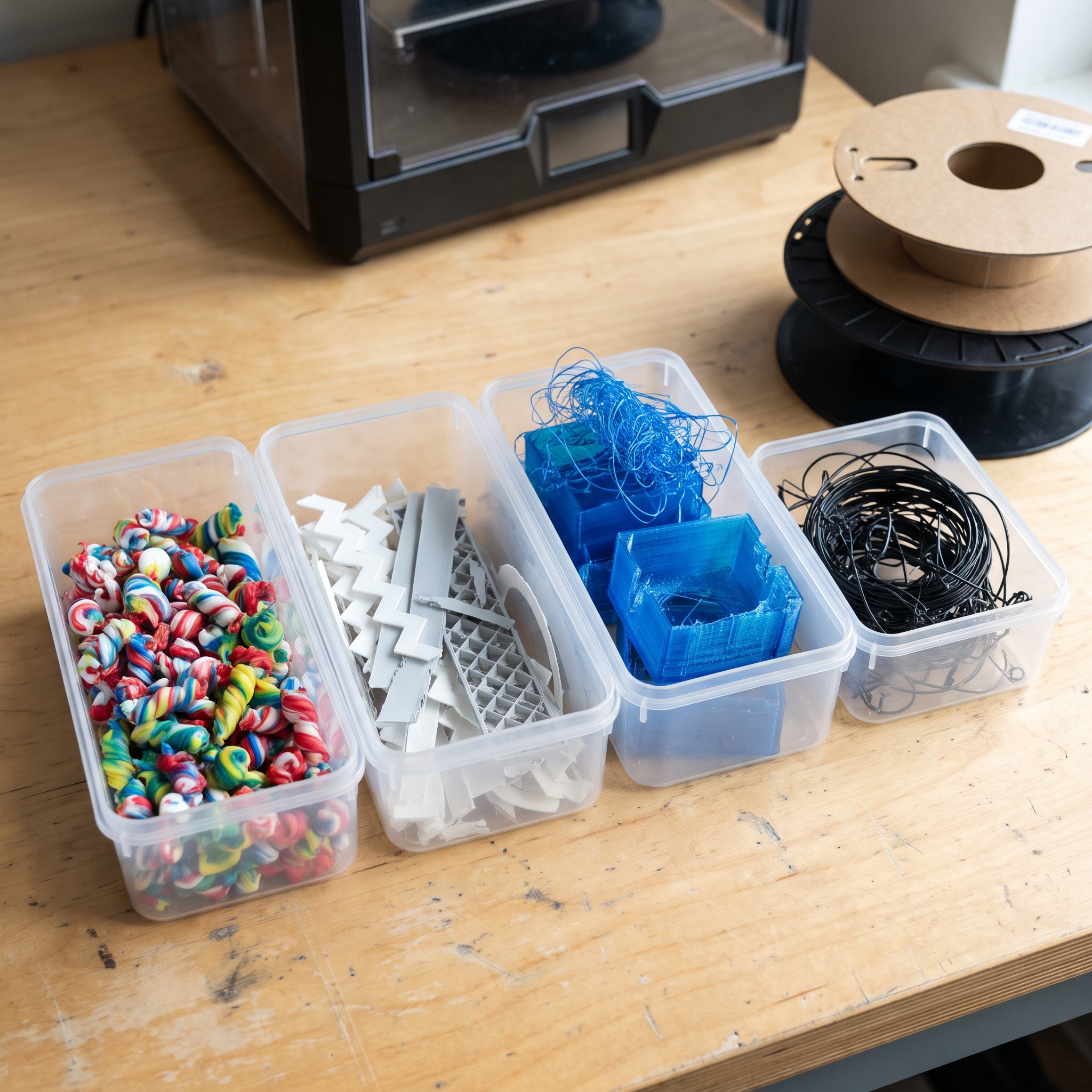
Where does the sorted waste go? To a take-back scheme where there is one. For example, Filamentive in the UK has, since April 2024 and together with 3D Printing Waste, collected PLA from customers who meet its conditions, and only that material. Otherwise, to a makerspace or school with a shredder. Or reuse it as it is: purge blobs make good ballast or test pieces. If you have no outlet at all, general waste is the right answer. Putting plastic in the wrong bin on the off chance lowers the quality of what does get recycled and ends up rejected at the plant.
Empty plastic spools can take refill (spool-less) filament, or go back to the brand if it takes them. Cardboard ones go in paper and card recycling; their problems in switchers are covered in What comes on a spool of filament.
If you also print in resin, its waste is a different case. Uncured resin and the washing alcohol are hazardous waste: cure the leftovers and the liquid in the sun or in a curing station before you throw them away, never pour them down the drain, and take whatever will not cure to the household recycling center. Cured parts and supports are thermosets, cannot be recycled and go in general waste. The details are in Handling resin safely.
Recycled filament
Reliable recycled filament comes from post-industrial waste: clean offcuts of a single material and known origin. As of late 2026, Prusament PETG Recycled and PLA Recycled are made 100 % from Prusament offcuts of the same polymer with no added pigment, so each batch comes out a different color. According to Prusa's own life-cycle assessment, its recycled PLA has a carbon footprint 57 % lower than virgin pellets; the figure is the manufacturer's. Recreus makes Reciflex, a TPU made from footwear-industry offcuts and its own production scrap. Fillamentum sells rePETG Loopfill, PETG recovered from medical-device manufacturing.
When the source is clean, it prints like the base polymer. The diameter tolerance can be wider: Prusa states ±0.05 mm for its PETG Recycled against ±0.02 mm for standard Prusament, so calibrate the flow on every spool. And since the color changes from batch to batch, buy all the filament a job will need in one go.
Much of what is sold as "rPET" is recycled PETG and prints like PETG; check the datasheet (PETG, PCTG and other copolyesters). Post-consumer filament (from PET bottles, for example) exists, but it carries more moisture and impurities and varies more from batch to batch: treat it as an experiment.
Reading an "eco" label
| What it says | What to ask | What it means |
|---|---|---|
| Recycled | What percentage? Post-industrial or post-consumer? | Single-material post-industrial is the most reliable |
| Compostable | Which standard and which certificate number? | EN 13432 or ASTM D6400: industrial composting. OK compost HOME, AS 5810 or NF T51-800: home |
| Biodegradable (on its own) | Under what conditions and how long? | Without conditions it says nothing |
| Bio-based | What share of the carbon is plant-based? | It speaks of origin, not end of life |
| Reduced carbon footprint | Who did the assessment and what does it cover? | "Cradle to gate" stops at the factory gate: it does not count use or disposal |
Making filament at home
The chain has five steps: shred, dry the flakes, extrude with a single-screw extruder with diameter control, cool, and spool. The hard part is the diameter. Your extruder pushes length, not volume: a 1.80 mm filament instead of 1.75 mm carries (1.80/1.75)² ≈ 1.058, almost 6 % more plastic per millimeter, and the part comes out over-extruded.
There are three tiers today. Lab-grade desktop lines, such as 3devo's shredder and Filament Maker, carry five-figure prices. Hobby extruders, such as Filabot or Felfil, cost less and ask for more patience. And there are open projects such as Polyformer, which turns PET bottles into 1.75 mm filament. Creality launched its Filament Maker M1 with the Shredder R1 through crowdfunding in 2026; check whether it is shipping before you count on it.
Mixed purge gives filament of no particular color and sometimes of several materials. Diameter and moisture control decide whether that filament will feed through a switcher. And the machine's cost and energy only pay back with a lot of volume. It makes sense in a school, a makerspace or a print farm with sorted single-material offcuts. At home, sorting and finding a take-back scheme usually pays off more.
Printers that melt pellets directly skip the filament step, but they are a different class of machine.
When it fails
| Symptom | Cause | Fix |
|---|---|---|
| PLA sits intact in the home composter | Below 55–60 °C it does not hydrolyze and lasts for years | Sort it like any other plastic |
| Nobody will take the waste | Everything in one bag: once mixed, it is no use to anyone | One container per material from day one |
| Regrind filament comes out brittle or clogs | PETG purge in the PLA regrind | Purge sorted by material, and purge that mixes materials apart |
| Recycled filament gives uneven parts | Its diameter varies more than virgin filament's | Calibrate the flow on every spool and dry it |
| Home-made filament comes out weak | Regrind not dried: moisture cuts chains in the extruder | Dry the flakes before you melt them |
| Printed parts get rejected at the plant | They are not packaging and do not go in the packaging bin | General waste, the recycling center or a dedicated take-back scheme |
See also
- Purge and multicolor waste: tuning the purge, the largest source of waste if you print in color.
- What a printed part costs: what each gram, failure and kilowatt-hour costs you.
- What to calibrate, and in what order: the calibration that prevents most failures.
- Designing out supports: removing support in the model.