
You are about to load a spool for a part that has to work. The filament decides what temperature it survives, how it takes a knock, whether it can flex, how far it drifts from the model's dimensions and which machine can print it. Start from what would make this part fail, not from what is on the shelf or what is fashionable. The failure picks the property, the property picks the family, and your machine rules out the ones it cannot print.
What would make the part fail
It is almost always one of these six, and each one is decided by a different property.
- Heat. A phone mount on the dashboard, a part next to a motor or a lamp. What matters is the heat deflection temperature (HDT), plus creep if the load is permanent. PLA is fine indoors, up to about 40 °C under load; PETG reaches about 50 °C. Above that, ASA, PC or fiber-filled composites. The numbers are below.
- Impact. A tool handle, a bumper, a housing that will end up on the floor. Toughness decides it (the energy a material absorbs before it breaks, and how far it stretches), not tensile strength. PLA is stiff but brittle; PETG copes better; PCTG, PC and nylon are the tough ones, and TPU does not break from a knock. On datasheets PCTG looks a good deal tougher than PETG, but those figures come from test bars: read them as a trend, because a printed part falls short of them. Stiffness, strength and toughness explains why.
- Repeated bending. Snap fits, clips, living hinges. Allowable strain and fatigue are what count. For a snap that is assembled once, PLA takes 2 %, PETG 3–4 %, conditioned nylon 6 % and PP 8–10 %. For a hinge that opens thousands of times, PP; nylon if a few hundred cycles will do. For a part that must bend and fully recover its shape, TPU. The design is in Print-friendly snap fits and Living hinges and flexures.
- Sunlight and weather. What matters is resistance to UV and moisture. ASA exists for this; ABS, on the other hand, yellows and turns brittle in the sun. PETG holds up reasonably well. PLA in the sun softens and warps, because a dark part goes past 57 °C on a summer afternoon; over time it also turns brittle.
- Chemicals. Petrol, oil, solvents, cleaning products, water. Resistance to that particular product decides it. PP and nylon resist oils and fuels; PETG resists many cleaners and dilute acids; ABS dissolves in acetone (which is why it can be vapor-smoothed); PC stress-cracks with some solvents and is attacked by alkaline detergents. Water counts too: nylon absorbs it, loses stiffness and changes size, and PLA softens in hot water and in the dishwasher. Always check the datasheet against your specific product. The detail is in Heat, cold, sunlight and chemicals.
- Looks. Display pieces, prototypes, jigs, organizers. Finish, color range, accuracy and print time count. PLA wins, with its matt, silk and decorative variants: nothing else comes out as clean or as predictable.
There is a seventh failure that gives no warning: sustained load, as in a shelf bracket or a clamp that must keep gripping. At room temperature, PLA holds a light sustained load about as well as PETG: no reliable data on printed parts says which creeps more. PETG only wins when the part gets warm. For a sustained load, use PC or ASA, or a fiber-filled filament if the part is not a spring (Creep and fatigue). Unfilled nylon gives way more than either, especially when moist.
When a part has two failure modes, filter by the stricter one first and check the family also survives the other. Heat and impact in a car's console or glovebox, in the shade, means PC: PCTG cannot take the heat and ASA is less tough. On top of the dashboard and under load, even PC is not enough.
The family map
The families, grouped by what they demand of the machine, which is the second filter. The full comparison, column by column, is in Filament comparison table.
Open printer
- PLA: nozzle at 215 °C and an HDT of 57 °C. The easiest to print. It comes in matt, silk, high-speed, PLA-HT and "PLA+" variants; the last one is not standardized and every brand uses the name for something different, so test it before you trust it. In PLA and its variants.
- PETG, PETG-HF and PCTG: PETG has an HDT of 69–71 °C. Tougher and more chemical-resistant than PLA; they string more and stick too hard to smooth PEI. In PETG, PCTG and other copolyesters.
- TPU (95A down to 85A): flexible and nearly unbreakable. It needs drying; the softer grades want a direct-drive extruder and slow printing. Watch out: Bambu's "TPU for AMS" is a much harder grade, 68D. In TPU and flexible filaments.
- PLA-CF and PETG-CF: they print on an open machine, but the fiber needs a hardened nozzle. In Carbon and glass fiber filaments.
Enclosed
- ABS (HDT 87 °C) and ASA (HDT 100 °C, UV-stable): on an open printer they lift at the corners and delaminate; they also give off styrene. In ABS and ASA.
- PC (HDT 112–117 °C) and PC-ABS: the toughest of the common rigid materials. Nozzle at 260–290 °C and drying is mandatory. In Polycarbonate and its blends.
- Unfilled nylon (PA6 or PA12) (HDT 90–130 °C): tough, low-friction and more flexible than stiff. It shrinks 1–2 % and absorbs moisture within hours. In Nylons and polyamides.
- PP: light, chemically inert, the living-hinge material. It shrinks 1.5–2.5 % and is fussy about the bed. In Polypropylene.
Enclosure required, heated chamber recommended and hardened nozzle
- High-temperature fiber composites: PA-CF and PAHT-CF (HDT 186–194 °C), PET-CF (205 °C), PPA-CF (227 °C) and PPS-CF (264 °C, nozzle at 310–340 °C). Stiff and stable along the bead (0.2–0.5 % shrinkage), but weak between layers: count on Z holding about 30 % of its XY value. The stiffness comes from the fiber, not from an "engineering plastic" label: PC and unfilled nylon are tough but not especially stiff. In Carbon and glass fiber filaments.
Industrial equipment (400–500 °C hotend, chamber at 90 °C or more)
- PEEK, PEKK and PEI (ULTEM): as of late 2026 they are still beyond consumer printers and need an industrial-class machine. If your part needs them, you would normally have it made by a service. In PPS, PEEK, PEKK and PEI and When to order the part instead.
Specialty
- Decorative (wood, marble, glitter, glow-in-the-dark; several are abrasive): Decorative filaments.
- Functional (ESD, conductive, magnetic, LW-PLA, PVB): Functional specialty filaments.
- Soluble and breakaway supports (PVA, BVOH, HIPS): Support materials.
- Bound metal for sintering: Metal filaments and sintering.
Heat: the service temperature under load
HDT is a short test on a bar at a fixed stress: it ranks materials, but it is not the temperature a loaded part survives. Under load, design 15–20 °C below the HDT at 0.45 MPa if the plastic is amorphous (PLA, PETG, ABS, ASA, PC), and 15–20 °C below the HDT at 1.8 MPa if it is semi-crystalline, with or without fiber (nylon, PP, PA-CF, PET-CF, PPA-CF, PPS-CF). Why there are two rules is in Heat, cold, sunlight and chemicals.
| Family | HDT at 0.45 MPa | Service under load (approx.) |
|---|---|---|
| PLA | 57 °C (52–60) | 40 °C; a sustained load only below about 30 °C |
| Annealed PLA-HT | about 105 °C | about 85 °C, light loads only |
| PETG / PETG-HF | 69–71 °C | 50 °C |
| ABS | 87 °C | 70 °C |
| ASA | 100 °C | 80 °C |
| PC | 112–117 °C | 95 °C |
| Unfilled PA | 90–130 °C | about 50 °C, lower when moist |
| PA6-CF / PAHT-CF | 186 / 194 °C | about 140 / 150 °C |
| PET-CF | 205 °C | about 165 °C |
| PPA-CF | 227 °C | about 180 °C |
| PPS-CF | 264 °C | about 210 °C; test it hot |
In semi-crystalline plastics the HDT at 0.45 MPa misleads: unfilled nylon passes 100 °C on it and under load does no better than ABS. Bambu's own guide advises against PLA anywhere that hovers around 50 °C.
The car is where most parts fail. In summer, a car's dashboard in the sun reaches 70–100 °C. A loaded part there needs a fiber-filled compound: PA-CF, PET-CF or PPA-CF. Unloaded or in the shade, in the console or the glovebox, ASA, PC or annealed PLA-HT will do, and PC wherever it takes knocks. Inside a car, never PLA or PETG.
PLA-HT is the exception within the PLA family: an HDT of about 70 °C as printed and about 105 °C once annealed. The price is that annealing shrinks it in XY (Polymaker quotes 0.3–0.6 % for its HT-PLA Pro and HT-PLA-GF; measure yours on a coupon) and usually makes it grow a little in Z, which you have to allow for in the design. Annealing and strengthening explains how.
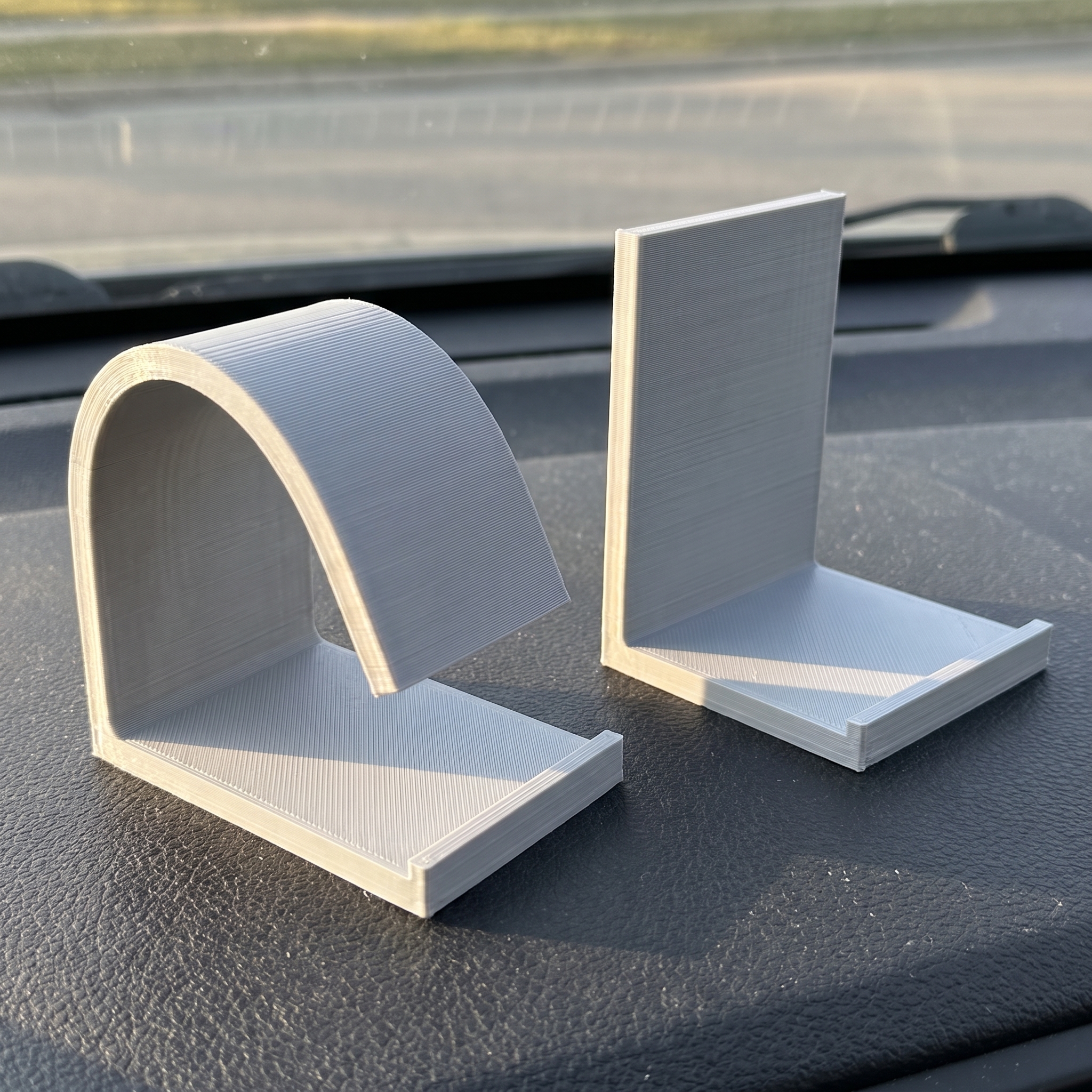
The same stand after an afternoon in the sun on the dashboard, carrying almost no load. The PLA one (left) has gone past its HDT: it has softened and its own weight has bent it down. The ASA one (right) is still straight. No cracks, no scorch marks: the plastic does not break, it deforms and stays that way once it cools.
Second filter: your machine
Every limit of your printer has a physical cause.
- Enclosure. ABS, ASA, PC, nylon and PP shrink 0.5–2.5 % as they cool. Each new layer shrinks onto one that is already cold and rigid; if a draft cools the part below its glass transition (or, in PP and nylon, while it crystallizes), the stress builds layer by layer, lifts the corners and splits the layers. The minimum is a passive enclosure; for large parts and nylon or PC composites, a heated chamber at 50–65 °C. The enclosure can also get in the way: with PLA, PVA and TPU, open the door or the lid once the bed goes past about 45 °C, and with PETG once it goes past about 70 °C. Otherwise heat climbs the heatsink and clogs the hotend (heat creep). In Enclosures and heated chambers.
- Hotend temperature. On current machines the stock hotend reaches 290–300 °C: enough for PC, nylon and PA-CF. PPA-CF wants 285–320 °C and PPS-CF 310–340 °C, which means a hotend that reaches 320–350 °C, like the one on the Bambu X1E or the H2D. A hotend with a PTFE liner down to the nozzle runs at 240 °C at most: it suits PLA and TPU, and PETG only at the bottom of its range, 230–240 °C.
- Nozzle. Anything with carbon or glass fiber, glow-in-the-dark filler, marble or similar needs a hardened steel nozzle or something harder. A 0.4 mm brass one visibly widens after a few hundred grams and throws your calibration off without you noticing. With abrasive fillers use a hardened nozzle, preferably 0.6 (Nozzles: size and material).
- Drying. PC, nylon, TPU, PVA and every fiber composite must be dried before printing. A 65 °C built-in dryer, like the AMS 2 Pro's, is not enough for ABS, ASA, PC or nylon; an 85 °C one, like the AMS HT, is. PPA-CF and PPS-CF need an oven (Drying and storing filament).
- Bed surface. PETG sticks to smooth PEI so hard it can tear it off: use textured PEI or a layer of glue stick as a release agent. PP only sticks to a PP sheet or packing tape. Nylon wants glue or garolite. In Bed prep for each material.
- Where you print. ABS and ASA give off styrene, nylon gives off caprolactam, and PC fumes are not something to breathe either. Print them in an enclosure with a HEPA and activated-carbon filter, or with extraction to the outside; never in a bedroom. In Emissions and ventilation.
- Food. No family is food-safe straight off the printer; Printing for food contact explains why.
Change the material, change the settings
Each family shrinks differently and flows a little differently, so a clearance tuned in PLA can come out tight or loose in another material.
| Family | Linear shrinkage |
|---|---|
| PLA | 0.2–0.5 % |
| PETG | 0.3–0.5 % |
| ABS | 0.5–0.8 % |
| Unfilled PA | 1–2 % |
| PP | 1.5–2.5 % |
| Fiber composites | 0.2–0.5 % along the bead, more across it |
What breaks the fit is the difference between families. In a 20 mm hole, going from PLA (0.3 %) to nylon (1.5 %) changes the diameter by about 0.24 mm, 0.12 mm per side: nearly all the clearance of a sliding fit (0.15–0.20 mm per side on a modern machine). When you change family, print the clearance coupon again; if you only change brand within the same family, checking it is usually enough. The coupon is in Test coupons, the physics in Shrinkage and dimensional stability and the recalibration in When your numbers drift.
When it fails
| Symptom | Cause | Fix |
|---|---|---|
| The car mount has sagged after a day in the sun | PLA or PETG above its service temperature | Loaded in the sun, PA-CF, PET-CF or PPA-CF; unloaded or in the shade, ASA or PC |
| ABS or ASA part with a crack between layers or lifted corners | Printed without an enclosure or in a draft | Enclosure, door shut and a brim; see Warping and lifting corners |
| With fiber filament, the first parts come out fine, then walls and holes drift off size | Brass nozzle worn by the fiber: the bead comes out wider | Switch to a hardened nozzle and recalibrate the flow |
| Nylon or TPU crackles, strings and comes out weak and rough | Wet: from the factory or after a few days out of a dry box | Dry it before use and print from a dry box |
| You picked the highest tensile strength on the datasheet and the part snapped | Tensile strength is not toughness, and in Z a part holds about half what it holds in XY (with fiber, 30 %) | Choose by failure mode and run the load along the bead; see Layer adhesion and anisotropy |
| A snap fit that worked in PLA comes out loose or tight in PETG | Different shrinkage and flow | Print the clearance coupon again |
| Hours of tuning, enclosure and drying to print a desk part in PC or PA-CF | More material than the part needs | Choose the cheapest family that survives the failure mode |
How to test it
Test walls, overhangs and fits in PLA first: it is the most predictable material, and if something fails, the problem is in the model, not the filament. Then print the clearance coupon in the final material and adjust the fits, because clearances do not carry over from one family to another. If the part will work warm, load it as in use and leave it for a few hours at its service temperature under load, the one in the table above; if it has moved or marked, go up a family.
See also
- What comes on a spool of filament: diameters, tolerances and tags on what you buy.
- Filament comparison table: every family, column by column.
- Heat, cold, sunlight and chemicals: why a loaded part works below its HDT, and how sun and chemicals attack it.
- Creep and fatigue: what happens to a part under a load that is never removed.