
An anti-static tray for circuit boards, a touch button printed inside the part, a fridge label, a glider wing of a few grams or a clear, glossy part without sanding: no ordinary filament does those jobs, and five specialty families claim they can. Almost all are a familiar polymer with a filler, such as carbon or iron, or a foaming agent; PVB is a different polymer that dissolves in alcohol. The function costs strength, layer adhesion or nozzle life, and it only works with the number on the datasheet and a print made to match it.
ESD: plastic that lets static leak away slowly
PLA and PETG are insulators. When they rub against something (another tray, a glove) they pick up charge, and the charge stays put until it jumps to the first chip pin it finds. A discharge you do not even feel can damage a sensitive component.
ESD stands for electrostatic discharge, and on a filament it means dissipative. The bands come from the packaging standard ANSI/ESD S541 (equivalent to IEC 61340-5-3), and surface resistance is measured to ANSI/ESD S11.11:
| Class | Surface resistance | What it does with the charge |
|---|---|---|
| Conductive | < 10⁴ Ω | dumps it at once |
| Dissipative (ESD) | 10⁴ to < 10¹¹ Ω | drains it in a fraction of a second |
| Insulative | ≥ 10¹¹ Ω | holds on to it |
The middle band is the one you want: the charge leaves gradually instead of crossing the component in a single spark. These bands follow the 2008 wording of S541; the 2026 revision changes how the limits are expressed. If your work falls under the new standard, check its text.
A note on units. S11.11 measures surface resistance in Ω, with two-point probes or concentric rings. Many datasheets give it in Ω/sq (ohms per square), which is a similar but not identical quantity. Quote each datasheet in its own unit and be wary of odd ones: Fiberlogy publishes 10⁵–10⁸ Ω (ASTM D257) labeled as "Ω/cm²", the same kind of typo you will meet again with conductive filaments.
Plastic becomes dissipative when carbon black or carbon nanotubes are dispersed in it. At a low loading the particles are isolated islands and the plastic stays an insulator. Past a certain concentration, the percolation threshold, they touch or nearly touch and form a network that charge can flow through. That network is fragile: temperature, speed and the way the beads fuse can shift the resistance by several orders of magnitude.
Raise3D's current datasheet for Industrial PETG-ESD shows it in numbers: about 1.6 × 10⁷ Ω/sq printed at 250 °C, about 4 × 10⁵ at 270 °C and under 10⁴ at 290 °C. Its recommended range is 260–280 °C. Across those 40 °C the resistance falls by more than three orders of magnitude, close to one for every 10 °C, and the same filament goes from dissipative to conductive. Raise3D also asks for walls of at least 1.5 mm and a high infill to keep the property: a thin wall or a hollow part does not guarantee the path.
That is why no material has "an" ESD resistance. Current datasheets give different ranges: 10⁷–10⁹ Ω for 3DXSTAT ESD-PETG, 10⁷–10⁹ Ω/sq for Spectrum PETG ESD and 10⁵–10¹² Ω/sq for Polymaker's Fiberon PETG-ESD (formerly PolyMax), whose upper end already falls in the insulative class. Print at the temperature the datasheet value was measured at, and check which test method it used.
Almost everything sold as ESD is PETG, plus PLA, ABS, PC and PA-based variants from industrial brands such as 3DXTech, Polymaker, Raise3D, Jabil, Fiberlogy and Spectrum. They print and dry like their base: an ESD-PETG like a PETG (PETG, PCTG and other copolyesters). Some datasheets call for a hardened nozzle and others do not. Do what yours says.
That is as far as the material goes. The rest is up to you:
- Without a path to ground it does nothing. The tray has to sit on a grounded mat or be wired to ground.
- Measure it. An ordinary multimeter cannot read 10⁹ Ω. Surface resistance is checked with a dedicated meter at the voltage the standard sets (10 V or 100 V).
- Carbon fiber does not make a filament ESD-safe. If the datasheet gives no resistance value, it is not (Carbon and glass fiber filaments).
- A datasheet is not a certificate. In an ESD protected area (EPA) certified to IEC 61340-5-1 or ANSI/ESD S20.20, the printed part gets measured like any other object.
Conductive filament: a resistor, not a wire
This is the same percolation taken further, with carbon black, graphite, graphene or, in one particular family, metal. Here the number that matters is volume resistivity, in Ω·cm. Proto-pasta warns that "Ω/cm" is a common typo on datasheets: if you see it, read it as Ω·cm. And do not compare this number with a surface resistance in Ω: they measure different things.
Proto-pasta's conductive PLA gives about 15 Ω·cm injection molded, about 30 Ω·cm printed along the layers (XY) and about 115 Ω·cm across them (Z). Z comes out roughly four times worse because current crossing a layer line has to pass through the joint between beads, where the carbon network is thinnest. It is the same reason layers are the mechanical weak point; see Layer adhesion and anisotropy. For comparison, copper sits at 1.7 × 10⁻⁶ Ω·cm: some twenty million times more conductive.
Do the sum for a track 2 mm wide, 1 mm thick and 100 mm long, printed along the layers. With R = ρ·L/A:
R = 30 Ω·cm × 10 cm / 0.02 cm² = 15 kΩ
At 5 V that passes about 0.3 mA. Enough for a capacitive touch button, for wiring a switch to a microcontroller input, or for a sensor that reads resistance, such as a printed flex or pressure sensor. Not enough to light an LED properly, and nowhere near enough to drive a motor. If the same track runs across layers, multiply by four.
There are far more conductive filaments. Electrifi, from Multi3D, is a metal-polymer composite that the manufacturer puts at around 0.006 Ω·cm (between 0.001 and 0.1); the same track drops to about 3 Ω. But it prints very cold, at 140–180 °C according to the manufacturer, with the bed at 50 °C at most, needs its own profile and is very soft. As of late 2026 its availability is patchy, so source it before you design around it. It is for low-current circuits printed into the part, not for powering anything.
Its limits:
- A resistor heats up (P = I²·R), and the base is PLA, which softens at around 57 °C. Never at mains voltage, and never to power a load.
- Contacts are the weak point. Drive a pin or a heat-set insert into the plastic, or put conductive paint or epoxy on the joint. A contact held only by pressure has a resistance that drifts over time.
- The resistance changes with temperature, flexing and humidity. In a sensor that is the whole point; in a circuit, it is a fault.
- Print it like PLA, with a dry spool and a filament path free of tight bends: with that much filler it is brittle. Layer adhesion and nozzle wear depend on the specific filler, so the datasheet rules.
To put a conductive track inside an insulating part you need a filament switcher or a toolchanger: the machine side is in Four ways to print in color, and the bond between the two materials in Functional multi-material parts.
"Magnetic" filament: magnets stick to it, it does not attract
What is sold as magnetic filament is an iron-filled filament: PLA loaded with fine iron powder. The best known is Proto-pasta's Magnetic Iron PLA. Iron is ferromagnetic, so a magnet sticks to the printed part. The part is not a magnet: it will not pick up steel or another part like itself.
The pull is weak. Iron is only part of the volume and every grain is wrapped in plastic, so the part concentrates the magnet's field far less than steel does. On top of that, the force drops off sharply with any gap, as shown in Magnets in mechanisms. Nobody publishes a holding force for this material, so test it with your magnet before you design around it.
It is good for a label that stays on the fridge, a light lid held by a magnet, or faking rusty cast iron: sealed in plastic, the iron does not rust by itself, but it will if you treat the part with salt water and vinegar. That finish overlaps with the ones in Decorative filaments. What it will not give you is a metal part: for that, see Metal filaments and sintering.
It costs at the printer too. Iron is abrasive, so it needs a hardened nozzle like any filled PLA (Nozzles: size and material), and it is more brittle than PLA. It is also much denser: a 500 g spool holds about 100 m, against about 165 m of ordinary 1.75 mm PLA. The manufacturer suggests printing it about 10 °C cooler than your usual PLA.
If you need real holding force, embed neodymium magnets in the part or set a magnet against a steel washer. The first is covered in Embedding magnets and nuts mid-print, and the design in Magnets in mechanisms. Filaments filled with NdFeB do exist and give printed permanent magnets, but they have to be magnetized afterwards and are much weaker than a sintered magnet.
Foaming lightweight filament: LW-PLA, PLA Aero, ASA Aero
This filament carries a foaming agent that releases gas above a certain temperature: the bead leaves the nozzle and swells with closed bubbles. Foaming TPU works the same way and is covered in TPU and flexible filaments. Temperature decides how much it foams. colorFabb's LW-PLA starts at around 215–230 °C (the manufacturer says 230; CNC Kitchen measured foaming from about 215) and peaks at 240–250 °C. Other brands exist, such as eSUN's ePLA-LW, and each foams at different temperatures: the numbers below are for colorFabb LW-PLA, the physics holds for all of them, and you calibrate your own spool.
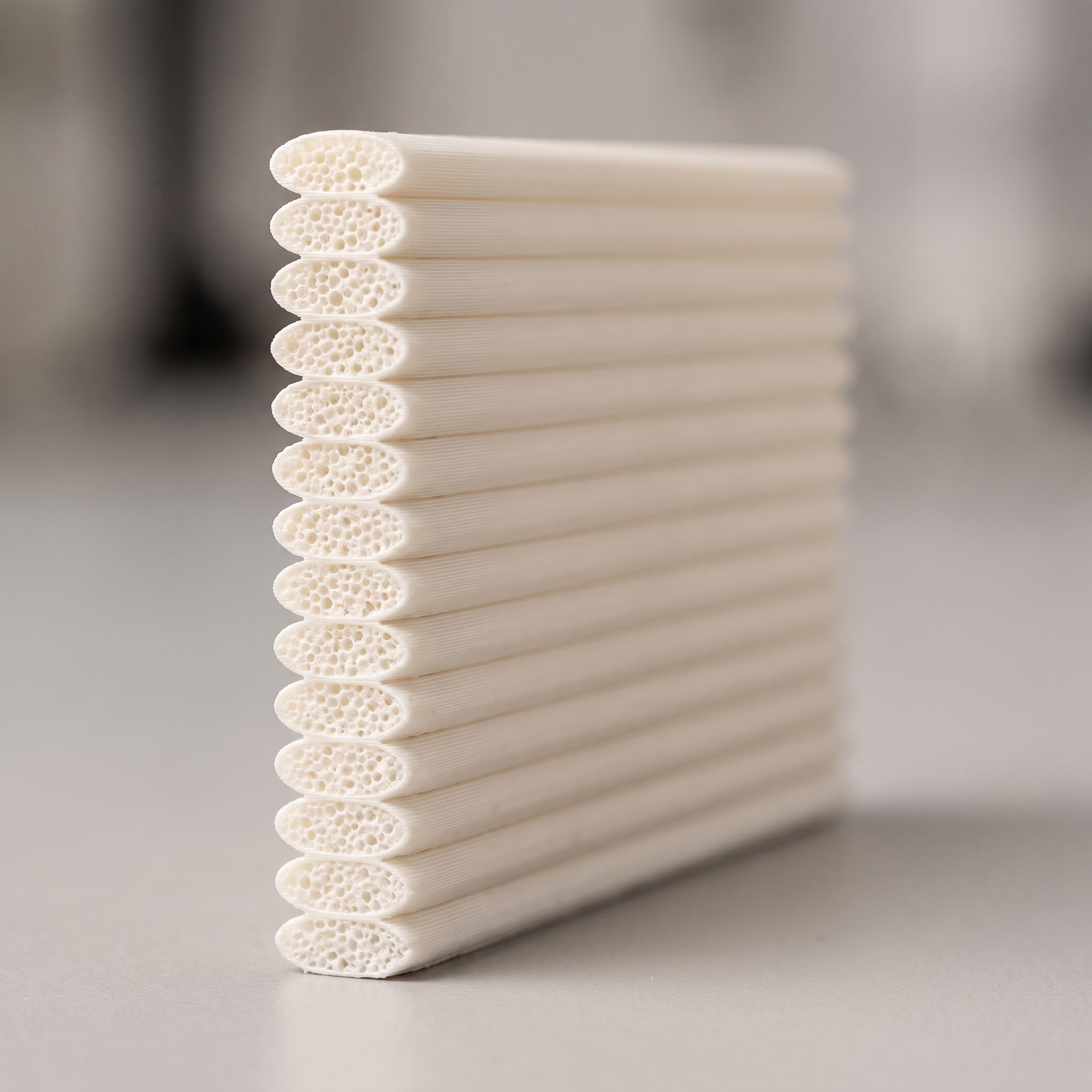
This is what a foamed PLA wall looks like inside: every layer line is one bead, and every bead is closed-cell foam under a matt skin. The bubbles are what take the weight out, and they are also what take the strength out, as the table below shows.
The setting almost everyone skips: if the bead grows, lower the flow multiplier by roughly the same proportion. Otherwise the walls come out over-extruded and the nozzle drags through the foam it has laid down a moment before. colorFabb talks about up to 65 % less flow for maximum weight saving, which is a multiplier of 0.35–0.4; doubling the volume calls for about 0.5. To calibrate it, print single-wall cubes at several temperatures, measure the wall and reduce the flow until the wall matches the line width. Expansion also depends on speed and layer time, so calibrate at the speed you will actually print at. The general procedure is in Flow ratio and max flow tests and Test coupons.
What it costs in strength, from a series of CNC Kitchen tests on LW-PLA:
| Temperature | Relative density | Tensile | Flexural modulus | Layer adhesion |
|---|---|---|---|---|
| 205 °C (unfoamed) | 100 % | 49 MPa | 3200 MPa | — |
| 225 °C | ≈ 67 % | 24 MPa | 1600 MPa | 13 MPa |
| 250 °C | ≈ 44 % | 12 MPa | 900 MPa | 4.3 MPa |
colorFabb gives 0.40–0.48 g/cm³ at full activation; the densities in the table, relative to PLA at 1.24 g/cm³, work out at 0.55–0.83. Strength falls faster than density because, in a closed-cell foam, the cell walls bend instead of stretching. The Gibson–Ashby model puts numbers on it: stiffness scales roughly with density squared, and strength with density to the power 1.5. At 44 % density that gives 19 % of the modulus and 29 % of the strength; the measurements say 28 % and 24 %.
It still wins for wings and shells, because what you are buying is thickness. For the same mass, foam at 44 % density can be 1/0.44 ≈ 2.3 times thicker. The bending stiffness of a plate scales with E·t³: 900 × 2.3³ ≈ 10,900, against 3200 for solid PLA. At equal weight, the foamed plate is about three times stiffer. That is why it suits RC aircraft wings and fuselages, model shells and cosplay printed with a single wall, and why it is a poor choice for a bracket, a thread or a clip. To save weight through geometry, whatever the material, go to Lightweighting.
Bambu Lab sells two foaming variants, and these are the values from their datasheets:
| PLA Aero (TDS V4.0) | ASA Aero | |
|---|---|---|
| Nozzle | 210–260 °C | 240–280 °C |
| Bed | 35–45 °C, with glue | 80–90 °C, with glue |
| Chamber | open | enclosed, 45–60 °C |
| Speed | < 180 mm/s | < 150 mm/s |
| Retraction | 0.6–1.0 mm | 0.8–1.4 mm |
| Drying | 55 °C × 8 h | 80 °C × 8 h |
| Filament density | 1.21 g/cm³ | 0.99 g/cm³ |
| HDT (0.45 MPa) | 53 °C | 85 °C |
| Max overhang / bridge | 55° / 30 mm | ≈ 70° / ≈ 40 mm |
ASA Aero is the choice for outdoor parts and parts exposed to heat, and like any ASA it needs an enclosure; its base is covered in ABS and ASA, and LW-PLA's in PLA and its variants.
PVB: the PLA-like plastic you smooth with alcohol
PVB (polyvinyl butyral) is the interlayer in laminated windscreens. In 3D printing it is sold as Polymaker PolySmooth, Prusament PVB and others. Its reason to exist: it dissolves in isopropyl alcohol (IPA), so you smooth it with alcohol rather than acetone, and it prints almost like PLA.
| Parameter | Value |
|---|---|
| Nozzle | 205–225 °C (215) |
| Bed | 60–75 °C |
| Fan | 100 % |
| Enclosure | no |
| Surface | smooth or textured PEI |
| Abrasive | no, brass nozzle |
| Drying | 45–55 °C × 6–8 h, recommended |
| Shrinkage | 0.3–0.5 % |
| Tg (PolySmooth datasheet) | 70 °C |
| Density | 1.10 g/cm³ |
Polymaker's datasheet gives no HDT (only a Tg of 70 °C); one reseller lists 68 °C at 0.45 MPa and other sources give lower values (55–65 °C). Treat it like PLA: it is not for a car or anywhere hot.
It has two strengths. The first is smoothing with 90 % or stronger IPA: wiped on with a cloth, sprayed, or in a vapor station, it leaves a glossy skin, close to an injection-molded part. The method, how much it changes dimensions and the safety side (IPA is flammable) are in Vapor and chemical smoothing. The second is clarity. Smoothing removes light scattering at the surface; the scattering inside, at the joints between beads and in the air gaps, you reduce with solid walls, 100 % concentric or aligned infill, slightly high flow and thin layers. Done that way, natural PVB comes out much clearer than a transparent PLA or PETG: translucent and clean, not glass-like.
IPA also dissolves PVB enough to solvent-weld PVB parts together; see Gluing and welding printed parts. For supports, see Support materials.
Its limits: it takes little heat, absorbs moisture faster than PLA, and smoothing rounds sharp edges and alters mating faces. Allow for that when you design: keep faces that have to fit away from the solvent.
At a glance
| Filament | What it adds | Base | Key number | Trade-off | Nozzle |
|---|---|---|---|---|---|
| ESD | dissipates static | mostly PETG | class 10⁴–10¹¹ Ω; datasheets 10⁵–10¹² Ω/sq | depends on print temperature; needs ground | per datasheet |
| Conductive PLA | carries mA currents | PLA | 30 Ω·cm XY / 115 Ω·cm Z | brittle; heats up | per datasheet |
| Iron-filled PLA | a magnet sticks to it | PLA | about 100 m per 500 g spool | abrasive, brittle | hardened |
| LW-PLA | stiffness per gram | PLA | 0.4–0.8 g/cm³ depending on temperature | strength and adhesion drop faster than weight | — |
| PVB | IPA-smoothable, clear | PVB | Tg 70 °C | low heat resistance, like PLA | brass |
When it fails
| Symptom | Cause | Fix |
|---|---|---|
| The ESD tray protects nothing | No path to ground | Stand it on a grounded mat or wire it to ground |
| The ESD part measures insulative or conductive | Printed off the datasheet temperature, thin walls or low infill | Datasheet temperature, walls of 1.5 mm or more, high infill; check it with a surface resistance meter |
| A conductive sensor's reading drifts | Pressure-only contact, or changes in temperature and humidity | Drive in a pin or a heat-set insert, or put conductive epoxy on the joint |
| The conductive track heats up | Too much current for a resistor in the kilohm range | Milliamp signals only; never power or mains voltage |
| Dimensions drift after a spool of iron-filled PLA | Brass nozzle worn by the iron | Hardened nozzle, then recalibrate |
| LW-PLA walls over-extruded and dragged | Flow not cut back for the swollen bead | Lower the multiplier until the wall measures the line width |
| Stringing on travel moves with LW-PLA | The foam keeps expanding inside the nozzle | Fewer travel moves, no wall crossings; in CNC Kitchen's test, more than about 2.5 mm of retraction jammed an MK3S |
| Uneven surface and dimensions on LW-PLA | Expansion changes with layer time | Constant layer time: print a small part alongside others |
| Bubbles where they do not belong | Wet spool plus foaming agent | Dry it (Drying and storing filament) |
| Annealed LW-PLA warps and gains nothing | Foam does not gain from annealing (CNC Kitchen, 100 °C × 1 h) | Do not anneal it |
| The PVB part no longer fits after smoothing | IPA rounds edges and mating faces | Keep mating faces away from the solvent |
See also
- Filament comparison table: every family and its numbers in one table.
- Choosing a filament: which material a part needs before you reach for a specialty one.
- Carbon and glass fiber filaments: why carbon fiber does not make a part anti-static.
- Vapor and chemical smoothing: smoothing PVB with IPA, step by step.