
Use polypropylene (PP) for hinges and clips that open every day, for parts that work submerged or among chemicals, and for light parts that take knocks: it is the plastic of the flip-top cap on a shampoo bottle and the food tub in the fridge. It survives that treatment because it bends without breaking and almost nothing attacks it or sticks to it. That last property is exactly what makes it so hard to keep on the bed. It is not the material for stiff parts, precise parts or parts that work hot.
What PP is and why it behaves this way
PP is a polyolefin, like polyethylene: a chain of nothing but carbon and hydrogen. It has no oxygen, no nitrogen and no polar groups: regions where the charge is unevenly spread, which is where water, acids, alcohols and nearly every adhesive take hold. This is what low surface energy means: water and polar liquids do not wet it, they bead up. Non-polar liquids such as oil or petrol do wet it; more on that under chemicals. Three things follow from the missing polar groups: it resists most chemicals, it barely absorbs water, and almost nothing sticks to it.
It is also semi-crystalline. As it cools, some of the chains fold into ordered, tightly packed crystals; the rest stays as a tangle between them, the amorphous region. Crystals take up less volume than the tangle, so PP shrinks more than an amorphous plastic: 1.5 to 2.5 %, against 0.3–0.5 % for PETG. And the amorphous region is soft at room temperature. That is why, where it bends, PP yields and whitens instead of cracking.
Not all PP is the same. Injection-molding PP is often a homopolymer: stiffer, with a higher melting point, and brittle near 0 °C. Many filaments use copolymers, with some ethylene in the chain, because they crystallize less, warp less and print better; the price is that they are softer. To find out which you have, check the composition line on the datasheet or look for the word "copolymer" on the label. If the datasheet says nothing, assume it is a soft grade.
Density is around 0.90 g/cm³ (0.9 on the Formfutura Centaur PP datasheet). It is the lightest common filament: it floats, and a kilo of PP gives you noticeably more meters than a kilo of PLA.
What PP does well
Flex fatigue
This is the reason to print PP. In the folding test cited in Living hinges and flexures (Balderrama-Armendariz et al., 2019), printed PP reached a million cycles, while the stiff plastics broke before 1000. The hinge works because in the first few folds the material yields and aligns its chains along the bend. The geometry, and how to break the hinge in over those first folds, are in that article.
Snap fits and clips
It tolerates 8–10 % strain in a snap fit assembled once and 6 % in one assembled and taken apart repeatedly, against 2 % and 1–1.5 % for PLA. A soft, ductile material takes a lot of deflection before the root of the arm yields, so a PP clip can be shorter or thicker for the same travel. The formula is in Print-friendly snap fits.
Chemicals
It resists acids, alkalis, alcohols, detergents and most water-based cleaners. All of them are polar and have no affinity for a non-polar chain, and no molecule gets into the crystals readily. Non-polar solvents do have that affinity: aromatics and chlorinated solvents (toluene, xylene, chlorinated cleaners) swell it, more so when hot, and strong oxidizers attack it. It handles oil and fuel at room temperature, but hydrocarbons swell it over time or when hot; for long immersion in petrol, check the manufacturer's table. Heat, cold, sunlight and chemicals has the tables by product.
Water
It hardly absorbs any: the Prusament PP Carbon Fiber datasheet gives 0.03 % after 24 h and 0.04 % after 7 days at 25 °C and 30 % humidity. So it resists chemicals and holds its size in damp conditions, unlike nylon (Nylons and polyamides). It suits bathroom, aquarium, boat and washing-machine parts.
Toughness
At room temperature it takes knocks well: it yields before it breaks.
Where it falls short
Stiffness
As filament, many unfilled PPs sit at 0.4–0.6 GPa flexural modulus (0.40 GPa on the Centaur PP datasheet; 0.38–0.58 GPa on the Forward AM Ultrafuse PP one, depending on orientation); homopolymers give a little more, and injection-molding PP is around 1.3–1.6 GPa. PLA gives 2.8 GPa in the Filament comparison table: five to seven times as stiff as those spools. Tensile strength is low too: 12–15 MPa in XY on those datasheets and about 9 MPa in Z on the Ultrafuse PP one. A PP bracket bends. Design a PP part to flex, not to hold its shape, or move to PP-GF or PP-CF.
Creep
Under sustained load it keeps deforming at room temperature, because its modulus is low and the glass transition of the amorphous region sits below 0 °C. A PP hook opens up over time, and a clip that stays closed for months loses its grip (Creep and fatigue).
Heat
Unfilled PP gives way early once it is both loaded and warm. Its heat deflection temperature (HDT at 0.45 MPa) varies so much with the grade that no single figure is worth quoting. The Centaur PP datasheet gives a Vicat of about 103 °C, but Vicat measures when a needle penetrates the surface, not when a part deflects under load. Rule of thumb: unfilled PP in hot water or the dishwasher only if the part holds nothing up. If there is load and heat together, PP-GF/CF or another family.
Cold
Homopolymer turns brittle near 0 °C and below, because the amorphous region passes through its glass transition and stops yielding. Impact copolymers, with a dispersed rubber phase, stay tough below zero. Random copolymers, the most common in filament, improve little on the homopolymer. For freezer boxes or outdoor clips in winter, look on the datasheet for cold impact strength (at 0 °C or −20 °C); if it is not given, do not count on it.
Sunlight
Unstabilized PP degrades under ultraviolet: its surface chalks into a white powder and it turns brittle, sooner than ASA does. Outdoors, only a UV-stabilized grade or a painted part; otherwise, ABS and ASA.
Finishing
For the same lack of polar groups, it cannot be glued, painted or smoothed with the usual products. To join parts you have to heat-weld them or use a polyolefin primer (Gluing and welding printed parts). To paint it you need an adhesion promoter (Painting and priming). There is no practical solvent for smoothing it (Vapor and chemical smoothing). In multi-material it bonds only to itself, not to any common filament (Functional multi-material parts).
Why it does not stick to the bed, and what holds it
A molten bead bonds to the plate in one of two ways. On a polar plate, such as PEI, glass or a layer of glue, a polar plastic wets it and grips by attraction between the two faces. PP has nothing polar to offer: on PEI it barely wets, only weak forces hold it, and the part lifts as soon as shrinkage pulls. On a PP sheet or PP tape, something else happens. The hot bead melts the top layer of the surface and the chains on one side tangle with those on the other: the bead welds to it the same way two layers of PP weld to each other. That is why what holds PP is PP, or a surface formulated to behave like it: a PP plate or a polyolefin adhesion agent.
What works: PP packing tape (its backing is polypropylene), stretched taut and flat on the plate; a plate made for PP, such as Prusa's powder-coated one, which also takes PLA, PETG and TPU; or a PP-specific agent such as Magigoo PRO PP. PVC tape, masking tape, PEI in any finish and glass do not work. Nor does more glue stick or more heat. Keep a roll of PP tape to hand before you start; the full procedure is in Bed prep for each material.
The bed runs at 80–100 °C on a PP plate or PP agent; Prusa gives 85 ± 10 °C for its fiber-filled PP. In a semi-crystalline plastic, a hot bed slows the cooling of the first layers and, with it, crystallization, which causes most of the shrinkage. With tape, check the temperature rating on the roll and stay at the low end of the range: its adhesive softens with heat.
On tape, the part can weld so well that the tape comes away with it. That is the sign it works: peel the tape off the part, not the part off the tape, and lay fresh strips.
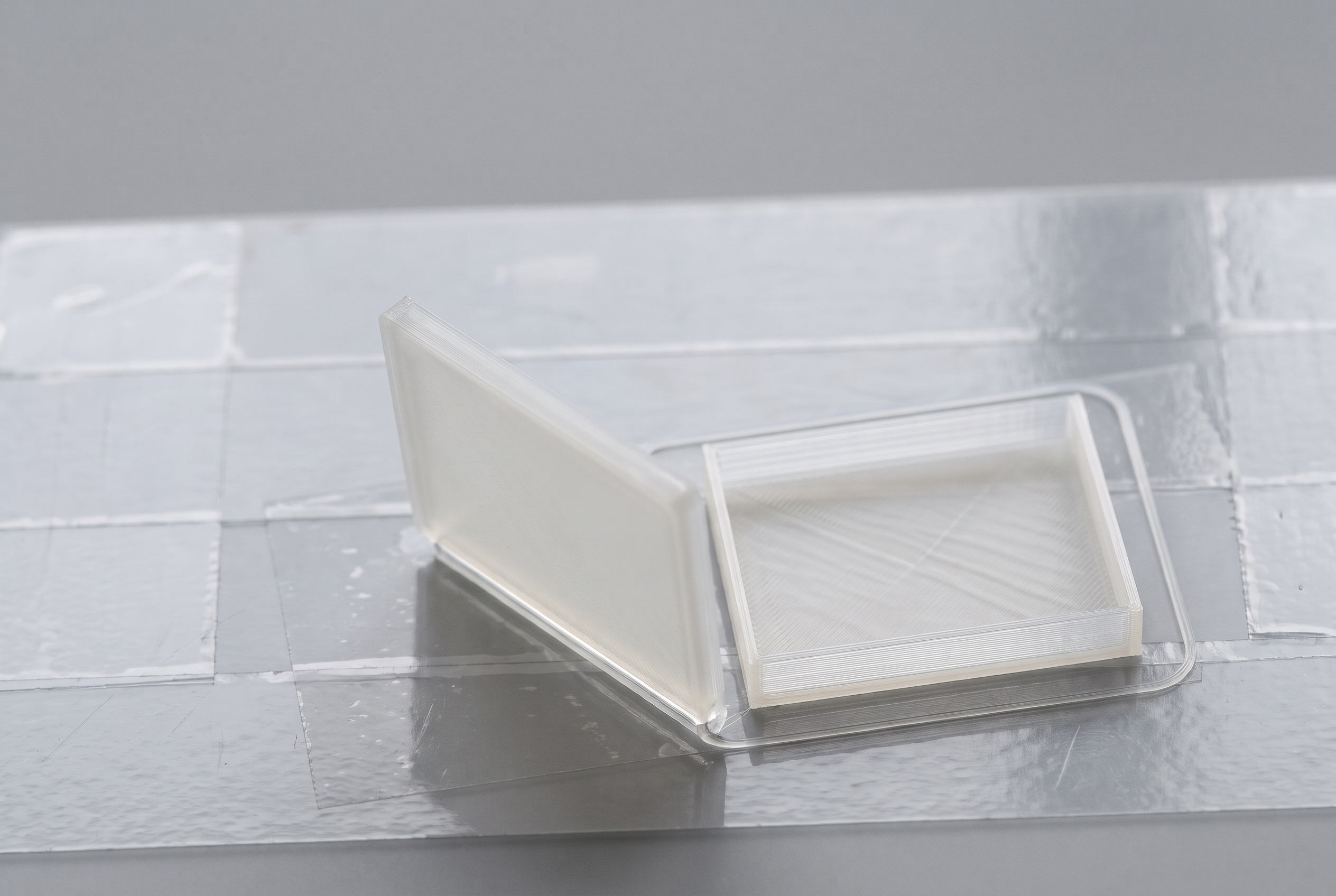
This is what unpigmented PP looks like: milky and translucent. The hinge is a thin strip printed in the same plane as the floor of the box. After the first folds it shows a white line: that is stress whitening, not a crack.
Printing it without warping
| Parameter | Value |
|---|---|
| Nozzle | 220–250 °C, brass |
| Bed | 80–100 °C on PP or PP agent |
| Chamber | passive: enclosed printer, no heater |
| Part cooling fan | 20–50 % |
| Drying | rarely; 50–60 °C × 4–6 h if the spool has been open for months |
| Linear shrinkage | 1.5–2.5 % |
The main problem is shrinkage: on a 100 mm part that is 1.5–2.5 mm, and the corners pull upwards. The remedies, from most to least effective:
- Brim. More grip area right at the corners, where the pull concentrates. With PP it is not optional (Brims, rafts and mouse ears).
- Rounded corners and chamfered bottom edges in the model. A sharp corner adds the pull of two edges at one point.
- Enclosed printer, no drafts. If it cools evenly everywhere, it crystallizes evenly and shrinks evenly.
- Fan at the low end of the range. Slower cooling spreads the shrinkage out over time.
- No long, flat, solid bases. Split them or stiffen them with ribs.
The general list is in Warping and lifting corners.
Layer adhesion is good, because PP welds to itself: Prusament PP Carbon Fiber gives 13 MPa between layers against 27 MPa in XY. Even so, Z remains the weak direction (Layer adhesion and anisotropy).
As of late 2026, PrusaSlicer and OrcaSlicer ship generic PP profiles. Some printer makers neither sell PP nor ship a profile for it: in that case, start from the generic one and the spool's datasheet.
PP with glass or carbon fiber
Short fiber carries load along the bead and holds the matrix in place while it crystallizes. Shrinkage and warping drop sharply in that direction; stiffness and service temperature go up.
| Property | Value |
|---|---|
| Nozzle | 270 ± 10 °C, hardened |
| Bed | 85 ± 10 °C, PP plate, with brim |
| Speed | up to 40 mm/s |
| Fan | off, 100 % on bridges only |
| Tensile modulus | 2.1 GPa (XY) / 2.5 GPa (XZ) |
| Tensile strength | 27.3 MPa (XY) / 30.7 MPa (XZ) |
| Elongation at yield | 3.4 % (XY) / 3.2 % (XZ) |
| Flexural modulus | 1.8 GPa (XY) |
| HDT | 158 °C at 0.45 MPa · 115 °C at 1.8 MPa |
| Charpy notched | 14.5 kJ/m² (XY) |
Fan off is Prusa's instruction for its fiber-filled grade, not for unfilled PP. With glass, Forward AM's Ultrafuse PP GF30 reaches 3.5 GPa flexural in XY and 1.7 GPa with the layers loaded in Z (what its datasheet calls ZX), with the nozzle at 240–260 °C. Each grade has its own bed temperature, and some glass-filled ones want it much lower than the 80–100 °C of unfilled PP: follow the datasheet.
What you lose is the hinge. Fiber-filled PP is a stiff, light, chemical-resistant structural plastic, not a material for folding: it yields at around 3 % strain, far from the 6–10 % of unfilled PP. Never print a living hinge in PP-CF or PP-GF, and design its clips for the strain limits of a stiff plastic, around PETG's. The fiber is abrasive and needs a hardened nozzle (Nozzles: size and material). And it still needs a PP surface, because fiber does not change the chemistry of adhesion. Carbon and glass fiber filaments covers the effects of fiber in detail.
PP or something else: when to choose which
- Hinge or clip that opens every day: PP. The design is in Living hinges and flexures; a project to try it, in Living-hinge folding box.
- Part in water or chemicals, under little load: PP.
- Stiff bracket, precise fit or load above room temperature: not unfilled PP. PETG or PC; PP-GF/CF if chemicals matter as well.
- Tough, stiff part that works in oil: fiber-filled nylon (Nylons and polyamides).
- Soft part, seal or bump stop that has to recover its shape fully: TPU (TPU and flexible filaments).
- Direct sunlight: ASA, or UV-stabilized PP.
PP is the plastic of food tubs, but a printed PP part is not food-safe merely because it is PP: layer lines trap residue, and the nozzle and additives matter too (Printing for food contact). It carries recycling code 5 and is only recycled if it is sorted as PP (Printing with less waste).
When it fails
| Symptom | Cause | Fix |
|---|---|---|
| The part lifts mid-print | The surface is not made for PP, or the tape has come unstuck with the heat | Move to PP tape, a PP plate or a PP agent, or lower the bed; raising the temperature on PEI never fixes it |
| Overhangs droop and details round off on small parts | PP is slow to crystallize and the next layer arrives before the last one has solidified | Raise the minimum layer time or print two copies at once; do not expect PLA overhangs |
| Strings and blobs between features | Molten PP is very runny and slow to solidify | Increase retraction slightly and bring the nozzle toward the low end of the range |
| The extruder slips or the filament buckles | A soft copolymer in a long Bowden tube or a filament switcher | Direct drive and an external spool, bypassing the switcher |
| Holes and fits come out small | 1.5–2.5 % shrinkage | Correct shrinkage once, in the slicer's filament profile, and measure (Dimensional calibration) |
| The hinge turns white in the first folds | Stress whitening: the material yields and aligns its chains | It is normal; a crack is not |
See also
- Living hinges and flexures: the geometry of a PP hinge and how to break it in.
- Bed prep for each material: the full procedure with PP tape, plate or agent.
- Heat, cold, sunlight and chemicals: the chemical resistance tables by product.
- Printing for food contact: why a printed PP part is not food-safe merely for being PP.