
A spool that printed cleanly last month now crackles, strings and lays down rough, weak walls. Same printer, same profile, same file. Nothing has broken: the filament has taken up water from the air. Apart from PP, every common filament absorbs water, and how much depends on the air around it, not on the age of the spool. Heat and time fix it; a sealed box at a known relative humidity prevents it.
What water does in the hotend
The first mechanism is physical. In the nozzle, at roughly 190 to 340 °C depending on the material, the absorbed water flashes to steam inside the molten plastic. The bubbles come out with the bead, and that is where the symptoms come from: popping while it prints, puffs of steam, oozing on travel moves because the steam pushes the melt out (strings and blobs), a fuzzy, pitted surface and a bead of uneven width.
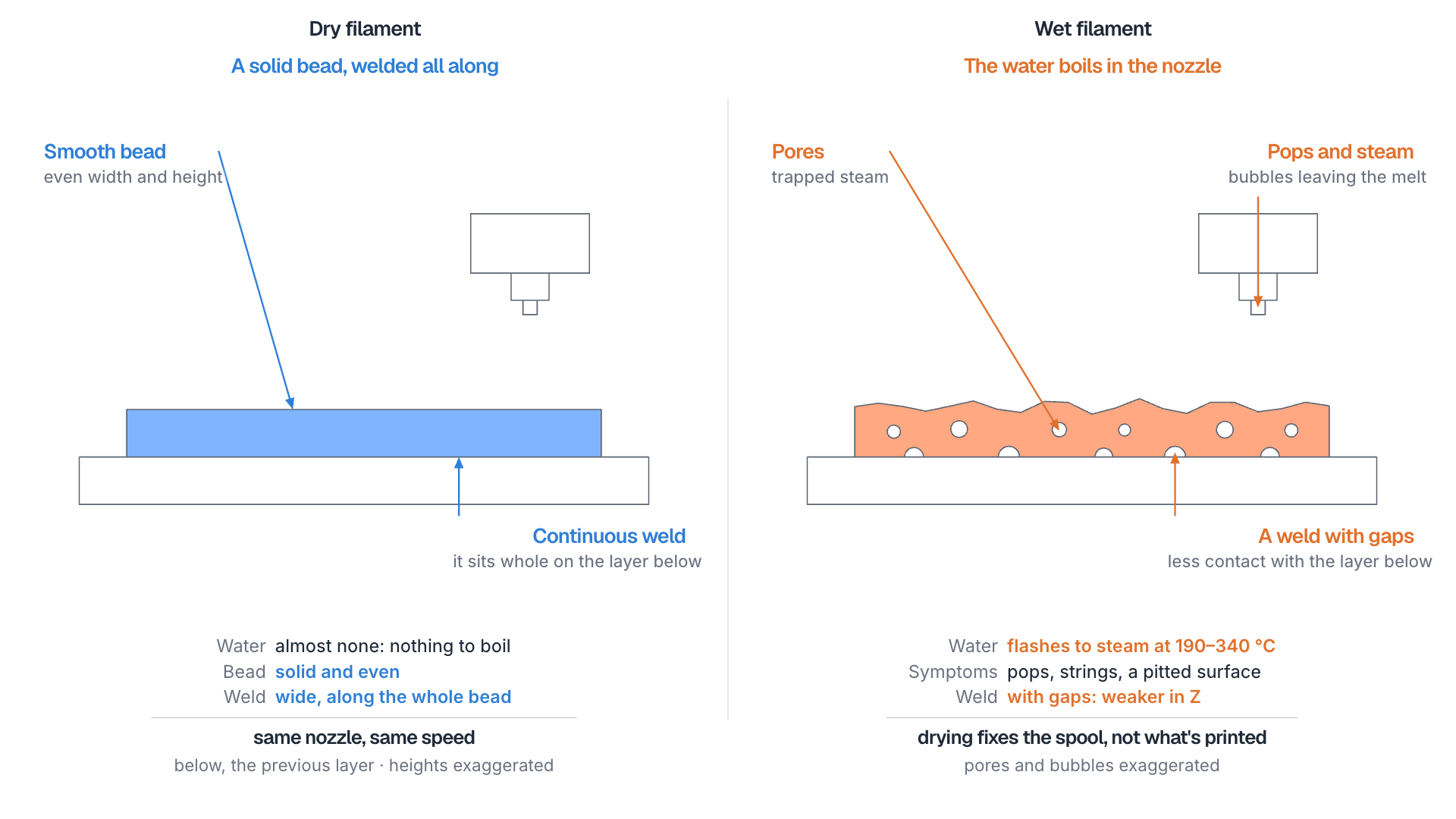
A porous bead has less area in contact with the layer below, and the voids sit right in the weld. The part loses strength in Z, which was already its weak direction (Layer adhesion and anisotropy).
The second mechanism is chemical and cannot be undone. In the melt, water also breaks the polymer chains of polyesters, polycarbonate and polyamides: PLA, PETG, PCTG, PC, PA and polyester-based TPU, which is most TPU sold as filament. This is hydrolysis. The melt runs thinner and the part comes out more brittle. Drying removes the water still in the spool; it does not repair what you have already printed with it wet. That is why technical materials are dried before printing, not after the first failure.
Filament that turns brittle and snaps inside the PTFE tube or the switcher is a separate matter. Moisture plays a part in some materials, but old PLA can go brittle for other reasons, and drying it sometimes helps and sometimes does not. If it snaps inside the tube or the switcher, see Multi-material failures.
Nylon has one more effect, at room temperature: water softens it. Damp nylon feels rubbery in the hand; dry nylon is stiff. What that means for parts already printed is covered in Nylons and polyamides.
How much water it takes up: equilibrium with the air
Filament does not keep getting wetter forever. It tends toward an equilibrium water content set by the relative humidity (RH) of the air around it. A spool in a room at 60 % RH ends up wetter than the same spool in a box at 30 %, however much time passes. Drying does not reset anything: it shifts that equilibrium.
The rate varies a great deal between families. In open air, PA, TPU, PVA and PC take up enough water to notice within hours or a few days. PETG and ABS/ASA take days or weeks; PLA, weeks. PP barely absorbs any.
A spool gets wet and dries from the outside in. The outer turns pick up water first, and the core of the inner turns is the last part to dry. That is why drying takes hours, and why a bad layer early in a print can come from the outer turns even when the rest of the spool is fine.
RH depends on temperature. The same air reads a higher RH in a garage or against a cold wall than at the temperature of your desk. A spool kept somewhere cold and damp is wetter than the hygrometer next to your computer suggests.
Is it wet? Check before you touch the profile
Three tests, from quickest to most reliable:
- Listen. If it crackles while printing, there is water.
- Extrude into the air. Push out 50–100 mm at printing temperature and look at what comes out: bubbles, sizzling and a rough surface give the moisture away. Compare it with a length of freshly dried filament.
- Weigh. Cut a sample several meters long and weigh it before and after drying, always at room temperature, on a precision scale. The difference is small: in a sample a few meters long, hundredths of a gram, which a kitchen scale will not see; you need a 0.01 g one. Weighing the full spool misleads if the reel is cardboard: cardboard gives off water too.
When a spool that printed cleanly starts stringing and coming out rough without you changing anything, dry it before you touch retraction, temperature or flow ratio. Compensating for a wet spool with retraction stops working the moment you change spools, and costs you hours (Stringing and blobs, Extrusion problems).
Moisture can also masquerade as under-extrusion or as layers coming apart. The full diagnosis is in Layers splitting apart.
Drying: temperature, time and venting
These values are for a forced-air dryer or an oven. They are a starting point: every brand publishes its own, and if your filament's datasheet says otherwise, the datasheet wins. After drying, check the result by extruding into the air.
| Material | Temperature | Time | Must you dry it? |
|---|---|---|---|
| PLA | 45–55 °C | 8 h | recommended |
| PLA-HT | 50 °C | 8 h | recommended |
| PVB | 45–55 °C | 6–8 h | recommended |
| PETG / PETG-HF | 60–65 °C | 8 h | recommended |
| PCTG | 60–70 °C | 6–8 h | recommended |
| HIPS | 60–65 °C | 4–6 h | recommended |
| ABS / ASA | 75–80 °C | 8 h | recommended |
| PC-ABS | 75–80 °C | 6–8 h | required |
| PC | 80 °C (max. 90) | 8 h | required |
| PA6 / PA12 / CoPA | 80–85 °C | 8–12 h | required |
| PA-CF/GF, PAHT-CF | 85 °C | 12 h | required |
| PET-CF | 80 °C | 8–12 h | required |
| PPA-CF, PPS-CF | 100–140 °C (oven only) | 8–12 h | required |
| TPU (95A, 90A, 85A) | 70–75 °C | 8–18 h | required |
| PVA | 75–85 °C | 8–12 h | required |
| BVOH | 60–80 °C | 8–12 h | required |
| PP | 50–60 °C | 4–6 h | hardly ever |
PEEK and PEI, dried at 120–150 °C, belong to industrial machines and are left out of the table.
Temperature has a ceiling. Above the point where the material softens, the turns stick to each other and the filament goes oval. PLA is the tightest case: its drying ceiling sits only a little below where it starts to soften. Never turn it up "a bit, to speed things up". The reel has a ceiling too: at 80 °C or more, check that it can take it. If it is cardboard or a plastic that softens early, rewind the filament onto a heat-resistant reel before drying PA or PC.
The time is long because the water has to diffuse out from the center of a 1.75 mm filament and from the inner turns. More temperature, within the ceiling, speeds it up. Adding hours at too low a temperature makes up for much less. The times in the table assume a full spool.
The damp air has to leave. Heating a closed box lowers the RH reading, but the water is still inside: it has to go out through a vent, be carried off by a fan bringing in fresh air, or be trapped by desiccant. Dryers that log RH show it falling as the water leaves; if the reading does not fall, the box is not venting.
Polycarbonate has its own rule: repeated cycles of drying and cooling make it brittle. Dry it once and keep it dry, rather than drying it again before every print (Polycarbonate and its blends).
Print PA, TPU and PVA straight from the dryer or a dry box. A freshly dried spool of nylon left in the open is damp again the same day (TPU and flexible filaments, Support materials).
Is the printer's own dryer enough?
It depends on its ceiling. As of late 2026, several filament switchers can dry: Bambu Lab's AMS 2 Pro reaches 65 °C and the AMS HT 85 °C with a single spool. Anycubic's ACE 2 Pro, the Qidi Box and Creality's CFS 2 dry as well; check the ceiling on their spec sheet. Whatever the model, compare its ceiling against the material's drying temperature.
A 65 °C ceiling covers PLA, PVB, PETG and HIPS, and PCTG at the low end of its range. It falls short for ABS/ASA (75–80 °C), PC (80 °C), PA (80–85 °C), TPU (70–75 °C), PVA (75–85 °C) and BVOH at the top of its range (up to 80 °C). At 85 °C, ABS/ASA, PC, fiber-filled and unfilled PA, TPU, PVA and BVOH all come in. No switcher reaches PPA-CF or PPS-CF.
Even when it falls short, the built-in dryer helps. A 65 °C unit keeps an already-dry spool of PLA or PETG dry through a long print, and slowly dries one that has picked up some moisture. What it will not do is rescue a soaked spool of nylon or TPU. Dry it first in a dryer or an oven at the temperature in the table, and let the switcher keep it dry afterwards.
Some materials should not go through a switcher at all: the AMS 2 Pro does not take generic TPU or TPE, nor damp PVA or BVOH. Filament switchers: AMS, MMU, CFS and ACE lists what each one accepts.
Storing: the target RH and the dry box
| Material | RH inside the box |
|---|---|
| PA, PC, TPU, PVA, BVOH | below 20 % |
| PLA, PETG, ABS, ASA | below 40 % |
These are rough bands, not manufacturer figures. Creality's CFS 2, for example, starts dehumidifying when its internal RH goes above 35 %, within the second band.
An airtight container or a vacuum bag will do, with desiccant and a hygrometer inside. The usual desiccant is color-indicating silica gel. It saturates: when the indicator changes color, regenerate it in the oven at the temperature on its label, or replace it. A filament dryer at low temperature only partly regenerates it.
Cheap hygrometers drift by several points, especially at the extremes, and below 20 % their reading is little more than a guide: trust the trend, not the number. If the box is still above target after a few days, the seal or the desiccant has failed.
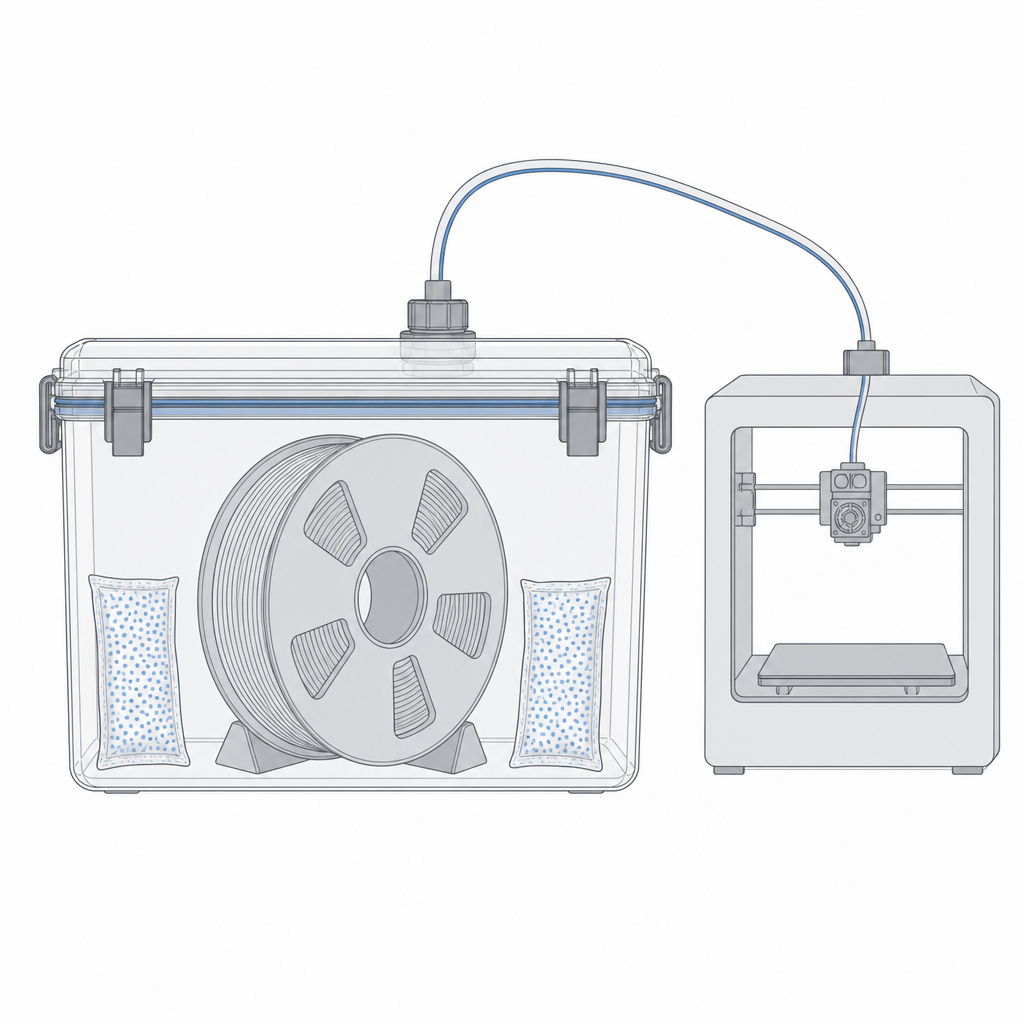
A dry box with a PTFE outlet lets you print hygroscopic materials without taking them out of the box. A spool on an open holder in a damp room, by contrast, soaks up water between prints.
Open the factory bag only when you are about to use the spool, and do not throw it away: with its desiccant, it is your first dry box (What comes on a spool of filament).
Moisture changes your clearances
A bead that foams comes out wider and less even, so walls grow and clearances close up in ways you cannot predict. A sliding fit that ran freely yesterday can bind today because the spool spent the night out.
Calibrate and print your fit coupons with dry filament, and note "dry filament" among the conditions your clearances depend on, alongside the nozzle and the material (Real printed clearances). When a proven fit stops working, the spool is one of the first suspects: dry it, reprint the coupon and compare (When your numbers drift).
When it fails
| Symptom | Cause | Fix |
|---|---|---|
| Crackles, strings and lays down rough walls with the usual profile | Wet filament | Dry it at the table's temperature before touching the profile; print from a dry box |
| After drying, the turns are stuck together or the filament is oval | Dried above the ceiling of the material or the reel | Lower the temperature; rewind onto a heat-resistant reel before drying PA or PC |
| Nylon still crackles after hours in the switcher | A 65 °C built-in dryer for an 80–85 °C material | A separate dryer or an oven at 80–85 °C; then the switcher keeps it dry |
| The box RH does not fall to the target within a few days | The lid does not seal or the desiccant is saturated | Change the box or the seal; regenerate or replace the desiccant |
| A sliding fit that ran freely now binds | Wet spool: the bead comes out wider | Dry it, reprint the coupon and compare |
| The part is still brittle although the spool is now dry | It was printed wet: hydrolysis cannot be undone | Reprint with the dry spool |
See also
- What comes on a spool of filament: the factory bag, the reel and what the label says.
- Filament switchers: AMS, MMU, CFS and ACE: which materials each switcher accepts and which ones it dries.
- Layers splitting apart: the full diagnosis when moisture looks like another cause.
- When your numbers drift: how to recalibrate when a proven fit stops working.