
Order the part out when it needs something your process cannot give: strength in every direction, a material, a size, a finish, a tolerance or a quantity that is not worth your time. While you are still iterating, print at home. A service printing in SLS, MJF, resin or metal sends the part within days; what you have to get right is preparing the file for its process, not for your printer, and comparing its quote with what the part costs you.
Five reasons to order out
Strength in every direction. A clip that holds a cable in the engine bay, well away from the exhaust manifold, comes off your FDM printer in an afternoon and a week later snaps between two layers; the same clip in sintered PA12 holds. In FDM the weak axis is the weld between layers; the figure is in Layer adhesion and anisotropy. Nylon in a powder bed (SLS or MJF) has no such weak joint: each layer fuses onto the one below while that layer is still hot and soft, and bonds across the whole section, not only through the narrow neck between two round beads. The part is nearly isotropic, with Z a little below XY. Nearly, not entirely: tensile strength in Z comes close to XY, but elongation at break can drop much further, especially in SLS. A clip works by flexing, so put its bend in XY or ask the service for that orientation. The typical cases are snap fits, living hinges loaded across the layers and thin-walled enclosures.
A material you cannot print well. PA12 and PA11 that do not warp, glass-filled PA12, sintered TPU, high-performance polymers (PEKK in SLS, ULTEM or Antero in industrial FDM) and solid metal: 316L stainless, AlSi10Mg aluminum or Ti6Al4V titanium by laser powder bed fusion. PPS, PEEK, PEKK and PEI and Metal filaments and sintering explain why the home routes fall short.
Size. If the part is longer than your build volume, think about splitting it first (Splitting large parts). A powder bed does not always solve it: the usual SLS and MJF machines are around 350–380 mm a side, and the large ones reach about 700 mm. Bigger parts in one piece come from industrial FDM (up to about 900 mm) or large-format SLA. Watch the price: in a powder bed you pay for material volume and for the bounding box, so a large hollow frame can cost more in one piece than split into four sections.
Finish and detail. Resin (SLA or DLP) gives smooth surfaces and fine detail. Ordering it makes sense if you have no resin printer or do not want the chemistry at home: Handling resin safely covers what it demands, and FDM or resin for your part covers when owning one pays off. Black-dyed MJF gives an even matt finish with no visible layer lines on vertical faces; on gentle slopes the stepping does show.
Quantity. Dozens of identical parts. A powder bed nests parts in three dimensions, one above another, and prints them in a single build. The price per part falls with quantity far more than it ever can on your printer. Once the batch reaches the thousands, injection molding is usually cheaper after the tool is paid off. The break-even point depends on the part: ask for a tooling quote as well and compare. If what holds you back is volume rather than process, Print queues and print farms tells you when it pays to add machines instead of ordering out.
When not to order out: while the design is still changing. Every round trip costs you days and a shipment, and the part arrives after you have already changed three dimensions. Iterate in PLA or PETG and order only the final version, in the final material.
What each service process gives you
Five ways to 3D print explains how each process works. This section covers only what changes for the part and for the order. The values are the typical ones in service design guides, and they vary by service and machine: read the guide of the service you choose before you freeze the design.
| Process | Common materials | What you get | Minimum wall | General tolerance | Supports | Risks |
|---|---|---|---|---|---|---|
| SLS (laser-sintered nylon) | PA12, PA11, glass-filled PA12, TPU | Grayish white, grainy feel, can be dyed | 0.7–1.0 mm | ±0.3 mm or ±0.3 %, whichever is greater | No | Trapped powder, thin panels that warp, low elongation in Z |
| MJF (HP Multi Jet Fusion) | PA12, PA11, glass-bead PA12, TPU, PP | Gray, almost always dyed black; smoother and denser than SLS | 0.7–1.0 mm (up to 1.5 on large flat walls) | ±0.3 mm or ±0.3 %, whichever is greater | No | Same as SLS |
| SLA / DLP (resin) | Standard, tough, high-temperature, castable | The smoothest surface and the finest detail | Depends on the resin and the guide | ±0.1–0.2 mm on small parts | Yes | Support marks on one face; standard resins are brittle, soften with heat and yellow in sunlight |
| Laser-fused metal (SLM, DMLS) | 316L, AlSi10Mg, Ti6Al4V | Dense metal, rough surface | 0.5–1.5 mm depending on the guide | ±0.1–0.3 mm on small dimensions, ±0.2–0.4 % on large ones, as built | Yes, welded to the plate | Holes, threads and seats are machined afterwards |
| Industrial FDM | PEI (ULTEM), PEKK, Antero | Layer lines, as at home | Those of FDM | ±0.1–0.2 mm | Yes | Still weak in Z |
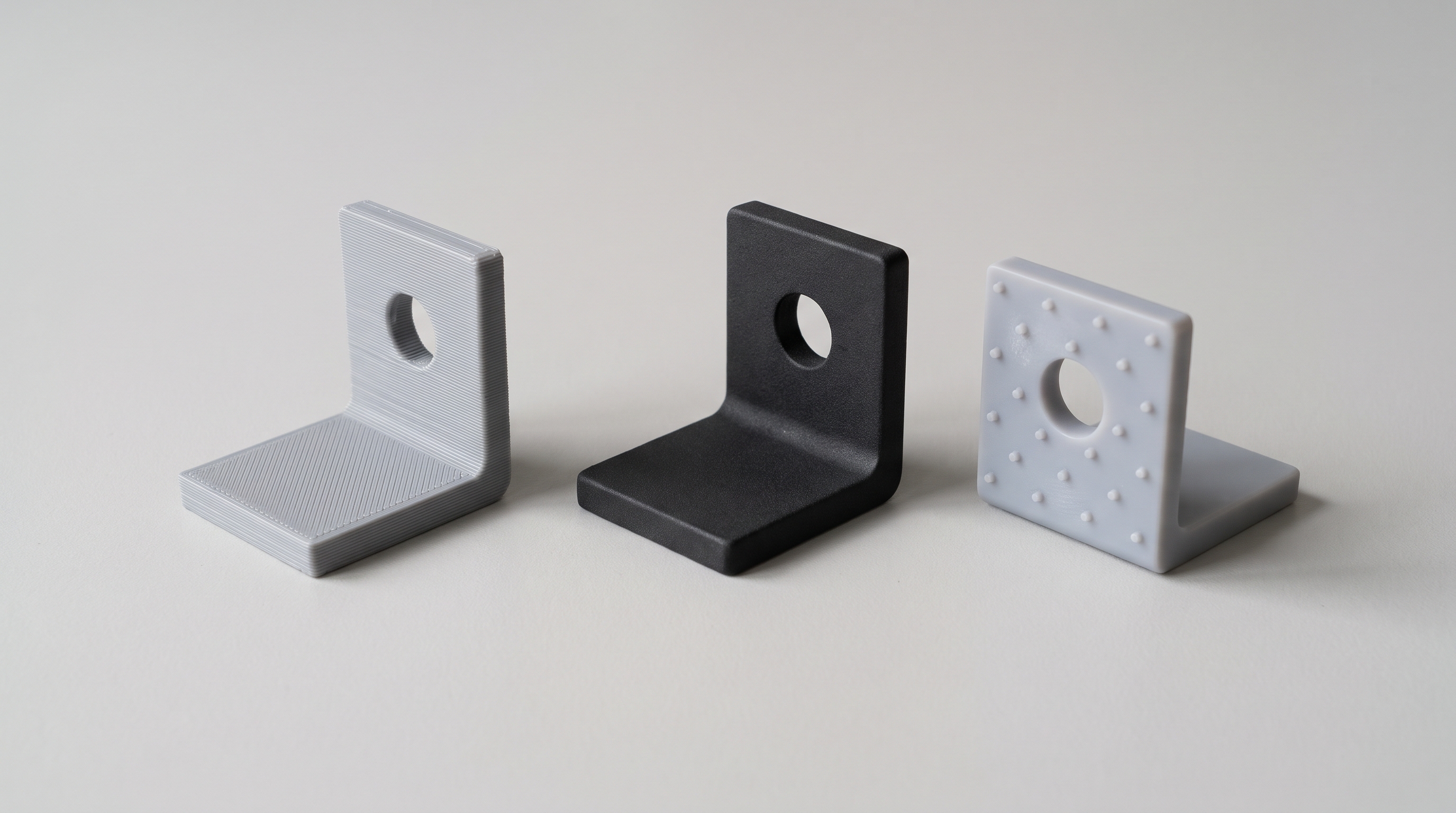
A powder bed changes the design rules. The unfused powder holds the part up, so overhangs, bridges and teardrops stop mattering, and internal channels need nothing special. In exchange, two new limits appear. The first is getting the powder out: a closed cavity traps it for good, so every cavity needs at least two drain holes of 2–6 mm, depending on the guide, like any hollow resin or powder part (Designing for resin). The second is thermal distortion of large, thin, flat panels: give them ribs. Moving parts printed in place need more gap than in FDM, 0.4–0.7 mm depending on the service against the 0.3 mm gap of a modern FDM printer, because loose powder sinters against the hot walls and joins them.
Resin gives the best surface, but copes badly with heat and impact. Supports leave marks on one face, and standard resins are brittle. If you order it, choose the family (Types of resin) and, if you hollow the part, apply the same drain-hole rule.
Laser-fused metal is dense metal, with strings attached. The part grows welded to a plate through supports, goes through a stress-relief treatment and is then cut from the plate. Downward-facing surfaces and overhangs shallower than about 45° from horizontal need supports, and their marks have to be cleaned up. Holes, threads and bearing seats that matter are machined afterwards. For the same volume, expect to pay an order of magnitude or more above nylon. Bound metal and binder jetting are a different route: they shrink by 5–20 % linear on sintering depending on the product (Ultrafuse 316L, 16.6 % in XY and 19.3 % in Z), and Metal filaments and sintering covers it.
Industrial FDM and CNC. For ULTEM or PEKK, a service prints FDM on industrial-class machines such as the Stratasys F900 or the Fortus 450mc (400–500 °C hotend, chamber up to about 200 °C). Several of the platforms listed below (Xometry, Protolabs, PCBWay, JLC) also quote CNC machining: for a flat aluminum plate with tight holes, ordering it machined usually beats ordering it printed.
Prepare the file for the service's process
Send the geometry the service asks for. Almost all of them accept STL and 3MF, and many quote from STEP. STL carries no units: compare the bounding box in the quote with your part's dimensions. The classic mistake is a factor of 25.4 or 1000. Formats and mesh resolution are in STL, 3MF or STEP for the slicer.
Remove the FDM workarounds the process does not need. In SLS and MJF you can drop teardrops, 45° chamfers under overhangs, sacrificial bridge layers and cuts made only to fit your printer. They compensate for a nozzle and a bed, and a powder bed has neither. The bottom-edge chamfer against elephant's foot and holes enlarged for your nozzle are unnecessary in every service process: enlarged holes arrive loose. In laser-fused metal, on the other hand, keep teardrops and 45° chamfers: there they save supports that have to be cut off and cleaned up.
Size clearances for the service's process, not for your printer. Your sliding fit of 0.20 mm per side on a modern bedslinger, or 0.15 mm on an enclosed CoreXY (Real printed clearances), is tighter than SLS and MJF guides ask for between moving parts. Use the guide's value. Between two parts printed separately and assembled later, the clearance per side has to cover the general tolerance of both: allow 0.3–0.4 mm per side, unless you ask for a tighter tolerance on those dimensions. At 0.20 mm, the fit can arrive as an interference.
Decide whether to hollow it. You are charged by volume and there is no infill, so a solid part comes out solid and expensive. Hollowing it lowers the price, but needs the drain holes described above.
Respect the service's minimums. Each guide sets its own for embossed and engraved detail, around 0.5–1.0 mm. What holds in Minimum features and text does not hold here, in either direction: check the guide.
Read the quote and place the order
As of late 2026, the usual route is an instant-quote platform or broker such as JLC3DP, PCBWay, Craftcloud, Xometry, Protolabs or Sculpteo, or Shapeways, which went back to its founders after going bankrupt in July 2024. Local workshops and individuals with an industrial machine are options too. Get at least two quotes: the same file can cost several times more at one than at another.
The price depends on material volume and, in a powder bed, on the bounding box and the height it takes up in the chamber; on finishing (dyeing, vapor smoothing, bead blasting, machining); on lead time; and on shipping. Small solid parts come out cheap. Large thin frames come out expensive for what they weigh. Almost every supplier has a minimum order or a minimum price per part: on a single small part, that and shipping are most of what you pay.
Fill in the order as if it were a drawing:
- Process and material, color and finish, quantity.
- Critical dimensions, with their tolerance, in the order notes or on a PDF drawing. If you specify nothing, you get the supplier's general tolerance (in machining, usually ISO 2768-m).
- Threads: whether they are modeled or tapped afterwards.
- The visible face, if it matters. In resin and in metal, supports mark one face.
On top of the part price come shipping and, if the supplier is outside the EU, import VAT (21 % in Spain), calculated on the goods plus shipping. Since 1 July 2026 the EU also charges a flat customs duty of €3 per item type (tariff heading) on consignments of up to €150, presented as a temporary measure until July 2028. The carrier usually adds its own customs handling fee. Check in the order how the supplier applies it.
Compare against your own cost, worked out as What a printed part costs explains: your failed attempts and your hours, not only the grams the slicer reports. An example with illustrative figures, not market prices: an unfilled nylon clip (PA6 or CoPA) at home needs dry filament, glue on the bed and warp control, and works on the third attempt. If each attempt is €0.40 of filament and 15 minutes of preparation at €20/h, the three add up to €16.20, before drying. If a sintered PA12 quote with shipping comes in below that, ordering out wins, even though your filament costs less per gram.
Before you pay
- The process and the material are written in the order.
- Clearances are sized for that process, not for your printer.
- Critical dimensions carry their tolerance.
- You have compared at least two quotes, and your own cost.
When it fails
| Symptom | Cause | Fix |
|---|---|---|
| The part arrives 25.4 or 1000 times too large or too small | STL carries no units and you picked the wrong unit on upload | Check the bounding box in the quote; send 3MF or STEP |
| Loose holes, pins that rattle | You sent geometry enlarged for your FDM, or with the clearances of your active setup | Export the nominal geometry, or geometry sized for the service |
| Two parts you assemble later do not fit | FDM clearance with no margin for the general tolerance of both | 0.3–0.4 mm per side, or request a tight tolerance on those dimensions |
| Moving parts fused together | Printed gap below the service's minimum | Use the guide's gap (typically 0.4–0.7 mm) |
| Powder rattles inside, or the part is heavier than expected | Closed cavity with no drain holes | At least two drain holes per cavity |
| Thin panel warped (powder bed) or cracked when supports came off (metal) | Large thin sections, residual stress | Ribs, thicker sections; ask the service about orientation |
| A sintered clip snaps on first use | Bending in Z, where elongation at break is lower | Put the bend in XY or ask for that orientation |
| A critical dimension 0.3 mm out | You got the general tolerance | Write the dimension and its tolerance in the order, or machine it afterwards |
| Marks on the visible face (resin, metal) | The service chose where the supports went | State the visible face in the order |
See also
- What a printed part costs: your real cost per part, to compare with the quote.
- Five ways to 3D print: how SLS, MJF, resin and metal work.
- Nylons and polyamides: which nylon you can print at home and when it falls short.
- Your Active Print Setup: which clearances go into the file you export.