
Work out the class of machine you need first, then look at which makers sell it. The class decides which materials you can print: a modern bedslinger is enough for PLA, PETG and TPU; ABS and ASA need an enclosure, and large PA and PC parts a chamber with a heater. The maker decides how you live with the machine: multicolor, firmware, spare parts. This is the market as of the November 2026 review, and the article is reviewed every six months. Deciding the purchase around what you print is covered in Choosing your first printer, and your second.
What any current printer ships with
Between 2023 and 2026 the enclosed CoreXY went from a kit for advanced hobbyists to the standard mid-range machine, and a modern bedslinger now costs what a classic Ender used to. Multicolor is sold as a bundle: the machine plus a filament switcher, in what manufacturers call a "combo". Toolchangers have reached hobbyist prices with the Snapmaker U1, Prusa's INDX and the hotend changer on the Bambu H2C; the Creality K3 has been on pre-order since October. The X1 Carbon, the benchmark machine of 2023, is no longer in Bambu's main line-up.
From the modern bedslinger upwards, almost every machine comes with this:
- Input shaping and pressure advance: the firmware cancels frame vibration and anticipates the pressure build-up in the nozzle, which lets the machine accelerate at 4,000–10,000 mm/s² without ringing on the walls.
- Direct drive: the extruder motor sits on the toolhead, a few centimeters from the nozzle.
- All-metal hotend at 290–300 °C: the Prusa MK4S and CORE One reach 290 °C; the Bambu A1, P1 and X1C, 300 °C.
- Automatic probing with a load cell, a strain gauge or an eddy-current sensor, plus automatic Z offset.
- 15–21 mm³/s of real volumetric flow in PLA with the stock hotend.
Five years ago each of those was an upgrade you bought separately. Today a machine missing one of them is an old design sold cheaply: a legacy bedslinger with 500–1,250 mm/s² of acceleration and ±0.2–0.3 mm of XY error. The giveaways are a long Bowden tube, a PTFE-lined hotend limited to 240 °C, manual leveling wheels and firmware without input shaping.
That baseline saves you money. In PLA and PETG, a calibrated entry-level machine and one five times the price print far more similarly than the price gap suggests. What separates them is build volume, the chamber, the multicolor route, reliability over thousands of hours, support and how open the machine is.
Each part of that baseline has its own article: resonance compensation in Acceleration, resonance and input shaping, probing in Bed probing and Z offset and mechanical layouts in Bedslingers, CoreXY and other layouts.
The five machine classes
Makers differ on four counts: which classes they sell, how they handle multicolor (filament switcher or toolchanger), how far they enclose and heat the chamber, and how open the machine is. Openness is covered in Closed and open ecosystems. Class matters most, because each one adds a capability that unlocks materials.
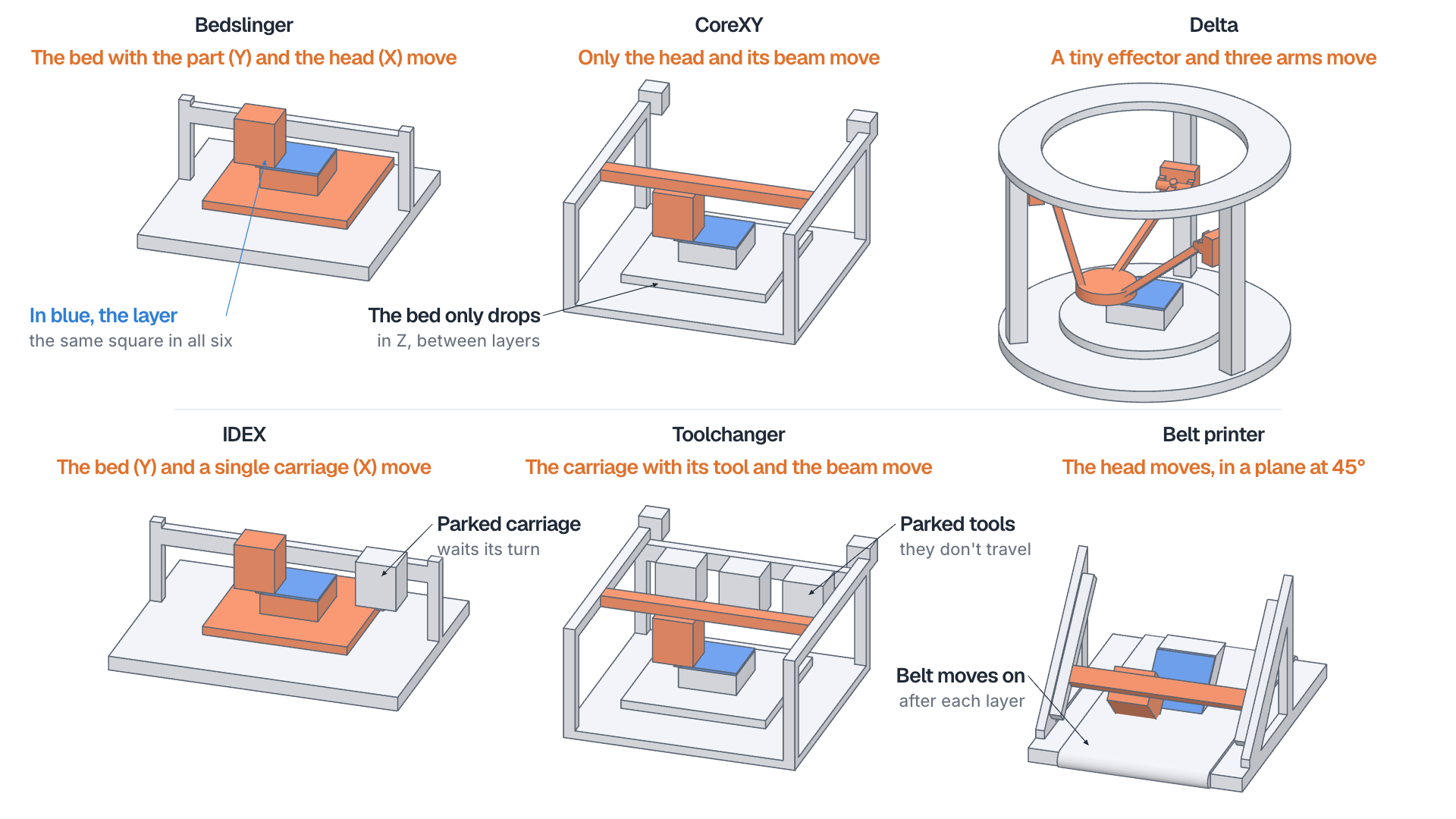
- Legacy bedslinger. A 2016–2021 design, Marlin without input shaping, often Bowden. Prints PLA at 40–80 mm/s on walls. Only worth it if someone gives you one.
- Modern bedslinger. The full baseline from the previous section, 4,000–6,000 mm/s² in the profile (up to about 10,000 on the spec sheet), ±0.1–0.15 mm in XY. Prints PLA, PETG and TPU fast, with no enclosure. The bed carries the part in Y, and the moving mass grows with bed size: that is why this design suits mid-size open machines.
- Enclosed CoreXY. 5,000–10,000 mm/s² in the profile (20,000 on the spec sheet), 21–25 mm³/s real in PLA, ±0.05–0.15 mm. The enclosure keeps the air around the part warm and keeps warping in check, the shrinkage that lifts the corners in ABS and ASA. With its own chamber heater, the same class moves up to PC, PA and fiber-filled nylons.
- Toolchanger / IDEX. Several complete nozzles, only one of which prints at a time. It can sit on any base and inherits its numbers, with a tool-to-tool offset of 0.04 mm or less (the U1's figure). It gives you multicolor and multi-material with a fraction of a filament switcher's purge.
- Industrial / high temperature. Hotends at 400–500 °C and a chamber of 90 °C or more. PEEK needs a nozzle at 380–440 °C and PEI at 340–390 °C, and both need a very hot chamber: a different league of price and process, covered in PPS, PEEK, PEKK and PEI.
Maker by maker
Each entry gives what the maker sells in each class, where it stands out and its drawback. Who each brand suits is summed up in the table at the end.
Bambu Lab
Bambu covers every consumer class. In modern bedslingers, the A1 mini (180 mm cube) and the A1 (256 mm), plus the A2L, a large bedslinger of about 330 mm. In enclosed CoreXY, the P2S, which replaced the P1S and reaches 300 °C, and the X2D, with two nozzles, 300 °C and an active chamber at 65 °C, which takes the X1C's place. Above them sits the H2 series: 325 to 340 mm wide and tall by 320 mm deep, nozzles at 350 °C and an active chamber at 65 °C; the H2S has one nozzle, the H2D two and the H2C an induction-heated hotend changer. The H3C, another toolchanger, was announced on 3 November 2026 and is not on sale yet. Bambu's strength is the most integrated package on the market: the AMS family, automatic calibrations, the video camera, Bambu Studio and the largest community of profiles. The drawback is closed firmware and a cloud-first design; what that means is covered in Closed and open ecosystems.
Prusa
In modern bedslingers Prusa sells the MK4S, permanently reduced in price since late 2025. In enclosed CoreXY, the CORE One and the larger CORE One L; the August 2026 update brought the CORE One+ Gen 2, the CORE One L+ and the XL+. In toolchangers, the XL, with up to five toolheads, and the INDX, designed with Bondtech: up to eight passive tools heated by induction and about 12 s per change; it is sold as a kit or fitted to the CORE One+ and the L+. What sets Prusa apart is open firmware and slicer, upgrade paths from earlier machines (MK4S to CORE One with a kit), manufacturing in the EU and years of spare parts. It has two drawbacks: hotends at 290 °C, below the competition, and a churn of versions, "+" suffixes and "Gen 2" revisions that makes second-hand listings hard to decode.
Creality
The widest catalog. In modern bedslingers, the Ender-3 V3 and V4, and the Hi, which has its own CFS filament switcher. In enclosed CoreXY, the successors to the K1 series and the K2 family: K2, K2 Pro (300 mm cube) and K2 Plus (350 mm cube), the last two with an active chamber at 60 °C. Up to four CFS units can be chained, which means sixteen spools. In October 2026 it opened pre-orders for the K3, a four-nozzle toolchanger with a 260 mm cube and about 5 s per change, which has not reached buyers yet. The firmware on the enclosed range, Creality OS, is based on Klipper, and the K2's source was published in September 2025. Creality wins on price per liter: at every price point it offers the most build volume. The drawback is less consistent quality between units and generations: check the exact revision before you buy.
Elegoo
Elegoo sells the Centauri Carbon (2025, nozzle at 320 °C) and the Centauri Carbon 2 (January 2026): an enclosed CoreXY with a 256 mm cube, nozzle at 350 °C, 20,000 mm/s² on the spec sheet and the four-color CANVAS switcher. The Centauri 2 is its open version. In bedslingers it still sells the Neptune series. Its selling point is price: it is the cheapest enclosed CoreXY on the market. Its firmware is based on Klipper, and in September 2025 it published the Centauri Carbon source under GPL-3.0. The drawback is a younger ecosystem: fewer community profiles, fewer third-party parts and a shorter long-term reliability record than the established brands.
Anycubic
In modern bedslingers, the Kobra 3 V2 and the Kobra 3 Max V2, the latter with a 420 × 420 × 500 mm build volume. In enclosed CoreXY, the Kobra S1 (about a 250 mm cube, passive chamber) and the Kobra S1 Max (350 mm cube, active chamber at 65 °C, shipping since April 2026). Its ACE 2 Pro switcher dries filament at 65 °C and chains together for up to sixteen spools. With the S1 Max it combines a large volume, an active chamber and multicolor with drying at a mid-range price, which serves large multicolor parts and engineering materials alike. It is also one of the big names in resin, a separate world covered in How a resin printer works. The drawback is compatibility between generations: according to Anycubic, the first-generation ACE Pro does not work with the S1 Max, and the ACE Pro and ACE 2 Pro cannot be used together. Check before you buy a used unit.
Qidi
Qidi sells only enclosed CoreXY machines: the compact Q2 and Q2C, the Plus4 (305 × 305 × 280 mm, active chamber at 65 °C) and the Max4. The Q2 has an active chamber at 65 °C; the Q2C does not. The Qidi Box is its filament switcher: it dries at 65 °C and up to four units chain together for sixteen spools. Its firmware is based on Klipper. Qidi offers an active chamber at a mid-range price: it is a cheaper route than Bambu's H2 series to printing PA-CF, PC and ASA. The drawback is a line-up that turns over quickly, with models that look alike from the outside but do different things, such as the Q2 and Q2C, and a spares network and community smaller than Bambu's or Prusa's.
Snapmaker
The U1 is an open CoreXY toolchanger: four preheated toolheads, about 5 s per change and, according to Snapmaker, up to 85 % less purge than a filament switcher on one of its sample models. The optional top cover encloses it for ABS, ASA and PA, with no chamber heater. It has been sold worldwide since spring 2026, and in March 2026 the company published its firmware changes under GPL-3.0. The Artisan line, which combines printing, laser and milling, is still on sale; the J1s has been discontinued. The U1 gives low-purge, tower-free multicolor at a hobbyist price. The drawback: the spools sit in the open, outside a dry box, and in a humid room the filament takes on moisture (Drying and storing filament).
Voron
Voron is an open design with no manufacturer: you build it from a kit (LDO, Formbot and others) or from parts you source yourself. The 2.4r2, with a fixed bed and a gantry that moves in Z, is still the current revision; the Trident, whose bed moves in Z, got its R2 revision in mid-2026; the 0.2 is a 120 mm cube, small and very fast. All of them run Klipper. It gives you total control and a community that popularized input shaping with Klipper and produced toolheads such as the Stealthburner and many toolchanger mods. The drawback: tens of hours of assembly and no technical support beyond the community's.
Other makers
Flashforge sells the Creator 5 and Creator 5 Pro, four-head toolchangers with a 256 mm cube. Sovol announced the M1D, a crowdfunded hybrid IDEX with deliveries expected from November 2026. Stratasys, Intamsys, 3DGence, AON3D and miniFactory sit in the industrial class.
Until they reach buyers, Bambu's H3C, Creality's K3 and Sovol's M1D are announcements: leave them out when you compare.
How to read a spec sheet
Almost every spec sheet promises the same things, and almost no headline figure tells you how you will actually print.
- Top speed. Almost every spec sheet quotes 500–600 mm/s, and the figure tells you nothing. The speed ceiling is the hotend's flow: speed = flow / (line width × layer height) (Volumetric flow sets the speed). With the 25 mm³/s in the figure, a 0.45 × 0.20 mm bead cannot go faster than about 278 mm/s.
- Acceleration. The spec sheet gives the maximum, 20,000 mm/s² on many CoreXY machines; the profile uses less. The X1C runs at 10,000 by default and 5,000 on the outer wall; the A1 at 6,000 against the 10,000 on its spec sheet; the MK4S at 4,000. Short moves never reach top speed anyway: a 10 mm segment at 5,000 mm/s² gets to about 224 mm/s before it has to brake.
- Flow. Manufacturers' figures are test maximums: Bambu measures with ABS at 280 °C in a single-wall vase. The real limit in PLA is the slicer's: 21 mm³/s on the X1 and P1; 25 on the H2D with the stock hotend and 40 with the high-flow one; with Prusament PLA, 15 with the standard nozzle and 24 with the HF. To compare machines, use the slicer figure. The reason is in Hotends and how much they can melt.
- Chamber. Check whether it has a heater and what temperature it reaches (60–65 °C is the consumer ceiling).
- Build volume. On dual-nozzle machines and toolchangers, the volume every nozzle can reach is smaller than the headline figure. The X2D gives 256 × 256 × 260 mm with one nozzle and 235.5 × 256 × 256 mm with both.
- Nozzle temperature. At 300 °C you can print everything up to PC and most PA-CF; 350 °C adds PPA-CF and PPS-CF on some machines. PEEK and PEI also need a chamber of 90 °C or more, and that is the industrial class.
- Multicolor. A combo purges at every color change: each change throws away about 0.2–0.8 g of purge; count the changes before you print (Purge and multicolor waste). A toolchanger purges milligrams per change instead of tenths of a gram (Toolchangers, IDEX and dual nozzles), but not zero: the parked tool oozes and has to be primed. An "up to 85 % less" on a spec sheet holds for the model it was measured on; Four ways to print in color compares the options.
Which maker suits whom
| Maker | Classes sold | Chamber | Multicolor | Firmware | Typical buyer |
|---|---|---|---|---|---|
| Bambu Lab | modern bedslinger, enclosed CoreXY, toolchanger (H2C) | passive (P2S); active at 65 °C (X2D, H2 series) | AMS; two nozzles on H2D and X2D | own, closed | wants to print without tuning |
| Prusa | modern bedslinger, enclosed CoreXY, toolchanger | passive (CORE One) | MMU3; XL up to 5 toolheads; INDX up to 8 tools | open | values repairing and modifying |
| Creality | modern bedslinger, enclosed CoreXY; toolchanger (K3, on pre-order) | active at 60 °C (K2 Pro, K2 Plus) | CFS, up to 16 spools; K3, 4 nozzles (on pre-order) | Klipper-based | wants volume or price and will tune |
| Elegoo | modern bedslinger, enclosed CoreXY | passive | CANVAS, 4 colors | Klipper-based, source published | wants a first enclosed machine on a small budget |
| Anycubic | modern bedslinger, enclosed CoreXY | passive (Kobra S1); active at 65 °C (Kobra S1 Max) | ACE 2 Pro with drying, up to 16 spools | own | wants large volume, multicolor or engineering materials at a mid-range price |
| Qidi | enclosed CoreXY | active at 65 °C (Plus4, Q2) | Qidi Box with drying, up to 16 spools | Klipper-based | prints engineering materials at a mid-range price |
| Snapmaker | toolchanger | open; enclosed with the optional cover | U1, 4 toolheads | own, changes published under GPL-3.0 | wants multicolor with far less purge |
| Voron | enclosed CoreXY (kit) | whatever you build | community mods | Klipper | wants to build and maintain |
What may change before the next review, in May 2027: whether Bambu's H3C, Creality's K3 and Sovol's M1D reach buyers, which other K3 models Creality confirms, which machines are discontinued and what changes in each brand's firmware or cloud policy.
When it fails
| Symptom | Cause | Fix |
|---|---|---|
| Two "600 mm/s" machines print at very different rates | The headline speed says nothing; the hotend's flow decides (15 against 25 mm³/s) | Compare the flow the slicer profile uses |
| Large PA or PC parts lift at the corners and split between layers on an enclosed machine | Passive chamber: enough for ASA, short for large PA and PC | Look for an active chamber and check what temperature it reaches |
| Multicolor uses more filament than expected | The combo includes the switcher, but every change purges | Work out the grams per part before choosing between a filament switcher and a toolchanger |
| The second-hand machine does not take the switcher or the spare you expected | A K2 is not a K2 Plus, a CORE One+ is not a CORE One+ Gen 2 and an ACE Pro does not work with every Kobra | Ask for the exact model and revision before you pay |
| The machine lacks the temperature or equipment you read about in a review | Both change between versions and markets | Trust the manufacturer's spec sheet at the time you buy |
| The room smells of ABS or ASA even though the machine is enclosed | An enclosure holds fumes in; it does not remove them | Filtering and ventilation (Emissions and ventilation) |
See also
- Choosing your first printer, and your second: how to decide the purchase around the parts you print.
- Closed and open ecosystems: what closed firmware or a mandatory cloud means for you.
- Filament switchers: AMS, MMU, CFS and ACE: how each filament-switching multicolor system works.
- Enclosures and heated chambers: why an active chamber decides which materials you can print.