First layer and bed adhesion
Watch enough prints fail and you notice they nearly all fail in the same place: the first layer. If that layer doesn't stick flat and stay stuck, nothing built on top of it can succeed — a corner peels, the part shifts, and four hours later you're peeling spaghetti off the bed. The first layer is the foundation, and like any foundation it decides whether everything above it stands. Part of getting it right is the printer's job, but a surprising amount is decided by the shape you designed.
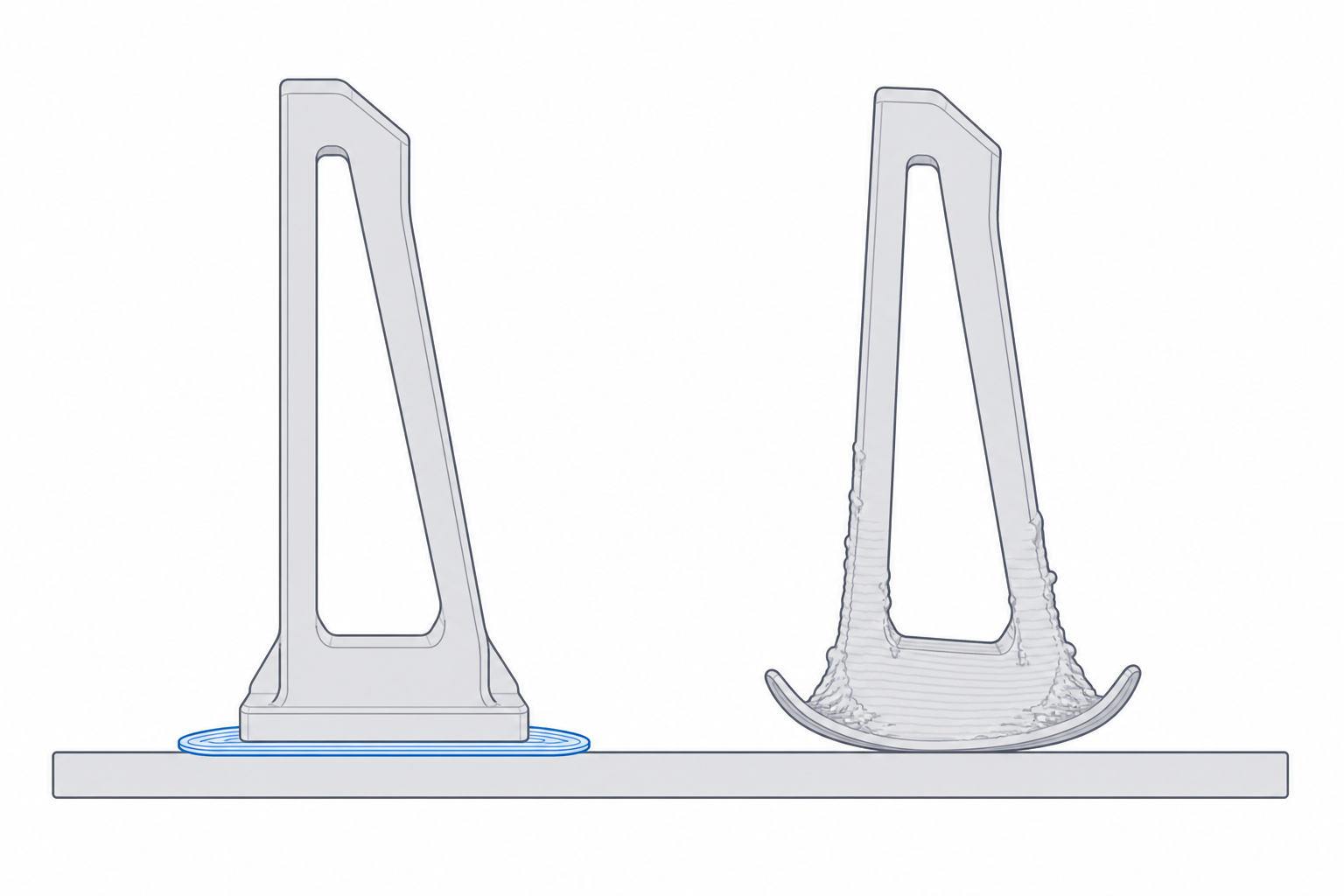
Why the first layer rules everything
Every other layer prints onto plastic. The first prints onto glass or steel or PEI — a surface plastic doesn't naturally want to grip. So the printer cheats: it squishes the first layer down harder and prints it hotter and slower than the rest, smearing the plastic flat against the bed so it grabs. Get that squish right and the part is anchored. Get it wrong and the whole print is living on borrowed time.
Squish and levelling at a glance
First-layer squish is how firmly that opening layer is pressed into the bed. The nozzle rides slightly closer to the surface than one layer height, flattening each bead so it spreads and bonds. Too high and the lines sit as round, barely-touching strings that lift away; too low and the nozzle drags, starves the flow, and leaves gaps.
For squish to be even across the whole part, the bed has to be level — the nozzle the same distance from it at every point. A tilted bed gives you beautiful adhesion on one corner and none on the opposite one. Levelling (manual or auto) is a printer task, not a modelling one, but it's the first thing to check when a part lifts on one side only.
Brim vs raft
When a part won't hold on its own, two slicer aids add bed contact. They solve different problems.
A brim is a flat skirt of extra perimeters printed in the same first layer, fused to the part's outline and spreading outward across the bed. It adds grip exactly where parts lift — the edges — and peels off easily after. It's the right tool for most adhesion trouble: small footprints, sharp corners, tall parts that want to tip.
A raft is a full printed platform the part sits on top of, separated by a thin gap. It's heavier, slower, wastes plastic, and leaves a rough underside — but it forgives a bed that won't behave and helps on surfaces the part can't grip directly. Reach for a raft only when a brim isn't enough.
| Situation | Use |
|---|---|
| Corners lifting, small footprint | Brim |
| Tall, narrow part wanting to tip | Brim (wide) |
| Bed won't hold the part at all | Raft |
| Underside finish doesn't matter | Raft is fine |
| You want a clean part bottom | Brim, not raft |
How your geometry drives adhesion
This is the part you actually control. Three model choices decide how hard the first layer has to fight:
- Contact area. Adhesion is roughly proportional to how much part touches the bed. A flat face flat on the plate sticks; a part balanced on a thin edge or a few points barely does. Where you can, orient the part to put its widest flat face down — this is the same orientation question from Orientation and overhangs, now with adhesion as the tiebreaker.
- Tall and thin tips over. A slim, tall part has a tiny footprint and a high centre of mass, so the moving nozzle can knock it loose mid-print. A wide brim is the cheap fix; reorienting to a stabler stance is the better one.
- Sharp corners curl. As plastic cools it shrinks, and the pull concentrates at corners, lifting them off the bed. Generous corners cool more evenly and stay down — a fillet on the footprint is a real adhesion feature, not just styling.
One more shape effect belongs to the first layer: the slight bulge at the very bottom edge from the extra squish, called elephant's foot. It changes the dimensions of holes and pegs near the plate, which is why it's handled in Holes, pegs and first-layer squish rather than here.
Design a part that wants to stay on the bed — flat, stable, round-cornered — and the first layer mostly takes care of itself. Fight gravity and shrinkage with the geometry, and a brim handles whatever's left.