ABS, ASA and higher-temp plastics
There's a line PLA and PETG can't cross: real, sustained heat, and the sun. A part bolted inside an engine bay, a bracket on a south-facing wall, a housing next to something that runs hot — these live in a temperature range that makes PLA slump and pushes PETG to its limit. This is where ABS and its UV-stable cousin ASA earn their place, and where you accept a harder print in exchange for a part that survives its environment.
What ABS and ASA buy you, and what they cost
ABS softens far higher than PETG — usually around 95 °C — and it's tough, machinable and repairable (it welds and smooths with acetone, which the post-processing section covers). ASA is, for practical purposes, ABS reformulated to resist ultraviolet: same heat resistance and toughness, but it doesn't yellow, chalk or go brittle after months in sunlight. If a part lives outdoors, ASA is almost always the right pick over ABS.
The cost is warping. Both plastics shrink substantially as they cool, and that shrinkage doesn't happen evenly — the bottom of a big flat part cools and contracts while fresh hot layers pile on top, and the mismatch curls the corners up off the plate or cracks the part along a layer partway up. Fight it and you'll usually win, but you have to design and print for it: an enclosure to keep the ambient air warm and still, a heated bed, minimal cooling fan, and geometry that doesn't hand warping an easy target.
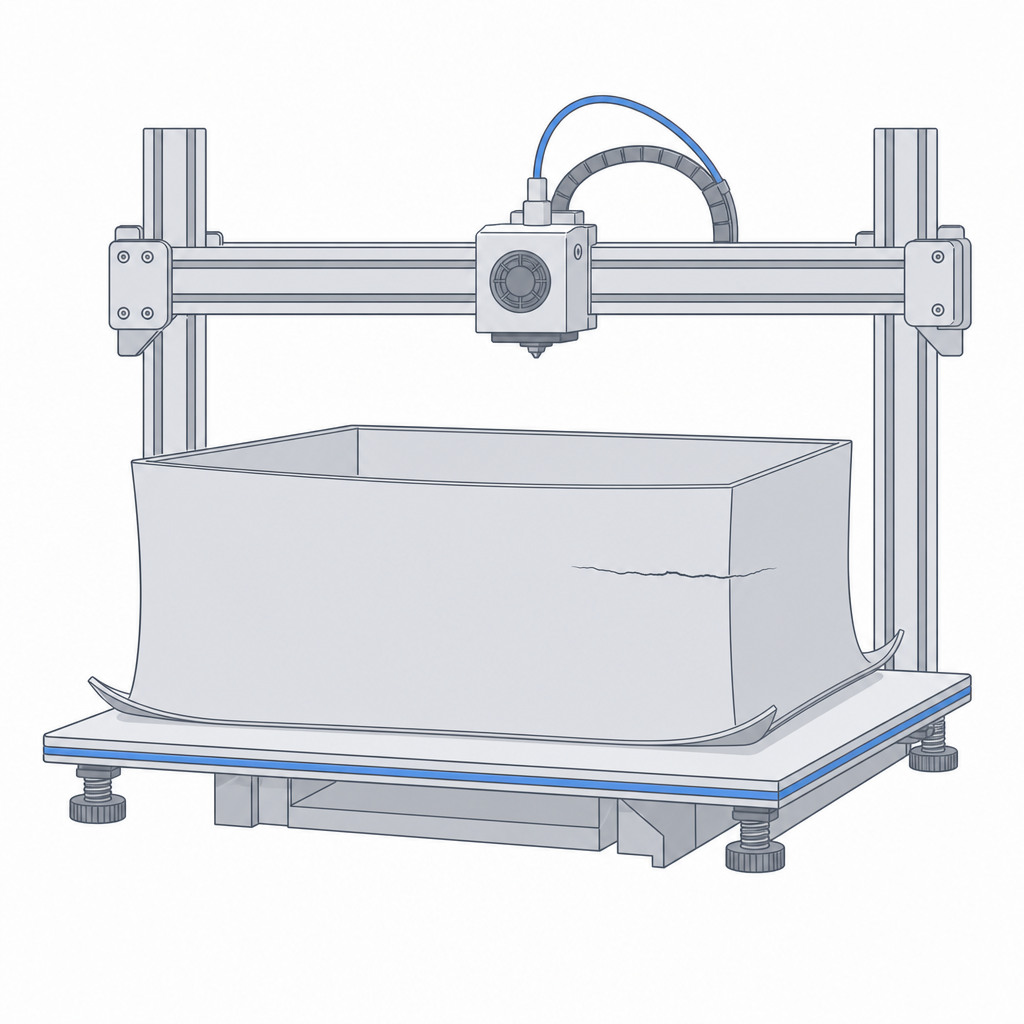
The dimensional tax is bigger here
Every printed part comes off smaller than you drew it, but ABS and ASA shrink more than PLA or PETG — enough that a fit calibrated on another material will be visibly wrong. A hole that was a perfect slip fit in PLA can close up too tight in ABS; an assembly that stacked up right can lose a millimetre across several parts. Budget for it: expect to reprint your test coupons when you move to these materials, and lean on Real printed clearances to re-establish the gaps. This is exactly the "change the material, recalibrate" rule from Choosing a filament, and it bites hardest here.
When even ABS isn't enough: PC and nylon
Above ABS sit the true engineering plastics, and they trade printability for performance:
- Polycarbonate (PC) is extremely strong and impact-resistant and takes the most heat of the common filaments — but it prints hot, warps like ABS, and drinks moisture. Reach for it when a part must not break, full stop.
- Nylon (PA) is tough, slippery and wear-resistant, which makes it excellent for gears, living hinges and parts that rub — but it's strongly hygroscopic and needs drying before nearly every print.
Both are covered as part of Filled and specialty filaments, alongside the fibre-filled versions that tame their warping and stiffen them up.
| Material | Heat before it softens | Prints… | Watch out for | Best for |
|---|---|---|---|---|
| ABS | ~95 °C | Hard | Warping, fumes | Tough indoor / warm parts |
| ASA | ~95 °C | Hard | Warping | Outdoor, UV-exposed parts |
| PC | ~110–115 °C | Very hard | Warping, moisture | Must-not-break parts |
| Nylon (PA) | Moderate (high only when fibre-filled; drops when wet) | Hard | Absorbs water badly | Gears, wear, hinges |
The theme of this whole family is the same: more capability, more warping, more moisture sensitivity, and a bigger gap between the size you draw and the size you get. Design with margin, keep the filament dry, and recalibrate your fits. When the requirement flips from "survive heat" to "bend and return," you're in a completely different material world — that's Flexible filament (TPU).