Vapour and chemical smoothing
Sanding fights layer lines one scratch at a time. There's a faster, stranger route: don't remove the ridges, melt them. Hang an ABS part in a sealed jar with a little acetone in the bottom and the solvent vapour softens the outermost skin of plastic just enough that surface tension pulls it flat and glossy — layer lines dissolve into a wet-looking, almost injection-moulded sheen, with no dust and no elbow grease. It feels like magic the first time. It's also the finishing step most likely to quietly change the size and detail of your part, which is exactly why it belongs in a chapter about designing for the finish.
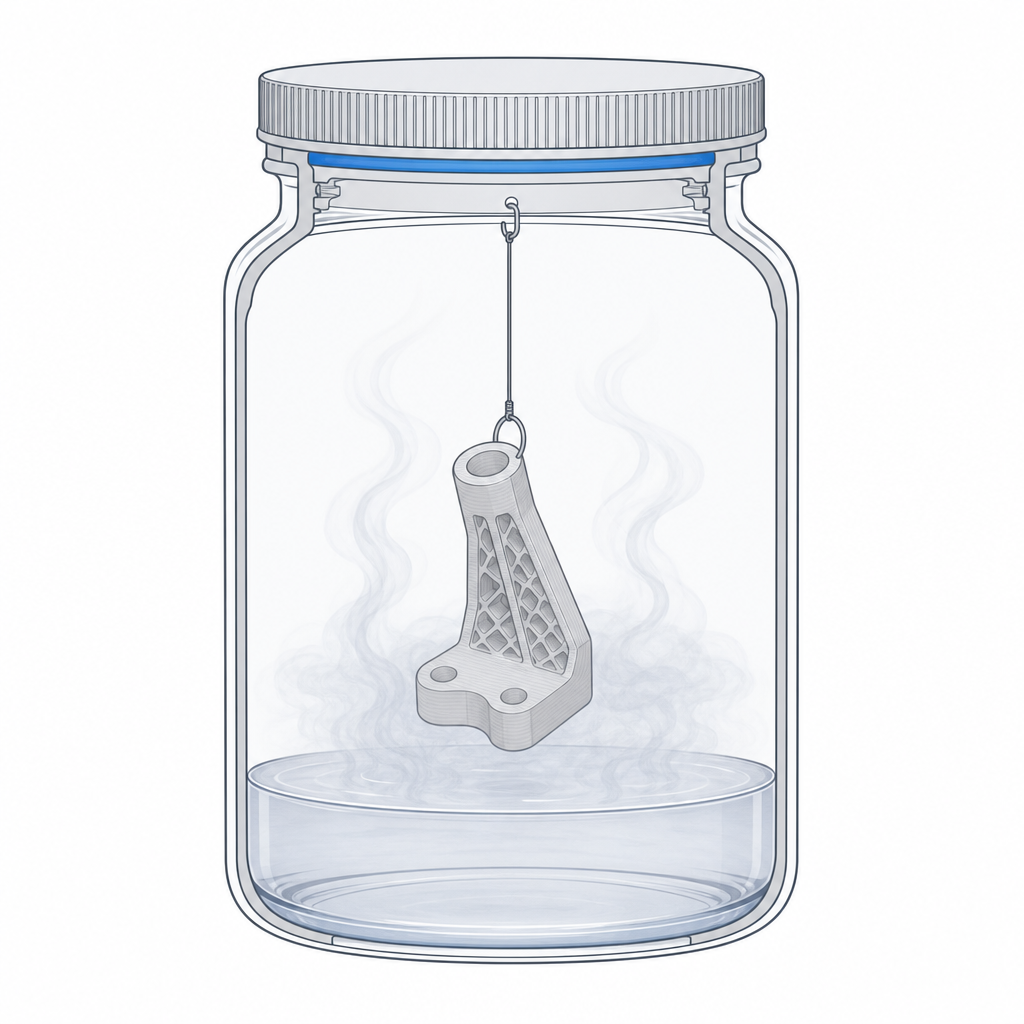
What the vapour actually does
Acetone dissolves ABS and ASA. As a vapour, it condenses on the cooler part and starts liquefying the top few microns of plastic; that softened skin flows under surface tension, filling the valleys between layers and rounding every ridge into a smooth curve. Leave it long enough and the whole surface goes glassy. Stop too late and it keeps going — corners round off, thin details slump, embossed text blurs, and small holes shrink or close as their edges flow inward.
That last part is the catch. Vapour smoothing doesn't respect your edges. It rounds sharp corners because sharp corners are exactly where surface tension pulls hardest. Fine engraving softens. And because you've melted and reflowed a skin of material, the part comes out slightly dimensionally shifted — usually a touch larger in some places, softened and rounded in others, never precisely the size you drew. It's a cosmetic process, not a precision one.
Not every plastic, and not without care
The clean acetone trick works on ABS and ASA. PLA doesn't dissolve in acetone — smoothing it needs far more aggressive solvents (things like tetrahydrofuran (THF) or dichloromethane (DCM)) that a home or hobby maker should simply avoid. Dichloromethane is a probable human carcinogen (IARC group 2A), needs a fume hood, and penetrates nitrile gloves; THF is highly flammable and forms peroxides over time. For PLA, sand it — that's almost always the right route. PETG shrugs off acetone too. Resin (SLA/MSLA) parts are a different world entirely: they come out smooth already and are finished by sanding and priming after their wash-and-cure, not by solvent vapour.
Designing for a melted skin
Because the process rounds detail and shifts dimensions unpredictably — rounding edges, shrinking small holes and fine detail — you build that in from the start. If a part is going to be vapour-smoothed, treat every dimension as if it will drift a little and every sharp edge as if it will soften. Give mating and functional features a dimensional allowance — smooth the outside of an enclosure, but if the lid has to snap onto a lip, either keep that lip out of the vapour or open the clearance to swallow the growth, the way Tolerances and fits teaches you to reason about real printed sizes.
The design lever is the same one running through this whole section: choose which faces get the finish. A gloss-smoothed display piece can be all curves and shine because nothing on it has to fit. A functional part with press-fits and threaded holes should keep those features crisp and as-printed, and let smoothing touch only the surfaces that are purely for looks. If you find yourself wanting both a glassy shell and a precise fit on the same feature, that's a sign to split the geometry so each face can be finished on its own terms.
Vapour gives you shine and seal; it doesn't give you colour. When what you want is a specific look — matte black, a colour that isn't the filament's, a hard protective coat — you prime and paint. That's Painting and priming.