Temperature, UV and environment
A part can be mechanically flawless and still fail, because force isn't the only thing acting on it. Heat, sunlight, water and chemicals work on the plastic itself, and no amount of clever geometry rescues a material used outside the conditions it can survive. The most common failure isn't a snapped part at all — it's a PLA phone mount that slumped into a curve on a car dashboard in July. Nothing was overloaded. The plastic just got warm enough to stop being a solid.
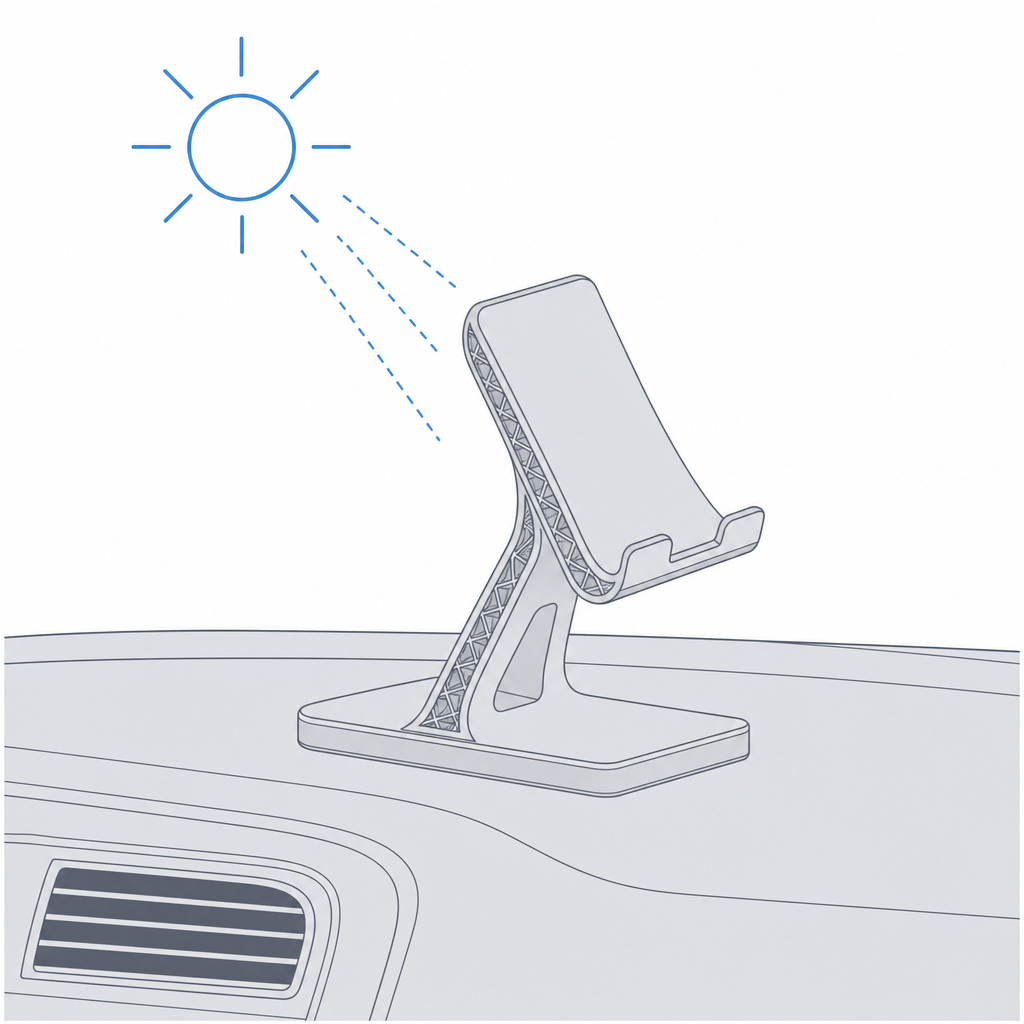
What "softens at ~55 °C" really means
HDT is the temperature where a plastic starts to give under load, and PLA's is around 55 °C. That number sounds high until you measure the real world. The inside of a parked car in the sun reaches 60–70 °C easily. A sunny windowsill, the surface of a black part in direct light, the air next to a motor, a power supply or a stepper driver — all of these sit near or above PLA's limit. Below the HDT the part is fine; cross it under any load and the plastic creeps, sags and keeps the new shape when it cools. It doesn't come back. So "55 °C" isn't a fun fact — it's a hard ceiling that rules PLA out of a whole class of jobs before you draw a single wall.
Sunlight and the outdoors
UV is the slow killer. Ultraviolet light breaks the polymer chains at the surface, and over months outdoors the part chalks, discolours and turns brittle. Materials differ enormously here. PLA degrades fast in sun and is a poor outdoor choice. ASA is built for it — it's the material of choice for anything that lives in the sun. ABS holds up reasonably. PETG is middling: fine for a season, tired after a few. Water and humidity are a separate axis: PETG shrugs off moisture and many chemicals, PLA slowly weakens in damp, and some nylons absorb water from the air and change size and stiffness as they do.
| Material | HDT | UV / outdoor | Chemical / water | Verdict |
|---|---|---|---|---|
| PLA | ~55 °C | Poor — degrades | Poor | Indoors, cool, dry |
| PETG | ~70 °C | Middling | Good | Wet, mild heat, outdoors briefly |
| ABS | ~95 °C | OK-ish | Good | Warm, indoor-to-sheltered |
| ASA | ~95 °C | Excellent | Good | The outdoor, full-sun choice |
Choose the material first, then design
This is the part that changes how you work. Mechanical properties you can partly design around — thicker walls, more infill, a rib in the right place. Temperature and UV you cannot. There is no wall thickness that keeps a PLA part rigid at 65 °C, and no fillet that stops sunlight breaking its chains. So when a part will live in heat or sun, the environment decides the material before you open the model — and only then do you design the geometry. Get that order wrong and you'll spend an evening reinforcing a bracket that was always going to melt.
Heat and light decide whether a material can live where the part lives. But even a perfectly chosen material won't print at the exact size you drew, because it shrinks as it cools — and that's where Shrinkage and dimensional stability takes over.